This article is currently available in English. A Spanish version is in progress.
Perinatal Tissue Donor Eligibility Under 21 CFR 1271
By Benn Bluestein-Veyra, M.Sc. Organic Chemistry · Updated 20 October 2026
ExaVeyra Sciences es un proveedor B2B con sede en Miami que suministra exosomas para uso estético tópico a clínicas con licencia, y remite a los prescriptores con licencia a una farmacia de preparados compuestos 503A que prepara formulaciones según prescripciones individuales.
| Pregunta | Respuesta |
|---|---|
| Qué cubre esta página | How placenta, umbilical cord and amnion donors are qualified under FDA rules: donor screening, testing, eligibility records and the regulatory frame. |
| Quién puede hacer pedidos | Clínicas y profesionales con licencia profesional activa y NPI verificados por ExaVeyra. Los pedidos de exosomas requieren además un reconocimiento firmado de uso profesional. |
| Qué se envía y cómo | El material de exosomas para uso estético tópico, caracterizado por lote, se envía en cadena de frío por exprés nocturno. La entrega puede tardar 1 a 3 días hábiles. Se emite un certificado de análisis para cada lote y se entrega a solicitud. |
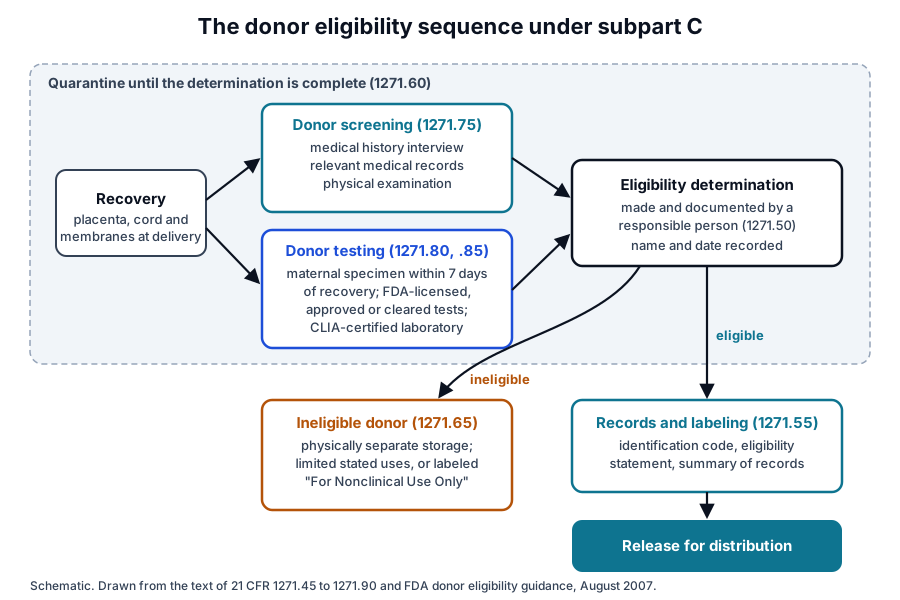
Perinatal tissue donor eligibility under 21 CFR 1271 is the documented conclusion, reached by a responsible person, that the donor of a placenta, umbilical cord or amniotic membrane met the regulation’s criteria, based on screening and testing of the birth mother.[1] Subpart C of Part 1271 sets out the sequence: donor screening, donor testing, the eligibility determination, the records that accompany the tissue, and quarantine until the determination is complete.[1][2]
FDA published these donor eligibility provisions as a final rule on May 25, 2004, and explained them in a guidance for industry issued in August 2007.[2][3] This reference reads each provision as the regulation states it, applies it to perinatal tissue, and points to the tissue banking literature that describes how establishments carry it out.
FDA is updating that guidance. In January 2025 it issued a draft guidance on determining donor eligibility, intended to update its existing donor eligibility guidance,[4] alongside draft guidances on specific agents including HIV, hepatitis B virus and hepatitis C virus.[5] In May 2025 it reissued its recommendations on Mycobacterium tuberculosis and on sepsis screening as draft guidances, so the 2007 guidance remains the final guidance in effect while the drafts are completed.[6]
Linking perinatal tissues to the birth mother’s screening and testing
Placenta, umbilical cord and amniotic membrane are recovered at delivery, and each has a defined anatomy: a placental disc with chorionic and basal plates, fetal membranes formed by amnion and chorion, and a cord whose vessels sit in Wharton’s jelly (Fig. 1).[7] The first international workshop on placenta-derived cells, summarized by Parolini and colleagues, asked that every cell population be reported with its exact region of origin.[8]
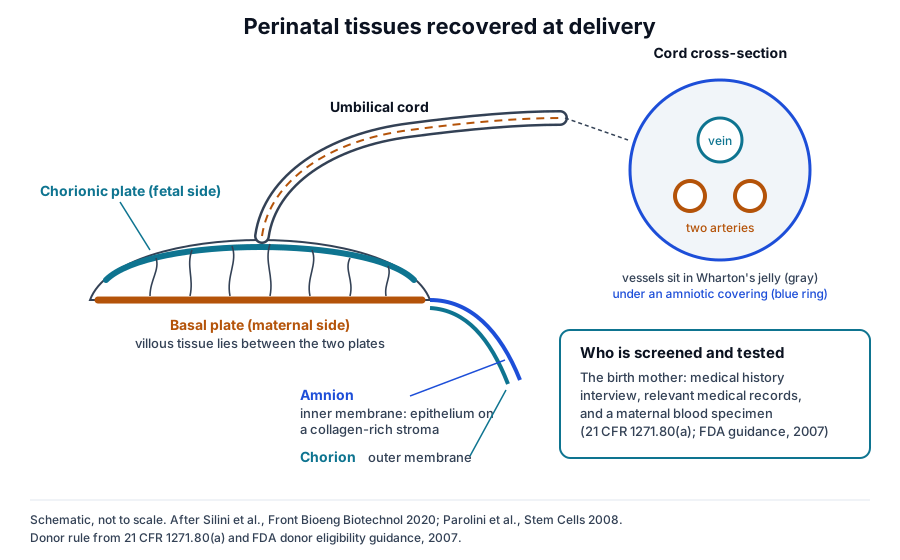
Subpart C connects perinatal donation to the birth mother through its testing rule. For a donor 1 month of age or younger, 21 CFR 1271.80(a) directs the establishment to test a specimen from the birth mother.[1] FDA’s 2007 guidance adds that the birth mother should also be screened through a donor medical history interview and review of available medical records, with a physical examination recommended when practical.[2]
Tissue banking practice follows the same line. Jirsova and Jones described placentas for amniotic membrane preparation as coming from mothers undergoing elective cesarean section, with maternal blood screened serologically at the time of donation.[9] In cord blood banking, Li and colleagues reported that donor eligibility criteria vary among banks.[10]
Informed agreement opens the donor pathway
Donation begins with the expectant mother’s agreement. In a survey of 150 expectant mothers in Ibadan, Onebunne and colleagues found that 12.0% knew about placenta donation and that knowledge of its uses was associated with willingness to donate.[11]
Elrahal and colleagues surveyed 923 women in Jordan and reported that 64.0% were unaware that a placenta could be donated for research, with data privacy among the reasons associated with declining.[12] Elrahal and colleagues recommended education programs to raise awareness of placenta donation.[12]
Understanding the structure of 21 CFR 1271 subpart C
Section 1271.45(b) requires a donor-eligibility determination, “based on donor screening and testing for relevant communicable disease agents and diseases,” for all donors of cells or tissue used in HCT/Ps, except as provided under 1271.90.[1] Section 1271.45(c) states that an HCT/P must not be implanted, transplanted, infused, or transferred until the donor has been determined to be eligible, subject to the exceptions in 1271.60(d), 1271.65(b) and 1271.90.[1]
The term “relevant communicable disease agent or disease” is defined in 21 CFR 1271.3(r).[13] For all human cells and tissues it lists human immunodeficiency virus types 1 and 2, hepatitis B virus, hepatitis C virus, human transmissible spongiform encephalopathy and Treponema pallidum, and it adds human T-lymphotropic virus types I and II for viable, leukocyte-rich cells and tissues.[13] FDA’s guidance abbreviates the term as RCDAD and explains how agents beyond that list are identified under 1271.3(r)(2).[2]
Section 1271.47 requires procedures for every step of screening, testing and determination, and defines establish and maintain as define, document, and implement, then follow, review, and as needed revise.[1] A responsible person reviews and approves each procedure before implementation, and any departure relevant to preventing communicable disease transmission is recorded and justified at the time it occurs.[1] The sequence runs from recovery through screening and testing to a documented determination and release (Fig. 2).
Screening the birth mother through medical history and physical examination
Under 21 CFR 1271.75(a), the establishment that performs donor screening reviews the donor’s relevant medical records for risk factors for, and clinical evidence of, relevant communicable disease agents and diseases, and for communicable disease risks associated with xenotransplantation.[1] Donors of viable, leukocyte-rich cells or tissue are also screened for human T-lymphotropic virus under 1271.75(b).[1]
Relevant medical records, as defined in 1271.3(s), include a current donor medical history interview and a current report of the physical examination of a living donor, together with available laboratory results and medical records.[13] The donor medical history interview is defined in 1271.3(n) as a documented dialog about medical history and relevant social behavior, held with the donor when the donor is living and able to participate.[13]
For perinatal donation the birth mother is the person interviewed and examined, and the guidance recommends her physical examination when practical.[2] Practice is still converging internationally: Chandrasekar and colleagues surveyed health authorities and professionals across Council of Europe member states, found wide variation in how physical examination of deceased organ and tissue donors is regulated and performed, and called for agreed best-practice guidelines.[14]
Testing maternal specimens within the collection window
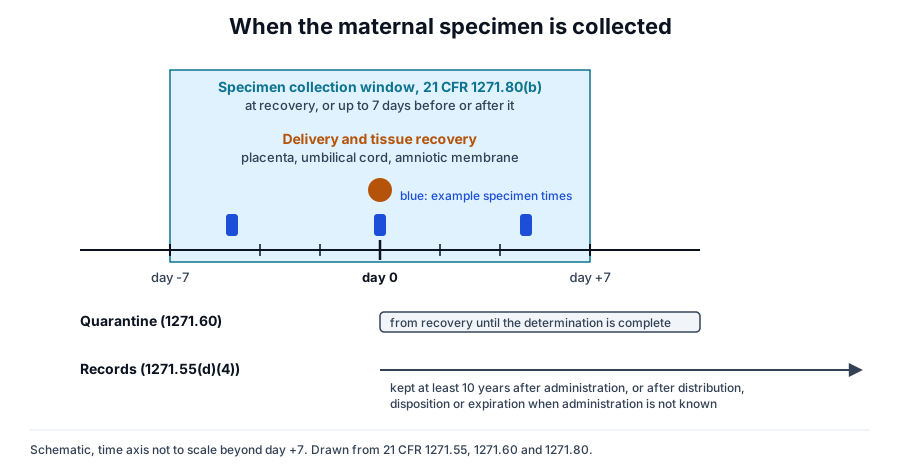
Section 1271.80(b) requires the donor specimen to be collected at the time of recovery of cells or tissue, or up to 7 days before or after recovery (Fig. 3).[1] FDA’s guidance states that for a donor 1 month of age or younger the birth mother’s specimen is collected within seven days of donation, and that the donor is ineligible when that specimen is unavailable.[2]
Testing uses appropriate FDA-licensed, approved, or cleared donor screening tests, in accordance with the manufacturer’s instructions, under 1271.80(c).[1] FDA maintains a public list of these donor screening assays, organized by agent, format and specimen type.[15] The laboratory must be certified under the Clinical Laboratory Improvement Amendments of 1988 and 42 CFR part 493, or meet equivalent requirements as determined by the Centers for Medicare and Medicaid Services.[1][16]
Section 1271.85(a) lists the agents tested in every donor, and 1271.85(b) adds human T-lymphotropic virus types I and II and cytomegalovirus for viable, leukocyte-rich cells or tissue, with a standard operating procedure governing release after a reactive cytomegalovirus result.[1] The guidance classes cells and tissues as viable and leukocyte-rich by their status at the time of recovery.[2]
Specimen handling shapes the result. A working group of the Superior Health Council of Belgium, led by Padalko, set out preanalytical variables for donor serology and nucleic acid testing, including tube choice, transport, centrifugation, storage and hemodilution.[17] Section 1271.80(d)(2) addresses plasma dilution directly, accepting a pre-transfusion specimen or an appropriate algorithm that evaluates volumes administered in the forty-eight hours before collection.[1]
Assay platforms also shape reported rates. In more than 160,000 deceased tissue and cornea donors, Dionne and colleagues reported higher serologic reactive rates after a move from manual enzyme immunoassays to automated chemiluminescent microparticle immunoassays, without a matching rise in nucleic acid test reactivity.[18] In European amniotic membrane banking, Jirsova and Jones described repeat maternal serology 6 months postpartum where advanced diagnostic testing is unavailable.[9]
Assigning the eligibility determination to a responsible person
Section 1271.50(a) places the determination with the establishment responsible for it and requires a responsible person to determine and document the eligibility of the donor.[1] A responsible person is defined in 1271.3(t) as a person authorized to perform designated functions for which he or she is trained and qualified.[13] The guidance adds that this person should have appropriate medical training and adequate knowledge of relevant federal regulations and guidances.[2]
Under 1271.50(b), a donor is eligible when screening shows freedom from risk factors for, and clinical evidence of, infection due to relevant communicable disease agents and diseases, and when test results are negative or nonreactive, except as provided in 1271.80(d)(1).[1] An establishment may engage another establishment to screen, test or determine eligibility, and those allocations of responsibility must comply with 1271.150(c).[2][19]
| Element | Section | What the rule requires |
|---|---|---|
| Procedures | 1271.47 | Defined, documented and implemented; approved by a responsible person before use |
| Screening | 1271.75 | Review of relevant medical records for listed agents and xenotransplantation risks |
| Specimen timing | 1271.80(b) | At recovery, or up to 7 days before or after it |
| Tests and laboratory | 1271.80(c) | FDA-licensed, approved or cleared tests in a CLIA-certified or CMS-equivalent laboratory |
| Determination | 1271.50 | Made and documented by a responsible person |
| Accompanying records | 1271.55(a) | Identification code, eligibility statement and summary of records |
| Quarantine | 1271.60 | Held and identified until the determination is complete |
| Retention | 1271.55(d)(4) | At least 10 years after administration, or after distribution, disposition or expiration |
Documenting eligibility in accompanying records and labeling
Once the determination is made, 21 CFR 1271.55(a) requires three items to accompany the HCT/P at all times: a distinct identification code affixed to the container, a statement whether the donor was determined eligible or ineligible, and a summary of the records used to make the determination.[1] For an unrelated allogeneic donation, the identification code relates the tissue to the donor and its records and excludes the donor’s name, social security number and medical record number.[1]
Section 1271.55(c) keeps the donor’s name and other identifying personal information out of the accompanying records.[1] The establishment retains test results with their interpretation and the testing laboratory’s name and address, the screening results, and the determination with the responsible person’s name and date, all accurate, indelible and legible.[1]
Labeling controls under 1271.250(c) require procedures ensuring that each HCT/P is labeled under applicable requirements including 1271.55, 1271.60, 1271.65 and 1271.90, and that each HCT/P made available for distribution carries documentation of the donor eligibility determination.[19] FDA’s guidance notes that electronic access to accompanying records within a facility satisfies the requirement when personal information is removed.[2]
Holding perinatal tissue in quarantine and applying the stated exceptions
Section 1271.60(a) keeps an HCT/P in quarantine until the donor-eligibility determination is complete, and 1271.60(b) requires it to be clearly identified and easily distinguishable from HCT/Ps available for release.[1] Quarantine is defined in 1271.3(q) as storage or identification that prevents improper release, in a physically separate area or through procedures such as automated designation (Fig. 4).[13]
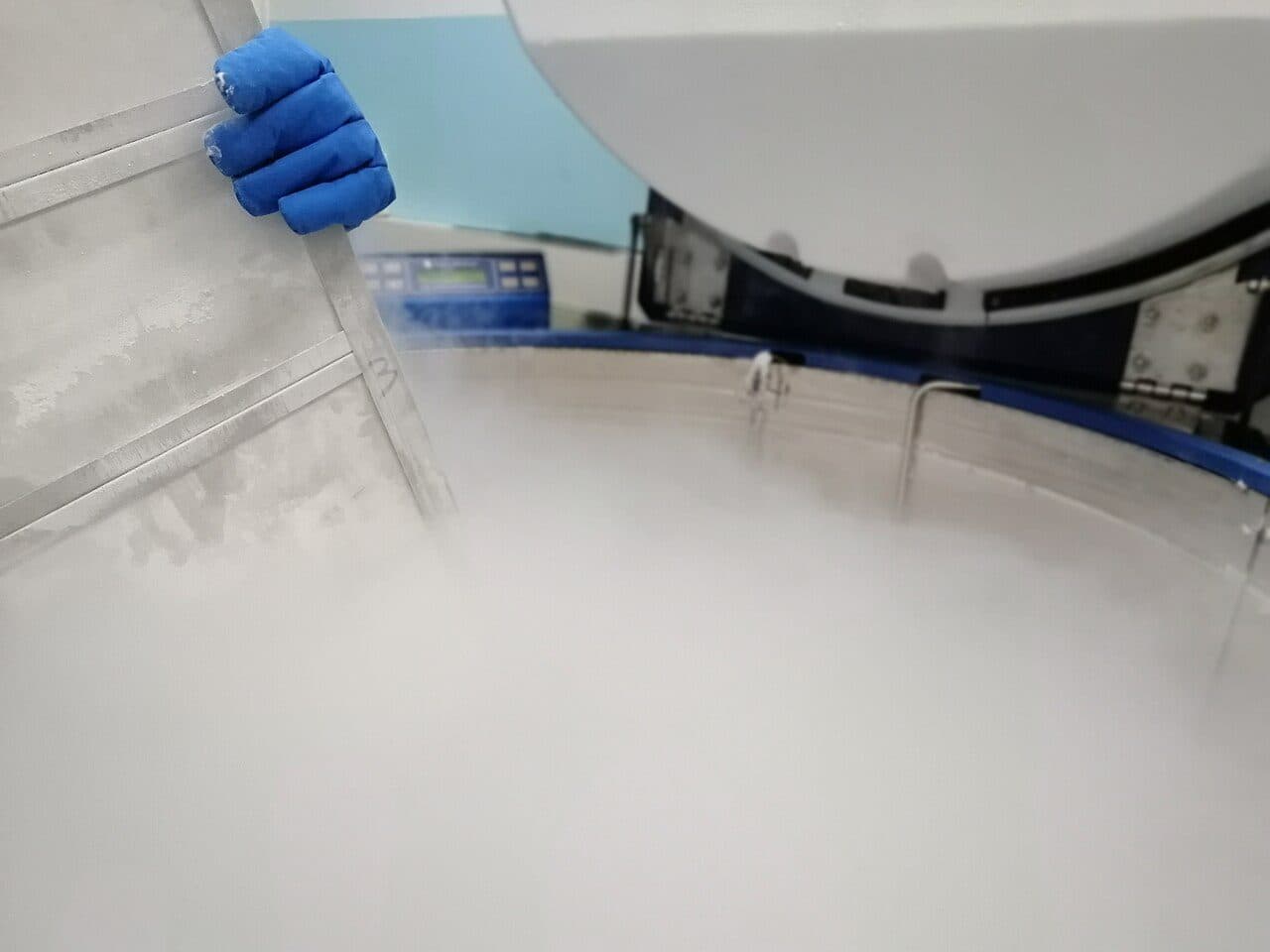
The guidance gives a validated computer system that tracks bar-code-labeled HCT/Ps held in a freezer as an example of automated designation.[2] Tissue may ship before the determination is complete when it stays in quarantine and travels with records identifying the donor, stating that the determination is incomplete, and stating that the tissue must not be implanted, transplanted, infused, or transferred until it is complete.[1]
Tissue from a donor determined ineligible is stored in a physically separate area or under equivalent procedures under 1271.65(a).[1] It may be made available for nonclinical purposes when labeled “For Nonclinical Use Only” together with the biohazard legend shown in 1271.3(h).[1]
Reading the exceptions and urgent-use provisions as written
Section 1271.90(a) lists the cases in which no determination is required, led by cells and tissues for autologous use, and 1271.90(c) sets their labels, including “FOR AUTOLOGOUS USE ONLY” and “NOT EVALUATED FOR INFECTIOUS SUBSTANCES” when the applicable screening and testing were not all performed.[1] Section 1271.65(b) permits limited use of tissue from an ineligible donor in a first-degree or second-degree blood relative, in directed reproductive donation, or under a documented urgent medical need, with prescribed labeling and physician notification.[1]
Urgent medical need has a specific definition in 1271.3(u), which begins with the condition that no comparable HCT/P is available.[13] Under 1271.60(d), tissue used for a documented urgent medical need before the determination is complete is labeled “NOT EVALUATED FOR INFECTIOUS SUBSTANCES” with an advisory statement, travels with the results completed so far and a list of what remains, and the determination is completed during or after use with the results reported to the physician.[1]
Connecting donor eligibility to the 361 framework and processing quality
Donor eligibility applies on both regulatory pathways. An HCT/P regulated solely under section 361 meets the four criteria in 21 CFR 1271.10, which the 361 versus 351 reference on this site quotes in full, and its manufacturer follows subpart C.[19] Under 1271.20, an HCT/P outside those criteria is regulated as a drug, device or biological product, and the applicable regulations require its manufacturer to follow the procedures in subparts C and D.[19]
Establishments that manufacture 361 HCT/Ps register and list them with FDA within 5 days of beginning operations and update registration annually in December, and each listing states whether the HCT/P meets the 1271.10 criteria.[19][20] FDA staff at the Center for Biologics Evaluation and Research describe this oversight as covering the entire product lifecycle.[21] Rothkrug and Robinson reviewed the current US regulatory framework in 2026, with perinatal tissue among the product categories discussed.[22]
Subpart D lists donor eligibility, screening and testing among the core current good tissue practice requirements, alongside facilities, environmental control, recovery, processing, labeling and storage.[19] Çopuroğlu and colleagues collected 160 perinatal samples from 32 term pregnancies and reported lower bacterial contamination in cesarean-derived samples than in vaginal-delivery samples, 25.8% against 60.0%.[23]
In a companion analysis of the same pregnancies, umbilical cord tissue gave the highest viable stromal cell yield per sample under GMP conditions, and placental tissues showed a higher microbial burden.[24] Lankford and colleagues built a CGMP process for placenta-derived stromal cells and reported master and working cell banks that were sterile, free from Mycoplasma and karyotypically normal.[25]
Validated procedures and trained staff anchor amniotic membrane banking (Fig. 5). Marsit and colleagues substantiated a 25 kGy radiation sterilization dose for air-dried amniotic membrane and found no difference in bioburden among four technician teams working to the same standard operating procedure.[26] A Nottingham group then validated an antibiotic-based aseptic decontamination protocol for vacuum-dried membrane and measured low natural bioburden in cesarean-derived tissue.[27]
Zahid and colleagues described a national amniotic membrane banking program that sterilizes grafts under the IAEA code of practice for radiation sterilization of tissue allografts.[28] Di Tullio and colleagues described cord blood banking as requiring accurate screening of potential donors and high-quality control systems, and linked birthweight and placental weight to unit cell content across 869 banked cord blood units.[29]
At the international level, McGrath and colleagues set out a World Health Organization remit for consistent standards, product nomenclature, traceability and biovigilance for medical products of human origin.[30] Navarro and colleagues reported that analysis of notifications to a regional tissue biovigilance system enabled targeted process improvements.[31]
Where to go from here
The 361 versus 351 reference explains where donor eligibility sits within FDA’s classification of HCT/Ps, and the MSC source tissues reference describes the umbilical cord, placental and amniotic compartments from which stromal cells are isolated. The ISCT minimal criteria reference covers how those cells are characterized once isolated, and the secretome reference follows what they release in culture.
The sterility, endotoxin and mycoplasma reference explains the release tests that follow processing. Verified practices can request lot documentation, and our team is glad to discuss the methods described on this page.
This article summarizes publicly available federal regulation for licensed practitioner education. It is not legal advice, medical advice, or regulatory guidance, and it does not establish that any particular product or practice is compliant. Confirm current federal and state obligations with qualified counsel.
Annotated References
Numbered in the order they are cited in the text. Each source is annotated with what it supports on this page; peer-reviewed articles are listed with journal, volume, issue and pages, and primary sources are regulations, agency documents and reference databases.
- 1.Regulatory21 CFR Part 1271, Subpart C, Donor Eligibility (1271.45 to 1271.90). Accessed 20 October 2026. https://www.ecfr.gov/current/title-21/chapter-I/subchapter-L/part-1271/subpart-C
- 2.RegulatoryFDA guidance for industry, Eligibility Determination for Donors of Human Cells, Tissues, and Cellular and Tissue-Based Products (HCT/Ps), August 2007. Accessed 20 October 2026. https://www.fda.gov/regulatory-information/search-fda-guidance-documents/eligibility-determination-donors-human-cells-tissues-and-cellular-and-tissue-based-products
- 3.RegulatoryFederal Register, Eligibility Determination for Donors of Human Cells, Tissues, and Cellular and Tissue-Based Products, final rule, 69 FR 29786, May 25, 2004. Accessed 20 October 2026. https://www.federalregister.gov/documents/2004/05/25/04-11245/eligibility-determination-for-donors-of-human-cells-tissues-and-cellular-and-tissue-based-products
- 4.RegulatoryFederal Register, Recommendations for Determining Eligibility of Donors of Human Cells, Tissues, and Cellular and Tissue-Based Products; Draft Guidance for Industry; Availability, January 7, 2025 (Docket FDA-2022-D-0464). Accessed 20 October 2026. https://www.federalregister.gov/documents/2025/01/07/2024-31524/recommendations-for-determining-eligibility-of-donors-of-human-cells-tissues-and-cellular-and
- 5.RegulatoryFDA, CBER, Tissue Guidances (list of current final and draft guidance documents for HCT/Ps). Accessed 20 October 2026. https://www.fda.gov/vaccines-blood-biologics/biologics-guidances/tissue-guidances
- 6.RegulatoryFederal Register, Recommendations on sepsis and Mycobacterium tuberculosis for HCT/Ps; final guidances withdrawn and reissued as Draft Guidances for Industry; Availability, May 5, 2025 (Dockets FDA-2024-D-3067, FDA-2024-D-3863). Accessed 20 October 2026. https://www.federalregister.gov/documents/2025/05/05/2025-07752/recommendations-to-reduce-the-risk-of-transmission-of-disease-agents-associated-with-sepsis-by-human
- 7.Peer-reviewedSilini AR, Di Pietro R, Lang-Olip I, et al. Perinatal Derivatives: Where Do We Stand? A Roadmap of the Human Placenta and Consensus for Tissue and Cell Nomenclature. Frontiers in Bioengineering and Biotechnology. 2020;8:610544. https://pubmed.ncbi.nlm.nih.gov/33392174/Annotation: COST SPRINT consensus review of placental structure and perinatal tissue and cell nomenclature. Cited for the anatomy of the placental disc, fetal membranes and umbilical cord shown in Fig. 1.
- 8.Peer-reviewedParolini O, Alviano F, Bagnara GP, et al. Concise review: isolation and characterization of cells from human term placenta: outcome of the first international Workshop on Placenta Derived Stem Cells. Stem Cells. 2008;26(2):300-311. https://pubmed.ncbi.nlm.nih.gov/17975221/Annotation: Workshop consensus on placenta-derived cells. Cited for the request that each cell population be reported with its exact region of origin within the placenta.
- 9.Peer-reviewedJirsova K, Jones GLA. Amniotic membrane in ophthalmology: properties, preparation, storage and indications for grafting-a review. Cell and Tissue Banking. 2017;18(2):193-204. https://pubmed.ncbi.nlm.nih.gov/28255771/Annotation: Tissue bank review of amniotic membrane preparation. Cited for placentas recovered at elective cesarean section, maternal serology at donation, and repeat serology 6 months postpartum in European practice.
- 10.Peer-reviewedLi Y, Liu J, Li M, et al. Maternal and Neonatal Factors Impacting the Volume and Cellular Composition of Umbilical Cord Blood. Stem Cell Reviews and Reports. 2026. https://pubmed.ncbi.nlm.nih.gov/42635946/Annotation: Retrospective analysis of 229 donated cord blood units. Cited for the observation that donor eligibility criteria vary among cord blood banks.
- 11.Peer-reviewedOnebunne CAC, Onebunne EO, Bello OO. Placenta Donation - The Expectant Mother's View. Women & Health. 2021;61(10):968-975. https://pubmed.ncbi.nlm.nih.gov/34802396/Annotation: Cross-sectional survey of expectant mothers. Cited for awareness of placenta donation and the association between knowledge of its uses and willingness to donate.
- 12.Peer-reviewedElrahal Y, Khabour OF, Alzoubi KH, et al. Women's perceptions of placenta donation for research purposes: a cross-sectional study from the MENA region. Philosophy, Ethics, and Humanities in Medicine. 2026;21(1):4. https://pubmed.ncbi.nlm.nih.gov/41680887/Annotation: Cross-sectional survey of women in Jordan. Cited for awareness of placenta donation for research, data privacy as a reason for declining, and the recommendation of education programs.
- 13.Regulatory21 CFR 1271.3, definitions. Accessed 20 October 2026. https://www.ecfr.gov/current/title-21/chapter-I/subchapter-L/part-1271/subpart-A/section-1271.3
- 14.Peer-reviewedChandrasekar A, Lomas R, Sánchez-Ibáñez J, et al. Physical Examination of Potential Deceased Organ and Tissue Donors: An Overview of the European Landscape. Transplant International. 2023;36:11394. https://pubmed.ncbi.nlm.nih.gov/37547749/Annotation: Surveys of health authorities and professionals in Council of Europe member states. Cited for variation in how donor physical examination is regulated and performed, and the call for best-practice guidelines.
- 15.RegulatoryFDA, Testing HCT/P Donors for Relevant Communicable Disease Agents and Diseases. Accessed 20 October 2026. https://www.fda.gov/vaccines-blood-biologics/safety-availability-biologics/testing-hctp-donors-relevant-communicable-disease-agents-and-diseases
- 16.RegulatoryCMS, Clinical Laboratory Improvement Amendments (CLIA). Accessed 20 October 2026. https://www.cms.gov/medicare/quality/clinical-laboratory-improvement-amendments
- 17.Peer-reviewedPadalko E, Colenbie L, Delforge A, et al. Preanalytical variables influencing the interpretation and reporting of biological tests on blood samples of living and deceased donors for human body materials. Cell and Tissue Banking. 2024;25(2):509-520. https://pubmed.ncbi.nlm.nih.gov/37624485/Annotation: Advice from the Superior Health Council of Belgium working group on donor serology and NAT. Cited for preanalytical variables: sampling, tubes, transport, centrifugation, storage and hemodilution.
- 18.Peer-reviewedDionne SO, Akana HCSR, Real M, et al. Increased serologic reactivity with automated CMIA testing and its implications for deceased donor eligibility determination in the United States. Cell and Tissue Banking. 2025;26(3):40. https://pubmed.ncbi.nlm.nih.gov/40920266/Annotation: Retrospective analysis of more than 160,000 deceased tissue and cornea donors. Cited for higher serologic reactive rates after the move from manual EIA to automated CMIA without a matching rise in NAT reactivity.
- 19.Regulatory21 CFR Part 1271, Human Cells, Tissues, and Cellular and Tissue-Based Products. Accessed 20 October 2026. https://www.ecfr.gov/current/title-21/chapter-I/subchapter-L/part-1271
- 20.RegulatoryFDA, Tissue Establishment Registration. Accessed 20 October 2026. https://www.fda.gov/vaccines-blood-biologics/biologics-establishment-registration/tissue-establishment-registration
- 21.Peer-reviewedSanduja S, Lessey-Morillon L, Allen R, et al. United States Food and Drug Administration Regulation of Human Cells, Tissues, and Gene Therapies. Advances in Experimental Medicine and Biology. 2023;1430:71-89. https://pubmed.ncbi.nlm.nih.gov/37526843/Annotation: Overview written by FDA staff at CBER. Cited for CBER oversight of cell and tissue products across the entire product lifecycle.
- 22.Peer-reviewedRothkrug AS, Robinson CL. Playing by the Rules: A Review of the Modern Regulatory Framework for Regenerative Medicine. Current Pain and Headache Reports. 2026;30(1):118. https://pubmed.ncbi.nlm.nih.gov/42696062/Annotation: Review of the current US regulatory framework for cell and tissue products. Cited as a current summary that includes perinatal tissue among the categories it discusses.
- 23.Peer-reviewedÇopuroğlu M, Yalçın ÖT, Kara SG. Comprehensive evaluation of the clinical feasibility of using perinatal medical waste as a source for fetal mesenchymal stem cell banking under good manufacturing practice conditions. Cell and Tissue Banking. 2025;27(1):1. https://pubmed.ncbi.nlm.nih.gov/41283960/Annotation: Prospective study of 160 perinatal samples from 32 term pregnancies. Cited for lower bacterial contamination in cesarean-derived samples than in vaginal-delivery samples, 25.8% against 60.0%.
- 24.Peer-reviewedÇopuroğlu M, Yalçın ÖT, Kara SG. Clinical feasibility and cost efficiency of perinatal mesenchymal stem cell production under GMP conditions. Scientific Reports. 2025;16(1):2791. https://pubmed.ncbi.nlm.nih.gov/41398367/Annotation: GMP comparison of perinatal tissue types from 32 term cesarean pregnancies. Cited for the highest viable stromal cell yield from umbilical cord tissue and higher microbial burden in placental tissues.
- 25.Peer-reviewedLankford L, Chen YJ, Saenz Z, et al. Manufacture and preparation of human placenta-derived mesenchymal stromal cells for local tissue delivery. Cytotherapy. 2017;19(6):680-688. https://pubmed.ncbi.nlm.nih.gov/28438482/Annotation: CGMP-compliant isolation and banking of placenta-derived stromal cells. Cited for master and working cell banks that were sterile, Mycoplasma-free and karyotypically normal.
- 26.Peer-reviewedMarsit N, Dwejen S, Saad I, et al. Substantiation of 25 kGy radiation sterilization dose for banked air dried amniotic membrane and evaluation of personnel skill in influencing finished product bioburden. Cell and Tissue Banking. 2014;15(4):603-611. https://pubmed.ncbi.nlm.nih.gov/24676699/Annotation: Tissue bank validation study. Cited for substantiation of a 25 kGy sterilization dose for air-dried amniotic membrane and for equivalent bioburden across four technician teams following one SOP.
- 27.Peer-reviewedMarsit NM, Sidney LE, Britchford ER, et al. Validation and assessment of an antibiotic-based, aseptic decontamination manufacturing protocol for therapeutic, vacuum-dried human amniotic membrane. Scientific Reports. 2019;9(1):12854. https://pubmed.ncbi.nlm.nih.gov/31492886/Annotation: Validation of an aseptic decontamination protocol for vacuum-dried amniotic membrane. Cited for the protocol validation and for low natural bioburden in cesarean-derived membrane.
- 28.Peer-reviewedZahid HM, Rahman MS, Diba F, et al. Human bone and amniotic membrane banking in Bangladesh for grafting: the impact of the international atomic energy agency (IAEA) programme. Cell and Tissue Banking. 2020;21(3):523-533. https://pubmed.ncbi.nlm.nih.gov/32472449/Annotation: Program report from a national tissue bank. Cited for amniotic membrane grafts sterilized under the IAEA code of practice for radiation sterilization of tissue allografts.
- 29.Peer-reviewedDi Tullio I, Azzolina D, Piras GN, et al. Factors associated with blood cord unit bankability: an analysis of a 15-year-long case series. Cell and Tissue Banking. 2020;21(1):77-87. https://pubmed.ncbi.nlm.nih.gov/31848776/Annotation: Retrospective study of 869 cord blood units banked from 1999 to 2015. Cited for donor screening and quality control as banking requirements, and for birthweight and placental weight as correlates of cell content.
- 30.Peer-reviewedMcGrath E, Herson MR, Kuehnert MJ, et al. A WHO remit to improve global standards for medical products of human origin. Bulletin of the World Health Organization. 2024;102(10):707-714. https://pubmed.ncbi.nlm.nih.gov/39318889/Annotation: Policy article on medical products of human origin. Cited for a WHO role in international standards, consistent nomenclature, traceability and biovigilance.
- 31.Peer-reviewedNavarro A, Len O, Muñiz-Diaz E, et al. The value of organ and tissue biovigilance: a cross-sectional analysis. Frontiers in Transplantation. 2024;3:1307946. https://pubmed.ncbi.nlm.nih.gov/38993767/Annotation: Retrospective analysis of notifications to the Catalan tissue and organ biovigilance systems. Cited for biovigilance analysis enabling targeted process improvements.
Cite this page
ExaVeyra Sciences Editorial Team. Perinatal Tissue Donor Eligibility Under 21 CFR 1271. ExaVeyra Sciences; 20 October 2026. Available from: https://exaveyra.com/science/regulatory/perinatal-tissue-donor-eligibility. Accessed [date accessed].