PDRN (polydeoxyribonucleotide) and polynucleotides are purified DNA fragments, most often prepared from salmon or trout sperm, while exosomes are membrane-bound vesicles released by cells and described by their size, surface markers and cargo. The two materials are frequently offered at the same visits, usually alongside microneedling or an energy-based device, yet they differ in origin, in proposed mechanism, in the clinical literature behind them and in how United States regulators classify them.
Regulatory Status
No exosome product and no injectable PDRN or polynucleotide product is FDA-approved as of 16 November 2026. Topical PDRN products are sold in the United States as cosmetics, a category that does not pass through FDA approval. ExaVeyra Sciences supplies exosomes made under cGMP by qualified partner manufacturers for topical aesthetic use by licensed practitioners and for laboratory research, with a certificate of analysis for each lot. The company does not provide care, does not make the clinical decision, and makes no efficacy claim for any product.
PDRN and Polynucleotides Are Purified DNA Fragments, and the Line Between the Two Terms Is Commercial as Much as Scientific
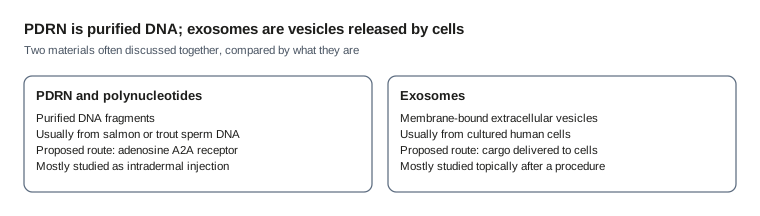
The comparison table in this section adds the evidence base and US status for each material (Fig. 1). Both are described here by what the cited studies report.
Squadrito and colleagues described PDRN in 2017 as a mixture of deoxyribonucleotides with molecular weights between 50 and 1,500 kDa, obtained by controlled purification and sterilization of sperm DNA from rainbow trout (Oncorhynchus mykiss) or chum salmon (Oncorhynchus keta). The authors reported that the purification is designed to leave no active protein or peptide in the final material, which is the basis for the low immunogenicity usually attributed to it.
The terms PDRN and polynucleotide (PN) appear side by side in marketing, and the 2025 review by Park and colleagues in Applied Sciences concluded that the distinction in clinical practice follows product content and regulatory branding more than a settled scientific definition. That review noted that some sources describe PN as the larger fragment, above 1,500 kDa, while others report an average near 400 base pairs, and that most studies do not measure fragment size experimentally by gel electrophoresis or HPLC. A practice comparing two salmon-DNA products can therefore ask each supplier for a stated molecular weight range and the analytical method behind it.
| Attribute | PDRN and polynucleotides | Exosomes | Source |
|---|---|---|---|
| Material | Purified DNA fragments | Membrane-bound extracellular vesicles | Squadrito 2017; Welsh 2024 |
| Usual source | Salmon or trout sperm DNA | Cultured human cells such as mesenchymal stem cells | Squadrito 2017; Park 2023 |
| Described by | Molecular weight range, purity, residual protein | Particle size and concentration, protein content, surface markers | Park S 2025; Welsh 2024 |
| Proposed mechanism | Adenosine A2A receptor engagement and the nucleotide salvage pathway | Delivery of protein, lipid and RNA cargo to recipient cells | Squadrito 2017; Welsh 2024 |
| Main form in the clinical literature | Intradermal injection | Topical application after microneedling or fractional laser | Lampridou 2025; Park 2023; Kwon 2020 |
| United States status, 16 November 2026 | No approved or cleared injectable; topical products sold as cosmetics | No approved product; supplied for topical aesthetic use and research | FDA records, see regulatory section |
Exosomes Are Cell-Derived Vesicles Described by Size, Markers and Cargo
The International Society for Extracellular Vesicles updated its reporting standard in 2024 as MISEV2023, authored by Welsh and colleagues with a consortium of contributors. The document uses extracellular vesicle as the umbrella term and gives guidance on nomenclature, on separating vesicles from non-vesicular particles, and on characterizing a preparation before any functional claim is made.
For a practice, the consequence is that an exosome lot is defined by measurements. A certificate of analysis for a lot typically reports particle concentration and size distribution by nanoparticle tracking analysis, protein quantification, sterility and endotoxin, and the tetraspanins CD9, CD63 and CD81 are the surface markers most often used to confirm vesicle identity.
PDRN’s Proposed Mechanism Runs Through the Adenosine A2A Receptor
Squadrito and colleagues summarized in vitro and in vivo experiments suggesting that the most relevant action of PDRN is engagement of adenosine A2A receptors, and that PDRN also supplies nucleosides and nucleotides to the cellular salvage pathway. In one study the review describes, by Thellung and colleagues in 1999, PDRN and adenosine both increased growth of cultured human skin fibroblasts, and an A2 receptor antagonist abolished the PDRN effect.
The same review reports a human pharmacokinetic study after intramuscular administration and describes PDRN as a proprietary, registered drug. That status applies in the markets where the product is authorized and does not extend to the United States.
Exosomes are studied under a different model, in which the vesicle membrane protects protein, lipid and RNA cargo and delivers it to recipient cells. The two mechanisms are independent of each other, and the first studies combining the two classes of material are described later in this article.
Clinical Evidence for Polynucleotides Comes Mainly From Injectable Studies Outside the United States
An Eight-Expert Consensus Set Out How the Products Are Used in Italy
Cavallini and colleagues published a consensus report in 2021 in which eight physicians with experience in polynucleotide products combined the available evidence with clinical judgment. The group reached recommendations, defined as agreement above 80 percent, for the face, the periocular area, the neck and décolleté, the hands, the scalp and stretch marks, and reached a lower 60 percent agreement on one item concerning the initial course for the face. The products discussed are regulated as medical devices in Italy, and a consensus report sits at the expert-opinion level of evidence.
A 2025 Systematic Review Pooled Nine Studies and 219 Patients
Lampridou and colleagues searched Embase, Medline and Cochrane and registered their protocol with PROSPERO. The review included nine primary studies of low to moderate quality covering 219 patients who received polynucleotide treatment, reported that side effects were generally mild and transient and that patient satisfaction was moderate to high, and called for rigorous, high-quality studies to establish optimal use. One author of the review also co-authored the 2021 consensus report.
A 2024 Review Graded the Wider Human Literature
K. W. A. Lee and colleagues, working in Hong Kong and Seoul, reviewed human studies of polynucleotides in aesthetic medicine in 2024 and classified them by the Oxford Centre for Evidence-Based Medicine hierarchy. The review described improvements in skin texture, wrinkle depth and facial appearance across the literature, noted that some studies reported limited or no benefit, and advised clinicians to weigh current limitations and potential risks.
A Randomized Split-Face Trial Compared Polynucleotide and Hyaluronic Acid Filler Around the Eyes
Y. J. Lee and colleagues at Asan Medical Center reported a randomized, double-blind, split-face trial in the Journal of Dermatological Treatment in 2022. Twenty-seven participants received three injections at two-week intervals, with a polynucleotide filler on one side of the periorbital area and a non-cross-linked hyaluronic acid filler on the other. Visual analog and global aesthetic scores improved to a similar degree on both sides, the polynucleotide side showed higher improvement rates for elasticity, hydration, roughness and pore volume, dermal density did not differ, and the authors reported no serious adverse events.
One Randomized Comparison Was Published and Later Retracted
Pak and colleagues reported a randomized, double-blind, matched-pairs trial in 2014 in which 72 patients received a polynucleotide filler on one side and a non-cross-linked hyaluronic acid filler on the other for crow’s feet. The abstract reported no statistically significant difference between the two sides on the primary and secondary objective outcomes and no unexpected adverse effects. The journal retracted the article in January 2016 after finding that the manufacturer’s funding of the trial and a co-author’s employment with the company had not been disclosed, and the retraction notice records the corresponding author’s position that the research itself was unaffected. The trial is cited here as part of the record and carries no weight as evidence.
A Post-Market Hydration Study Has Completed
ClinicalTrials.gov entry NCT06821867, sponsored by Mastelli S.r.l, describes a single-center, single-arm, post-market investigation of an intradermal gel combining polynucleotides and hyaluronic acid at 10 mg/ml each, with a global aesthetic scale assessed four months after the last session. The registry lists 26 participants and a completion date of 3 July 2025, and because the design has no comparator arm, its results will describe performance and safety and leave comparative questions open.
Topical Exosome Evidence Centers on Application After a Procedure
Park and colleagues reported a 12-week, prospective, randomized, split-face study in 2023 in which 28 participants received three sessions at three-week intervals. One side of the face received a solution containing human adipose tissue stem cell-derived exosomes with microneedling, and the other side received saline with microneedling. The Global Aesthetic Improvement Scale score was higher on the exosome side at the final visit (p = 0.005), instrument measurements of wrinkles, elasticity, hydration and pigmentation pointed the same way, and the authors recorded no serious adverse events.
Kwon and colleagues had earlier reported a 12-week, double-blind, randomized, split-face trial in 2020 in which 25 patients received three sessions of fractional CO2 laser for acne scars, with an exosome gel applied to one side of the face and a control applied to the other. The authors reported more favorable responses and a shorter recovery time on the exosome side. Both trials come from overlapping investigators working with the same class of adipose-derived material, so they describe that preparation and cannot be assumed to describe every exosome product.
Registered work continues in adjacent areas. ClinicalTrials.gov entry NCT06239207, a phase 2 study at Services Hospital in Lahore that enrolled 30 participants and was completed in July 2024, compared intradermal scalp injection of an exosome preparation with platelet-rich plasma in androgenetic alopecia, a route and setting outside the topical use described in this article. Readers can follow the existing ExaBlog reviews of exosomes after microneedling and exosomes with energy-based devices for the procedure-level detail.
The First Studies Combining the Two Classes of Material Have Appeared
Helmi and colleagues reported a randomized comparative trial in Advances in Dermatology and Allergology in 2026 in which 100 patients with atrophic acne scars received fractional CO2 laser three times over four weeks, either alone or followed by a commercial serum combining polynucleotide with exosome-mimetic nanovesicles. The authors reported a greater reduction in the acne scar severity score at three months in the combination group, at 47.3 percent. Exosome-mimetic nanovesicles are engineered particles, so the trial describes that formulation and leaves the pairing of polynucleotides with cell-derived exosomes untested.
Two smaller reports point in the same direction and add little certainty. A pilot comparative study by Biskanaki and colleagues, published in Applied Sciences in July 2026, evaluated HIFU alone and HIFU with microneedling-assisted delivery of an exosome and PDRN formulation using digital skin analysis, and a case series presented at the IMCAS World Congress in 2026 included one patient who received CO2 laser plus exosomes on one side of the face and CO2 laser plus PDRN on the other. Both are early and descriptive, and together they outline the questions a controlled trial of cell-derived exosomes with polynucleotides would need to answer.
Evidence on Both Sides Is Small, Short and Often Industry-Linked
The published record supports careful description and leaves several questions open as of November 2026.
- Sample size. The randomized exosome trials enrolled 28 and 25 participants, and the polynucleotide systematic review pooled 219 patients across nine studies.
- Follow-up. Twelve weeks is the typical observation period on both sides, which describes early response and leaves durability to future work.
- Comparators. No randomized head-to-head trial of PDRN or polynucleotides against cell-derived exosomes was located as of November 2026, so any ranking of one above the other goes beyond the data.
- Material differences. Salmon-DNA products differ in fragment size and manufacturing, and exosome products differ in cell source and isolation method, which limits how far one study generalizes.
- Funding and affiliation. The 2016 retraction shows why disclosure matters, and several studies on both sides involve investigators with ties to the product studied.
The direction of travel is encouraging. Characterization standards such as MISEV2023, prospective registration of trials and split-face randomized designs are now established on the vesicle side, and the 2025 systematic review sets the same expectation for polynucleotides.
Neither Material Is FDA-Approved, and the Regulatory Categories Differ
| Material and form | United States status as of 16 November 2026 | Record |
|---|---|---|
| Injectable PDRN or polynucleotides | No FDA-approved drug and no cleared device identified | No records in FDA’s 510(k) database for the device names polynucleotide, polydeoxyribonucleotide or PDRN, searched 14 November 2026 (reference 16); a Korean business report in Edaily of 27 August 2026 says the maker of the leading polynucleotide injectable is preparing an FDA medical device submission, with United States entry targeted for 2031 to 2032 |
| Topical PDRN skincare | Sold as cosmetics, which FDA does not approve before marketing; facility registration and product listing fall under the Modernization of Cosmetics Regulation Act of 2022 | Modernization of Cosmetics Regulation Act of 2022 (reference 15) |
| Exosome products | No FDA-approved product; FDA has issued a public safety notification and continues to send warning letters | FDA Public Safety Notification on Exosome Products, 6 December 2019; warning letters MARCS-CMS 728085, 26 May 2026, and 726330, 14 August 2026 (references 12 to 14) |
The two 2026 warning letters turned on how products were described and, in one case, on manufacturing controls. FDA’s letter to Blue Horizon International quoted website language describing exosomes as promoting tissue repair as evidence of intended use, and its letter to R3 Medical Companies cited manufacturing violations at two facilities and found that the described process did not appear to isolate exosomes (references 13 and 14). The lesson for a practice is that the supplier’s documentation and the practice’s own wording carry as much regulatory weight as the vial.
A Supplier’s Own Statements Define Its Intended Use
Statements consistent with the current framework:
- Supplied for topical aesthetic use by licensed practitioners, or for laboratory research
- Manufactured under cGMP, with a certificate of analysis for each lot
- No product is FDA-approved, stated plainly on the page
Statements that change the regulatory picture:
- Any claim to treat, cure or prevent a disease or condition, which the agency reads as a drug claim
- Any instruction for injection or infusion of an exosome product
- Any use of “FDA-approved” for a product that holds no approval
Educational Disclaimer: This article is for educational purposes only and does not constitute medical or legal advice. It does not identify any material, compound, device setting or protocol as safe, effective or appropriate for any patient, and it is not intended to diagnose, treat, cure, or prevent any disease. Questions about a treatment belong with the reader’s own licensed provider. Exosome material is supplied for topical aesthetic use by licensed practitioners. No exosome product is FDA-approved for any use, and ExaVeyra Sciences makes no statement about administration, route, or outcome. Compounded medications are not FDA-approved. They are prepared by a 503A compounding pharmacy licensed by the Texas State Board of Pharmacy for an individual patient against that patient’s prescription, and are available to NPI-verified licensed practitioners only, in the states where the pharmacy is licensed. Product, device and brand names mentioned are trademarks of their respective owners and are used only to identify the products discussed. Their mention is not an endorsement, and those owners have not reviewed or endorsed this article. ExaVeyra Sciences is a supplier and takes no part in any diagnosis, treatment decision, or plan of care. Findings described are attributed to the peer-reviewed literature, trial registries and agencies cited. The content of these guides is provided for general informational purposes only. It does not constitute legal, medical, or regulatory advice, and does not establish that any particular product or practice is compliant. Regulatory requirements vary by state and depend on the circumstances of each practice. Each practitioner should consult their own legal counsel and the applicable state licensing boards before acting on anything stated here.
References
- 1.Squadrito F, Bitto A, Irrera N, Pizzino G, Pallio G, Minutoli L, Altavilla D. Pharmacological Activity and Clinical Use of PDRN. Frontiers in Pharmacology. 2017;8:224. PMID 28491036. doi:10.3389/fphar.2017.00224. Corrigendum: 2022;13:1073510.Review. Carries in this article: the molecular weight range, source species, purification rationale, adenosine A2A mechanism, salvage pathway, the 1999 fibroblast experiment and the description of PDRN as a registered drug.
- 2.Park S, Baek S, Shin HJ, Kim JS, Gwon HI, Bae S, An S. Polydeoxyribonucleotides as Emerging Therapeutics for Skin Diseases: Clinical Applications, Pharmacological Effects, Molecular Mechanisms, and Potential Modes of Action. Applied Sciences. 2025;15(19):10437. doi:10.3390/app151910437Review. Carries in this article: the finding that the PDRN and PN distinction follows product content and branding, the conflicting size definitions, and the observation that most studies do not measure fragment size.
- 3.Cavallini M, Bartoletti E, Maioli L, Massirone A, Pia Palmieri I, Papagni M, Priori M, Trocchi G. Consensus report on the use of PN-HPT (polynucleotides highly purified technology) in aesthetic medicine. Journal of Cosmetic Dermatology. 2021;20(3):922-928. PMID 32799391. doi:10.1111/jocd.13679Expert consensus report. Carries in this article: the eight-expert panel, the anatomical areas that reached recommendation level, and the 60 percent item. Disclosure: expert-opinion evidence concerning named commercial products.
- 4.Lampridou S, Bassett S, Cavallini M, Christopoulos G. The Effectiveness of Polynucleotides in Esthetic Medicine: A Systematic Review. Journal of Cosmetic Dermatology. 2025;24(2):e16721. PMID 39645667. doi:10.1111/jocd.16721Systematic review. Carries in this article: nine studies, 219 patients, study quality, tolerability and the call for higher-quality trials. Disclosure: one author also co-authored reference 3.
- 5.Lee KWA, Chan KWL, Lee A, Lee CH, Wan J, Wong S, Yi KH. Polynucleotides in Aesthetic Medicine: A Review of Current Practices and Perceived Effectiveness. International Journal of Molecular Sciences. 2024;25(15):8224. PMID 39125793. doi:10.3390/ijms25158224Review graded by evidence level. Carries in this article: the evidence-level grading, the reported improvements, the studies with limited or no benefit, and the caution on limitations and risks.
- 6.Pak CS, Lee J, Lee H, Jeong J, Kim EH, Jeong J, Choi H, Kim B, Oh S, Kim I, Heo CY. A Phase III, Randomized, Double-Blind, Matched-Pairs, Active-Controlled Clinical Trial and Preclinical Animal Study to Compare the Durability, Efficacy and Safety between Polynucleotide Filler and Hyaluronic Acid Filler in the Correction of Crow’s Feet. Journal of Korean Medical Science. 2014;29(Suppl 3):S201-S209. PMID 25473210. doi:10.3346/jkms.2014.29.S3.S201. Retracted.Randomized trial, retracted in 2016. Carries in this article: the trial design and the reported absence of a statistically significant difference, cited as record only.
- 7.Notice of Retraction: Pak CS, et al. Journal of Korean Medical Science. 2016;31(2):330. PMID 26839493. doi:10.3346/jkms.2016.31.2.330Retraction notice. Carries in this article: the reason for retraction and the corresponding author’s stated position.
- 8.Park GH, Kwon HH, Seok J, Yang SH, Lee J, Park BC, Shin E, Park KY. Efficacy of combined treatment with human adipose tissue stem cell-derived exosome-containing solution and microneedling for facial skin aging: A 12-week prospective, randomized, split-face study. Journal of Cosmetic Dermatology. 2023;22(12):3418-3426. PMID 37377400. doi:10.1111/jocd.15872Prospective, randomized, split-face study. Carries in this article: 28 participants, three sessions, the global aesthetic score result (p = 0.005) and the adverse-event statement.
- 9.Kwon HH, Yang SH, Lee J, Park BC, Park KY, Jung JY, Bae Y, Park GH. Combination Treatment with Human Adipose Tissue Stem Cell-derived Exosomes and Fractional CO2 Laser for Acne Scars: A 12-week Prospective, Double-blind, Randomized, Split-face Study. Acta Dermato-Venereologica. 2020;100:adv00310. PMID 33073298. doi:10.2340/00015555-3666Double-blind, randomized, split-face study. Carries in this article: 25 patients, the split-face design and the authors’ reported response and recovery findings. Disclosure: shares investigators with reference 8.
- 10.Welsh JA, Goberdhan DCI, O’Driscoll L, and colleagues; MISEV Consortium. Minimal information for studies of extracellular vesicles (MISEV2023): From basic to advanced approaches. Journal of Extracellular Vesicles. 2024;13(2):e12404. PMID 38326288. doi:10.1002/jev2.12404Society reporting standard. Carries in this article: vesicle nomenclature, separation and characterization guidance.
- 11.ClinicalTrials.gov. NCT06821867, sponsored by Mastelli S.r.l, completed 3 July 2025 with 26 participants; and NCT06239207, sponsored by Services Hospital, Lahore, phase 2, completed July 2024 with 30 participants. https://clinicaltrials.gov/study/NCT06821867; https://clinicaltrials.gov/study/NCT06239207Registry entries. Carries in this article: design, enrollment and status of both studies.
- 12.US Food and Drug Administration. Public Safety Notification on Exosome Products. 6 December 2019. https://www.fda.gov/vaccines-blood-biologics/safety-availability-biologics/public-safety-notification-exosome-productsAgency web page. Carries in this article: the statement that there are no FDA-approved exosome products and the MedWatch reporting route.
- 13.US Food and Drug Administration, CBER. Warning letter to R3 Medical Companies, MARCS-CMS 726330. 14 August 2026. https://www.fda.gov/inspections-compliance-enforcement-and-criminal-investigations/warning-letters/r3-medical-companies-726330-08142026Primary source. Carries in this article: the 2026 enforcement example involving product description and manufacturing controls, including the finding that the described process did not appear to isolate exosomes.
- 14.US Food and Drug Administration, CBER. Warning letter to Blue Horizon International, MARCS-CMS 728085. 26 May 2026. https://www.fda.gov/inspections-compliance-enforcement-and-criminal-investigations/warning-letters/blue-horizon-international-llc-728085-05262026Primary source. Carries in this article: the website language the agency cited as evidence of intended use.
- 15.US Food and Drug Administration. Cosmetics and US Law. Agency page. https://www.fda.gov/cosmetics/laws-regulations/cosmetics-us-lawAgency web page, replacing the draft’s law-firm analysis at conversion. Carries in this article: facility registration and product listing under the Modernization of Cosmetics Regulation Act of 2022, and the absence of premarket approval for cosmetics.
- 16.US Food and Drug Administration. 510(k) Premarket Notification database (https://www.accessdata.fda.gov/scripts/cdrh/cfdocs/cfpmn/pmn.cfm), device-name searches for polynucleotide, polydeoxyribonucleotide, PDRN and Rejuran, each returning no records on 14 November 2026; an Applicant Name search for Pharma Research on 15 November 2026 whose only match was an unrelated Swiss applicant, APR Applied Pharma Research SA, for a wound care solution (K151168); and a Drugs@FDA search (https://www.accessdata.fda.gov/scripts/cder/daf/) for polydeoxyribonucleotide, also returning no results on 14 November 2026.Agency databases. Carries in this article: the absence of a cleared device or approved drug under those names. Context named beside it in the regulatory table: the Edaily business report of 27 August 2026 that the maker of the leading polynucleotide injectable is preparing a US medical device submission, with entry targeted for 2031 to 2032 (https://en.edaily.co.kr/news/eda202608275176/).
- 17.Lee YJ, Kim HT, Lee YJ, Paik SH, Moon YS, Lee WJ, Chang SE, Lee MW, Choi JH, Jung JM, Won CH. Comparison of the effects of polynucleotide and hyaluronic acid fillers on periocular rejuvenation: a randomized, double-blind, split-face trial. Journal of Dermatological Treatment. 2022;33(1):254-260. PMID 32248707. doi:10.1080/09546634.2020.1748857Randomized, double-blind, split-face trial. Carries in this article: 27 participants, the injection schedule, and the outcome and safety findings.
- 18.Helmi RR, Mohammed RSH, Nori W. Fractional CO2 laser augmented by polynucleotide and exosome-mimetic nanovesicles in atrophic acne scars: randomised comparative trial. Advances in Dermatology and Allergology (Postępy Dermatologii i Alergologii). 2026;43(3):314-321. PMID 42621380. PMC13487574. doi:10.5114/ada.2026.161825Randomized comparative trial. Carries in this article: 100 participants, the laser schedule, the 47.3 percent score reduction and the nature of the nanovesicles.
- 19.Biskanaki F, Varvaresou A, Papageorgiou EG, Protopapa E, Lazaris AC. Digital Skin Analysis of Multimodal Skin Rejuvenation with HIFU and Microneedling-Assisted Exosome/PDRN Delivery: A Pilot Comparative Study. Applied Sciences. 2026;16(14):7050. Published 14 July 2026. doi:10.3390/app16147050Pilot comparative study. Carries in this article: the existence and design of a small combination study.
Image credits
- Fig. 1ExaVeyra Sciences, original figure. ↩