Esta referencia está disponible actualmente en inglés. La versión en español está en preparación.
How Platelet Studies Report Methods: PRP Reporting Standards
Por Benn Bluestein-Veyra, M.Sc. en Química Orgánica · Actualizado el 21 de octubre de 2026
ExaVeyra Sciences es un proveedor B2B con sede en Miami que suministra exosomas para uso estético tópico a clínicas con licencia, y remite a los prescriptores con licencia a una farmacia de preparados compuestos 503A que prepara formulaciones según prescripciones individuales.
| Pregunta | Respuesta |
|---|---|
| Qué cubre esta página | How platelet-rich plasma studies report preparation methods, why reporting varies, and the minimum information checklists proposed to make preparations comparable. |
| Quién puede hacer pedidos | Clínicas y profesionales con licencia profesional activa y NPI verificados por ExaVeyra. Los pedidos de exosomas requieren además un reconocimiento firmado de uso profesional. |
| Qué se envía y cómo | El material de exosomas para uso estético tópico, caracterizado por lote, se envía en cadena de frío por exprés nocturno. La entrega puede tardar 1 a 3 días hábiles. Se emite un certificado de análisis para cada lote y se entrega a solicitud. |
PRP reporting standards are the checklists and classification systems that tell a platelet-rich plasma study what to record about its preparation: blood volume, spin settings, cell counts, final volume and activation. Systematic reviews found that most clinical PRP studies reported too little to repeat the method or compare the products.[1][2]
This reference follows that meta-research, the classification systems written in response, the MIBO checklist and ISTH guidance, and the laboratory measurements a complete methods section draws on.[3][4] Each section describes how studies report preparations, which is what makes results comparable across laboratories.
Understanding why preparation details define the product a PRP study tested
Platelet-rich plasma names a family of preparations. Dohan Ehrenfest and colleagues noted in 2009 that each preparation method leads to a different product with different biology, and grouped platelet concentrates by their leukocyte and fibrin content.[5]
Mazzocca and colleagues processed blood from eight donors with two single-spin methods and one double-spin method. Platelet, white cell and growth factor content differed significantly between methods, and every method raised platelet concentration above that of native blood.[6]
The same group drew blood three times from each donor and found wide intra-individual variation in platelet and cell numbers and in growth factor levels, whatever the separation method.[6] A preparation therefore reflects both the protocol and the donor, which is why the PRP preparation variables reference covers each step in turn.
Buffy coat and plasma-based methods give different cell profiles
Fitzpatrick and colleagues ran blood from three donors through four separation methods. The three that sampled the buffy coat layer gave platelets at 3 to 6 times baseline with white cells also at 3 to 6 times baseline, and the one that sampled plasma gave platelets at 1.5 times baseline.[7]
That study also recorded a small drop in pH, which the authors related to the citrate anticoagulant, and glucose at 3 to 6 times baseline in all samples.[7] Castillo and colleagues found leukocyte-rich and leukocyte-poor preparations from five donors differing in white cells, PDGF-AB, PDGF-BB and VEGF, with similar platelet, red cell, active TGF-beta1 and fibrinogen concentrations.[8]
Systematic reviews document incomplete reporting of PRP preparations
Chahla and colleagues reviewed 105 clinical orthopedic PRP studies published from 2006 to 2016. Only 11 (10%) described the preparation protocol clearly enough for another group to repeat it, and only 17 (16%) gave quantitative measures of the final product’s composition (Fig. 1).[1]
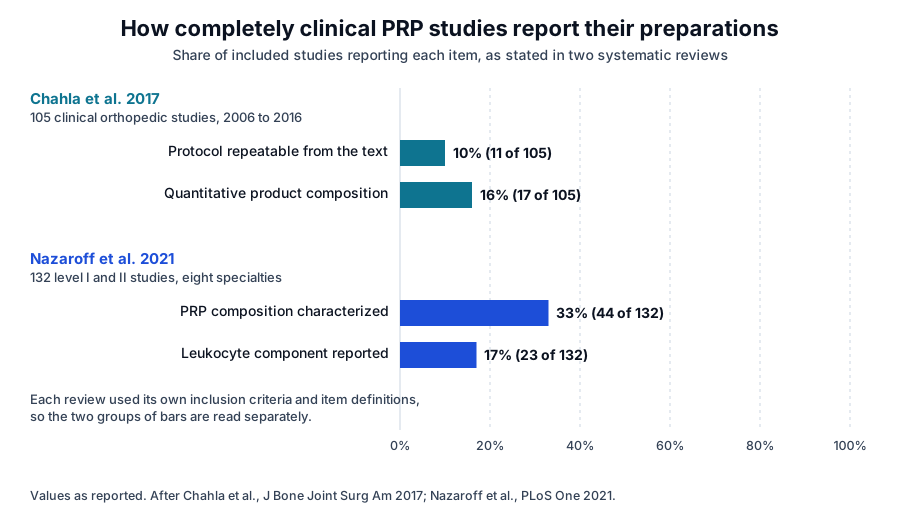
Nazaroff and colleagues widened the lens to 132 level I and II studies across eight medical specialties. Of these, 44 (33%) characterized the composition of the PRP used and 23 (17%) reported its leukocyte component.[2]
Tey and colleagues, reviewing 13 recent articles under the PRISMA protocol, found differences in how PRP was produced and in how far it was characterized.[9] Fadadu and colleagues compiled data on 33 preparation systems and protocols from 13 studies, and platelet concentration correlated with both the volume of blood collected and the centrifugal force applied.[10]
Oudelaar and colleagues screened 1,079 studies and included 19. Platelet and leukocyte concentrations differed largely between separation systems and to a lesser extent within them, and growth factor levels varied both between and within systems.[11]
| Review | Material analyzed | Reported finding |
|---|---|---|
| Chahla et al. 2017 | 105 clinical orthopedic studies | 10% repeatable protocols; 16% quantitative composition |
| Nazaroff et al. 2021 | 132 level I and II studies, eight specialties | 33% characterized composition; 17% reported leukocytes |
| Fadadu et al. 2019 | 13 studies, 33 systems and protocols | Platelet concentration tracked blood volume and centrifugal force |
| Oudelaar et al. 2019 | 19 studies | Platelet, leukocyte and growth factor levels differed between systems |
| Tey et al. 2022 | 13 articles | Production methods and depth of characterization differed |
| Robinson et al. 2019 | 36 MSC studies | 52% of critical variables reported on average |
Cell-based preparations show the same reporting pattern
Robinson and colleagues applied the same approach to 36 clinical studies of MSC-based preparations. Studies reported on average 52% (range 30% to 80%) of the variables the authors judged critical, and none reported all of them.[12]
Classification systems give PRP preparations a shared vocabulary
Five published systems sort PRP preparations by the variables each considers essential, and each records a different subset (Fig. 2).[5][13][14][15][16] Read together, they show which measurements a report needs for its product to be placed in any of them.
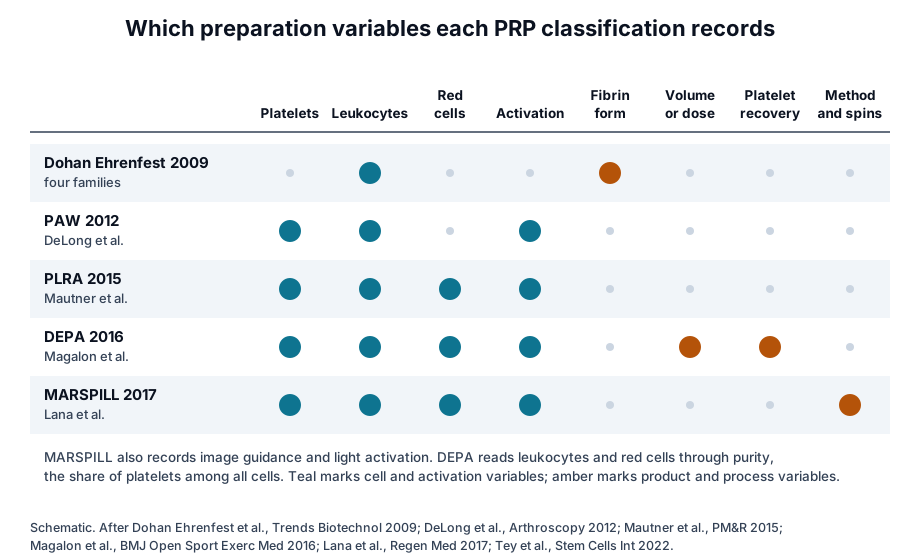
Dohan Ehrenfest and colleagues proposed four families in 2009: pure platelet-rich plasma (P-PRP), leukocyte- and platelet-rich plasma (L-PRP), pure platelet-rich fibrin (P-PRF) and leukocyte- and platelet-rich fibrin (L-PRF).[5] A 2012 expert panel kept these categories, defined by leukocyte content and fibrin architecture, and named the activated versions of the two liquid forms P-PRP gels and L-PRP gels.[17]
DeLong and colleagues built the PAW system on three components: the absolute number of platelets, the manner of platelet activation and the presence or absence of white cells.[13] Mautner and colleagues proposed a nomenclature built on platelet concentration, white cell number, red cell presence and activation status, and recommended minimal standards for PRP reporting.[14]
Tey and colleagues summarize the Mautner system as PLRA, for platelets, leukocytes, red blood cells and activation.[9] Lana and colleagues proposed MARSPILL, which adds harvest method, number of spins, image guidance and light activation to platelets, leukocytes, red cells and activation.[9][16]
DEPA scores dose, efficiency, purity and activation
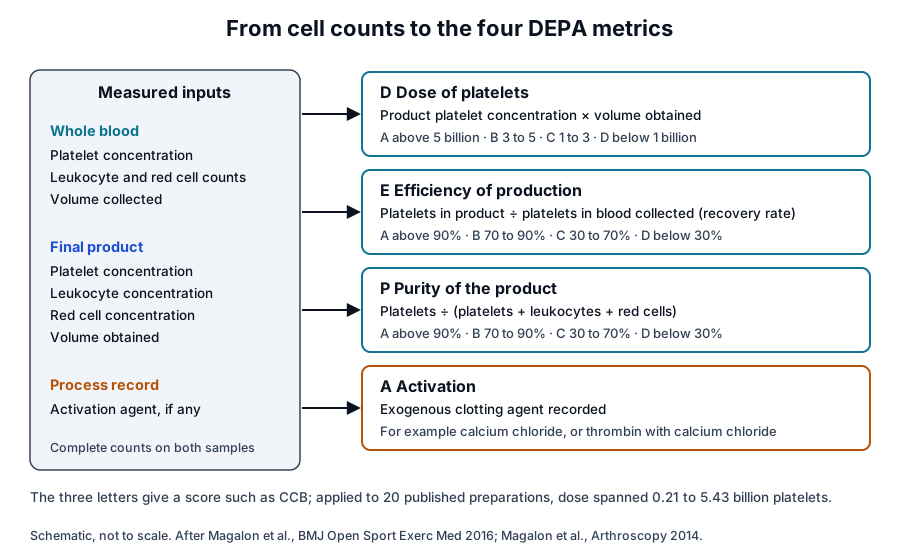
Magalon and colleagues drew the DEPA classification from standards used for cellular products. Dose is platelet concentration multiplied by the volume obtained, efficiency is the percentage of blood platelets recovered in the product, and purity is platelets as a share of platelets, leukocytes and red cells (Fig. 3).[15]
Activation, the fourth letter, records any exogenous clotting agent, such as calcium chloride alone or thrombin with calcium chloride. The calculations need complete cell counts for both whole blood and PRP, together with the collected blood volume and the final PRP volume.[15]
Applied to 20 published preparations, platelet dose ranged from 0.21 to 5.43 billion, a 25-fold spread, and no method recovered more than 90% of blood platelets. Three preparations reached the top purity grade, with platelets above 90% of the cells present.[15]
The MIBO checklist sets minimum information for biologics studies
Murray and colleagues developed Minimum Information for Studies Evaluating Biologics in Orthopaedics (MIBO) with Delphi consensus methods. Expert groups of 24 for PRP and for MSCs were surveyed in three rounds, and 23 experts (96%) in each group completed all three.[3]
For PRP, the working group drew 93 candidate items from the published literature and protocols. After three rounds, 58 items reached consensus, defined as more than 75% agreement and less than 5% disagreement, and were compiled into a 23-statement checklist.[3]
The parallel MSC exercise identified 103 items and reached consensus on 61, compiled into a 25-statement checklist.[3] Robinson and colleagues, writing from the same Edinburgh group, encouraged adoption of these emerging minimum reporting standards for MSC studies.[12]
ISTH guidance frames platelet preparations as products to characterize and control
The Platelet Physiology Subcommittee of the ISTH Scientific and Standardization Committee formed an expert working party to write consensus guidance on platelet preparations. Its abstract states that “the preparation, content and characteristics of platelet preparations are generally poorly defined and controlled.”[4]
With too few definitive studies for evidence-based guidelines, the panel used the RAND method, in which each expert scored 45 statements as appropriate, uncertain or inappropriate. The statements covered general aspects, platelet preparations, study design and potential uses, and the report proposes a new classification system.[4]
Harrison and colleagues presented the assessments at SSC meetings and refined them after public discussion into final consensus recommendations.[4] The working party’s collaborators included authors of the Dohan Ehrenfest and DEPA systems, which links the classification threads.[4][5][15]
Laboratory characterization supplies the numbers a methods section reports
Magalon and colleagues characterized five preparations from ten donors in a single-donor design. They recorded volumes and platelet, white cell and red cell concentrations, measured platelet activation by flow cytometry and quantified VEGF, PDGF-AB, EGF and TGF-beta1 by ELISA.[18]
From these counts they calculated platelet capture efficiency, relative composition, increase factors over whole blood, and platelet and growth factor doses. Platelet dose correlated positively with every growth factor measured, and white cell dose with VEGF and EGF.[18]
The centrifugation protocols in that study showed no difference in the percentage of activated platelets.[18] Castillo and colleagues counted platelets, white cells, red cells and fibrinogen on automated clinical laboratory analyzers and measured PDGF, TGF-beta1 and VEGF by ELISA.[8]
Reference methods anchor platelet counts
Platelet counts in whole blood and product are the base of every derived metric. The ICSH and ISLH reference method counts antibody-labeled platelets relative to red cells on a flow cytometer and combines that ratio with an impedance red cell count.[19]
The method specifies fresh EDTA-anticoagulated venous blood measured within 4 h of the draw, with at least 50,000 events and 1,000 platelet events counted.[19] Stating the counting platform and the interval from draw to count lets a reader judge how comparable two sets of counts are.
Building a complete PRP methods section from the published checklists
The reviews and classification systems converge on a short set of items (Fig. 4). Chahla and colleagues called for a detailed, precise and stepwise description of the preparation protocol so that studies can be compared and reproduced.[1]
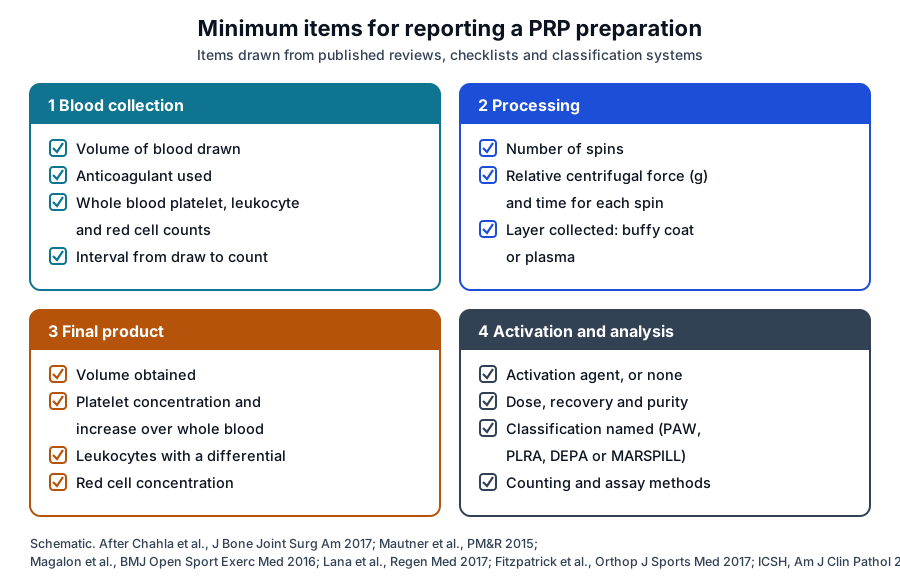
- Blood collection: volume drawn and the anticoagulant used; citrate was linked to a small pH shift in one product analysis.[7][15]
- Baseline counts: whole blood platelet, leukocyte and red cell concentrations, on which every increase factor and recovery rate depends.[15][18]
- Processing: number of spins, relative centrifugal force and time for each spin, and whether the buffy coat or the plasma layer was collected.[7][10][16]
- Product composition: final volume, platelet concentration, leukocytes with a differential, and red cells.[7][14][15]
- Derived metrics: platelet increase factor, recovery rate, dose and purity.[15][18]
- Activation: the agent used, such as calcium chloride or thrombin, or none.[13][15]
- Measurement methods: the counting platform and any growth factor assays.[8][19]
General reporting guidelines frame the PRP-specific items
CONSORT 2025 is a 30-item checklist with a participant flow diagram for reporting randomized trials, developed through a three-round Delphi survey of 317 participants and an expert consensus meeting. It adds a new section on open science.[20]
TIDieR, the Template for Intervention Description and Replication, is a 12-item checklist covering what materials and procedures were used, who provided them, how, where, when and how much, tailoring, modifications and how well the plan was followed. Its authors intended it to apply across all evaluative study designs.[21]
For applicable clinical trials registered at ClinicalTrials.gov, 42 CFR Part 11 lists intervention name, intervention description and intervention type among the registration data elements for each intervention studied.[22] The PRP-specific items above fill the intervention description that CONSORT, TIDieR and the registry each ask for.
Where to go from here
The PRP preparation variables reference explains each step these checklists record, from anticoagulant and spin force to leukocyte content and activation. The platelet granule biology and growth factor receptors references describe what platelets release and how cells read it, and the platelet-rich fibrin reference covers the fibrin matrix behind PRF.
The marrow and adipose composition reference applies the same reporting logic to cell counts and colony assays, and the MSC source tissues and secretome references extend it to stromal cells. The randomized controlled trials and systematic reviews references and our quality references support reading any study in depth, and our team is glad to discuss it.
Referencias comentadas
Numeradas en el orden en que se citan en el texto. Cada fuente lleva una nota sobre lo que respalda en esta página; los artículos revisados por pares se listan con revista, volumen, número y páginas, y las fuentes primarias son regulaciones, documentos de agencias y bases de datos de referencia.
- 1.Peer-reviewedChahla J, Cinque ME, Piuzzi NS, et al. A Call for Standardization in Platelet-Rich Plasma Preparation Protocols and Composition Reporting: A Systematic Review of the Clinical Orthopaedic Literature. Journal of Bone and Joint Surgery. American Volume. 2017. https://pubmed.ncbi.nlm.nih.gov/29040132/Annotation: Systematic review of 105 clinical PRP studies from 2006 to 2016. Cited for the 10% with repeatable protocols, the 16% with quantitative composition and the call for stepwise protocol description.
- 2.Peer-reviewedNazaroff J, Oyadomari S, Brown N, et al. Reporting in clinical studies on platelet-rich plasma therapy among all medical specialties: A systematic review of Level I and II studies. PLoS One. 2021. https://pubmed.ncbi.nlm.nih.gov/33891618/Annotation: Systematic review of 132 level I and II PRP studies across eight specialties. Cited only for its reporting findings: 33% characterized composition and 17% reported the leukocyte component.
- 3.Peer-reviewedMurray IR, Geeslin AG, Goudie EB, et al. Minimum Information for Studies Evaluating Biologics in Orthopaedics (MIBO): Platelet-Rich Plasma and Mesenchymal Stem Cells. Journal of Bone and Joint Surgery. American Volume. 2017. https://pubmed.ncbi.nlm.nih.gov/28509821/Annotation: Delphi consensus on minimum reporting for PRP and MSC studies. Cited for the 93 candidate items, 58 consensus items and 23-statement PRP checklist, and the 25-statement MSC checklist.
- 4.Peer-reviewedHarrison P, Subcommittee on Platelet Physiology. The use of platelets in regenerative medicine and proposal for a new classification system: guidance from the SSC of the ISTH. Journal of Thrombosis and Haemostasis. 2018. https://pubmed.ncbi.nlm.nih.gov/30099839/Annotation: ISTH SSC consensus guidance on platelet preparations. Cited for the RAND method, the 45 scored statements, the proposed classification and the working party membership.
- 5.Peer-reviewedDohan Ehrenfest DM, Rasmusson L, Albrektsson T. Classification of platelet concentrates: from pure platelet-rich plasma (P-PRP) to leucocyte- and platelet-rich fibrin (L-PRF). Trends in Biotechnology. 2009. https://pubmed.ncbi.nlm.nih.gov/19187989/Annotation: Landmark classification of platelet concentrates into P-PRP, L-PRP, P-PRF and L-PRF by leukocyte and fibrin content. Cited for the four families and for each method yielding a distinct product.
- 6.Peer-reviewedMazzocca AD, McCarthy MB, Chowaniec DM, et al. Platelet-rich plasma differs according to preparation method and human variability. Journal of Bone and Joint Surgery. American Volume. 2012. https://pubmed.ncbi.nlm.nih.gov/22336969/Annotation: Laboratory comparison of single-spin and double-spin PRP from eight donors. Cited for composition differences between methods and wide intra-individual variation across three blood draws.
- 7.Peer-reviewedFitzpatrick J, Bulsara MK, McCrory PR, et al. Analysis of Platelet-Rich Plasma Extraction: Variations in Platelet and Blood Components Between 4 Common Commercial Kits. Orthopaedic Journal of Sports Medicine. 2017. https://pubmed.ncbi.nlm.nih.gov/28210651/Annotation: Controlled laboratory study of four separation methods with blood from three donors. Cited for buffy coat versus plasma-based platelet and white cell levels, the citrate-related pH drop and glucose levels.
- 8.Peer-reviewedCastillo TN, Pouliot MA, Kim HJ, et al. Comparison of growth factor and platelet concentration from commercial platelet-rich plasma separation systems. American Journal of Sports Medicine. 2011. https://pubmed.ncbi.nlm.nih.gov/21051428/Annotation: Controlled laboratory study of three separation methods with blood from five donors. Cited for automated counts and ELISA, and for leukocyte-rich and leukocyte-poor composition differences.
- 9.Peer-reviewedTey RV, Haldankar P, Joshi VR, et al. Variability in Platelet-Rich Plasma Preparations Used in Regenerative Medicine: A Comparative Analysis. Stem Cells International. 2022. https://pubmed.ncbi.nlm.nih.gov/36311042/Annotation: PRISMA review of 13 articles on PRP preparation. Cited for differences in production and characterization, and for its summary of the PLRA and MARSPILL letters.
- 10.Peer-reviewedFadadu PP, Mazzola AJ, Hunter CW, et al. Review of concentration yields in commercially available platelet-rich plasma (PRP) systems: a call for PRP standardization. Regional Anesthesia and Pain Medicine. 2019. https://pubmed.ncbi.nlm.nih.gov/30992411/Annotation: Systematic review compiling 33 PRP systems and protocols from 13 studies. Cited for the correlation of platelet concentration with blood volume collected and centrifugal force.
- 11.Peer-reviewedOudelaar BW, Peerbooms JC, Huis In 't Veld R, et al. Concentrations of Blood Components in Commercial Platelet-Rich Plasma Separation Systems: A Review of the Literature. American Journal of Sports Medicine. 2019. https://pubmed.ncbi.nlm.nih.gov/29337592/Annotation: Systematic review of 19 studies on PRP composition. Cited for platelet, leukocyte and growth factor differences between and within separation systems.
- 12.Peer-reviewedRobinson PG, Murray IR, West CC, et al. Reporting of Mesenchymal Stem Cell Preparation Protocols and Composition: A Systematic Review of the Clinical Orthopaedic Literature. American Journal of Sports Medicine. 2019. https://pubmed.ncbi.nlm.nih.gov/29554460/Annotation: Systematic review of reporting in 36 clinical MSC studies. Cited for the 52% average (30% to 80%) of critical variables reported and the call to adopt minimum reporting standards.
- 13.Peer-reviewedDeLong JM, Russell RP, Mazzocca AD. Platelet-rich plasma: the PAW classification system. Arthroscopy. 2012. https://pubmed.ncbi.nlm.nih.gov/22738751/Annotation: Proposal of the PAW classification. Cited for its three components: absolute platelet number, manner of activation and presence or absence of white cells.
- 14.Peer-reviewedMautner K, Malanga GA, Smith J, et al. A call for a standard classification system for future biologic research: the rationale for new PRP nomenclature. PM&R. 2015. https://pubmed.ncbi.nlm.nih.gov/25864661/Annotation: Proposal of a PRP nomenclature (PLRA). Cited for classification by platelet concentration, white cells, red cells and activation, delivered volume, and minimal reporting standards.
- 15.Peer-reviewedMagalon J, Chateau AL, Bertrand B, et al. DEPA classification: a proposal for standardising PRP use and a retrospective application of available devices. BMJ Open Sport & Exercise Medicine. 2016. https://pubmed.ncbi.nlm.nih.gov/27900152/Annotation: Proposal of the DEPA classification applied to 20 published preparations. Cited for the dose, efficiency, purity and activation definitions, grade bands and calculation inputs.
- 16.Peer-reviewedLana JFSD, Purita J, Paulus C, et al. Contributions for classification of platelet rich plasma - proposal of a new classification: MARSPILL. Regenerative Medicine. 2017. https://pubmed.ncbi.nlm.nih.gov/28758836/Annotation: Proposal of the MARSPILL classification. Cited for its variables: harvest method, activation, red cells, number of spins, image guidance, leukocytes and light activation.
- 17.Peer-reviewedDohan Ehrenfest DM, Bielecki T, Mishra A, et al. In search of a consensus terminology in the field of platelet concentrates for surgical use: platelet-rich plasma (PRP), platelet-rich fibrin (PRF), fibrin gel polymerization and leukocytes. Current Pharmaceutical Biotechnology. 2012. https://pubmed.ncbi.nlm.nih.gov/21740379/Annotation: Expert panel terminology for platelet concentrates. Cited for the four categories defined by leukocyte content and fibrin architecture and the P-PRP gel and L-PRP gel terms.
- 18.Peer-reviewedMagalon J, Bausset O, Serratrice N, et al. Characterization and comparison of 5 platelet-rich plasma preparations in a single-donor model. Arthroscopy. 2014. https://pubmed.ncbi.nlm.nih.gov/24725317/Annotation: Single-donor characterization of five PRP preparations from ten donors. Cited for counts, flow cytometry of activation, growth factor ELISA, derived metrics and dose correlations.
- 19.Peer-reviewedInternational Council for Standardization in Haematology Expert Panel on Cytometry, International Society of Laboratory Hematology Task Force on Platelet Counting. Platelet counting by the RBC/platelet ratio method. A reference method. American Journal of Clinical Pathology. 2001. https://pubmed.ncbi.nlm.nih.gov/11246942/Annotation: ICSH and ISLH reference method for platelet counting. Cited for flow cytometric counting of labeled platelets against red cells, specimen handling and event counts.
- 20.Peer-reviewedHopewell S, Chan AW, Collins GS, et al. CONSORT 2025 statement: updated guideline for reporting randomised trials. BMJ. 2025. https://pubmed.ncbi.nlm.nih.gov/40228833/Annotation: Updated CONSORT reporting guideline. Cited for the 30-item checklist, flow diagram, Delphi development with 317 participants and the new open science section.
- 21.Peer-reviewedHoffmann TC, Glasziou PP, Boutron I, et al. Better reporting of interventions: template for intervention description and replication (TIDieR) checklist and guide. BMJ. 2014. https://pubmed.ncbi.nlm.nih.gov/24609605/Annotation: TIDieR checklist and guide. Cited for the 12 items of intervention description and its intended use across all evaluative study designs.
- 22.Regulatory42 CFR Part 11, Clinical Trials Registration and Results Information Submission (eCFR). Accessed 21 October 2026. https://www.ecfr.gov/current/title-42/chapter-I/subchapter-A/part-11
Cite this page
ExaVeyra Sciences Editorial Team. How Platelet Studies Report Methods: PRP Reporting Standards. ExaVeyra Sciences; 21 October 2026. Available from: https://exaveyra.com/science/platelet-biology/platelet-study-reporting. Accessed [date accessed].