MOTS-c is a 16-amino-acid peptide encoded in the 12S rRNA gene of mitochondrial DNA. Mouse studies report effects on insulin resistance, diet-induced weight gain and physical capacity, and exercise raises its levels in human muscle and blood. MOTS-c is not FDA-approved; an HHS interim policy announced on 28 October 2026 covers 503A compounding of MOTS-c acetate by subcutaneous or intramuscular injection.
Regulatory Status
MOTS-c is not an FDA-approved drug. The HHS policy is an interim statement of enforcement discretion for 503A pharmacies that meet its conditions, and it does not add MOTS-c to the 503A bulks list. MOTS-c is prohibited at all times in sport under the World Anti-Doping Agency list. ExaVeyra Sciences works with a state-licensed 503A pharmacy partner that compounds against patient-specific prescriptions and releases its formulary after NPI verification. ExaVeyra does not prescribe and makes no efficacy claim for any preparation.
Practitioners usually ask four things about MOTS-c: where it comes from, what the animal studies show, whether it has been tested in people, and how it can lawfully be obtained. The sections below take those questions in order and end with a route-by-route table.
MOTS-c Is Encoded in the Mitochondrial 12S rRNA Gene
Lee and colleagues reported in Cell Metabolism in 2015 a short open reading frame within the mitochondrial 12S rRNA gene that encodes a 16-amino-acid peptide, which they named MOTS-c, for mitochondrial open reading frame of the 12S rRNA-c [1]. At the time, humanin was the only other signaling peptide known to be encoded in mitochondrial DNA, so the finding extended a small class now called mitochondrial-derived peptides [1].
The sequence is MRWQEMGYIFYPRKLR, translated from a 51-base-pair open reading frame within the human 12S rRNA [1, 14]. Kim and colleagues identified residues 8 to 11, YIFY, as a hydrophobic core needed for the peptide to enter the nucleus [2], and Zempo and colleagues studied a naturally occurring change at position 14, where lysine is replaced by glutamine [5].
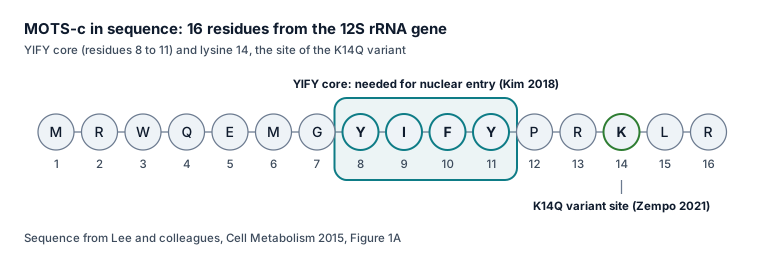
The diagram marks the four-residue core and the variant site discussed in this article. Both features come from the studies cited in this section.
Mouse Studies Report Effects on Insulin Resistance and Diet-Induced Weight Gain
In the 2015 study, MOTS-c treatment in mice prevented age-dependent and high-fat-diet-induced insulin resistance as well as diet-induced obesity, and the authors traced the effect to skeletal muscle and the folate-purine-AMPK pathway [1]. AMPK is the cell’s main energy sensor, and the proposed mechanism runs through an accumulation of an internal AMPK activator when the folate cycle is inhibited [1].
Kim and colleagues reported in Cell Metabolism in 2018 that MOTS-c moves from the cytoplasm into the nucleus under metabolic stress in an AMPK-dependent manner, binds to chromatin and regulates nuclear genes, including genes with antioxidant response elements, and interacts with the transcription factor NRF2 [2]. The finding placed MOTS-c among a small number of molecules through which mitochondria signal back to the nucleus [2].
Exercise Raises MOTS-c in Human Muscle and Blood
Reynolds and colleagues reported in Nature Communications in 2021 that endogenous MOTS-c rose 11.9-fold in skeletal muscle and about 1.5-fold in plasma in sedentary young men after a session on a stationary bicycle [3]. Muscle levels stayed elevated after a 4-hour rest, while plasma levels returned toward baseline [3]. These are measurements of the body’s own peptide, and they show that exercise turns MOTS-c expression up in people; they say nothing directly about injected MOTS-c.
Age appears to move the two compartments in opposite directions. D’Souza and colleagues measured MOTS-c in healthy young, middle-aged and older men and found circulating levels 11 and 21 percent lower in the middle-aged and older groups, while muscle levels were about 1.5-fold higher in the older groups than in the young [4]. The authors linked the muscle increase to the shift toward slow-type muscle fibers that comes with age [4].
Late-Life Dosing in Mice Improved Physical Capacity
In the same 2021 paper, the authors reported that systemic MOTS-c treatment roughly doubled treadmill performance in young, middle-aged and old mice, and old mice treated for two weeks ran about twice as long and 2.16-fold farther than untreated old mice [3]. In the study, intermittent treatment three times a week, started at 23.5 months of age, improved physical capacity and showed a trend toward longer lifespan without reaching a definite lifespan effect [3].
The authors’ conclusion was that aging is regulated in part by genes in the mitochondrial genome [3]. For a practice, the relevant point is the species gap. Every dosing result above comes from mice, and the human data in the same paper are observational measurements of the body’s own MOTS-c.
A Genetic Variant Links MOTS-c Activity to Diabetes Risk in Japanese Men
Zempo and colleagues studied an East Asian mitochondrial DNA variant, m.1382A>C, which changes lysine 14 of MOTS-c to glutamine (K14Q) [5]. Across Japanese cohorts, carriers of the variant had a higher risk of type 2 diabetes among men, particularly sedentary men, with no effect seen in women [5]. In male mice on a high-fat diet, standard MOTS-c reduced weight and improved glucose tolerance while the K14Q form did not, and in cell models the variant blunted insulin-stimulated signaling [5].
The study offers human genetic evidence that MOTS-c’s sequence matters for metabolic health, and it also shows that a one-residue change can remove the activity seen with the standard peptide. That has a practical corollary for identity testing, since a certificate of analysis should confirm the full sequence of the material supplied.
An Analog, CB4211, Completed an Early Human Study
No published randomized trial has tested native MOTS-c in people. The closest clinical data come from CB4211, an analog of MOTS-c developed by CohBar for nonalcoholic steatohepatitis and obesity [6]. CohBar reported in August 2021 that its phase 1a/1b study enrolled 65 healthy adults in a dose-finding stage and then 20 obese adults with nonalcoholic fatty liver disease, who received 25 mg of CB4211 or placebo by daily subcutaneous injection for four weeks [6]. The company reported that the drug was well tolerated with no serious adverse events, that the only adverse events in more than 10 percent of treated subjects were mostly mild injection-site reactions, and that ALT, AST and glucose fell compared with placebo [6, 7]. The trial is registered as NCT03998514 [8].
Those results come from a sponsor press release and a conference presentation for a modified molecule, and they cannot be transferred to native MOTS-c. As of November 2026, the published record for MOTS-c itself consists of cell studies, mouse studies and human observational data, and FDA’s briefing for the July 2026 committee meeting highlighted the lack of clinical data on efficacy and safety [9].
Educational Disclaimer: This article is for educational purposes only and does not constitute medical or legal advice. It does not identify any material, compound, device setting or protocol as safe, effective or appropriate for any patient, and it is not intended to diagnose, treat, cure, or prevent any disease. Questions about a treatment belong with the reader’s own licensed provider. Exosome material is supplied for topical aesthetic use by licensed practitioners. No exosome product is FDA-approved for any use, and ExaVeyra Sciences makes no statement about administration, route, or outcome. Compounded medications are not FDA-approved. They are prepared by a 503A compounding pharmacy licensed by the Texas State Board of Pharmacy for an individual patient against that patient’s prescription, and are available to NPI-verified licensed practitioners only, in the states where the pharmacy is licensed. Product, device and brand names mentioned are trademarks of their respective owners and are used only to identify the products discussed. Their mention is not an endorsement, and those owners have not reviewed or endorsed this article. ExaVeyra Sciences is a supplier and takes no part in any diagnosis, treatment decision, or plan of care. Findings described are attributed to the peer-reviewed literature, trial registries and agencies cited. The content of these guides is provided for general informational purposes only. It does not constitute legal, medical, or regulatory advice, and does not establish that any particular product or practice is compliant. Regulatory requirements vary by state and depend on the circumstances of each practice. Each practitioner should consult their own legal counsel and the applicable state licensing boards before acting on anything stated here.
References
- 1.Lee C, Zeng J, Drew BG, Sallam T, Martin-Montalvo A, Wan J, Kim SJ, Mehta H, Hevener AL, de Cabo R, Cohen P. The mitochondrial-derived peptide MOTS-c promotes metabolic homeostasis and reduces obesity and insulin resistance. Cell Metab. 2015;21(3):443-454. PMID 25738459. doi:10.1016/j.cmet.2015.02.009Discovery paper with cell and mouse studies. Carries in this article: the 12S rRNA open reading frame, the MRWQEMGYIFYPRKLR sequence shown in Figure 1A, the insulin resistance and obesity findings, and the folate-AMPK mechanism.
- 2.Kim KH, Son JM, Benayoun BA, Lee C. The mitochondrial-encoded peptide MOTS-c translocates to the nucleus to regulate nuclear gene expression in response to metabolic stress. Cell Metab. 2018;28(3):516-524.e7. PMID 29983246. doi:10.1016/j.cmet.2018.06.008Cell study. Carries in this article: AMPK-dependent nuclear translocation, the YIFY core, and the NRF2 interaction.
- 3.Reynolds JC, Lai RW, Woodhead JST, Joly JH, Mitchell CJ, Cameron-Smith D, Lu R, Cohen P, Graham NA, Benayoun BA, Merry TL, Lee C. MOTS-c is an exercise-induced mitochondrial-encoded regulator of age-dependent physical decline and muscle homeostasis. Nat Commun. 2021;12:470. PMID 33473109. doi:10.1038/s41467-020-20790-0Mouse dosing study with human exercise measurements. Carries in this article: the 11.9-fold muscle and 1.5-fold plasma rise with exercise, treadmill results across ages, and late-life intermittent dosing.
- 4.D’Souza RF, Woodhead JST, Hedges CP, Zeng N, Wan J, Kumagai H, Lee C, Cohen P, Cameron-Smith D, Mitchell CJ, Merry TL. Increased expression of the mitochondrial derived peptide, MOTS-c, in skeletal muscle of healthy aging men is associated with myofiber composition. Aging (Albany NY). 2020;12(6):5244-5258. PMID 32182209. doi:10.18632/aging.102944Human cross-sectional study. Carries in this article: lower plasma and higher muscle MOTS-c with age.
- 5.Zempo H, Kim SJ, Fuku N, and colleagues. A pro-diabetogenic mtDNA polymorphism in the mitochondrial-derived peptide, MOTS-c. Aging (Albany NY). 2021;13(2):1692-1717. PMID 33468709. doi:10.18632/aging.202529Human genetic association study with mouse and cell work. Carries in this article: the m.1382A>C variant, K14Q, diabetes risk in Japanese men, and the mouse and cell comparisons.
- 6.CohBar, Inc. CohBar Announces Positive Topline Results from the Phase 1a/1b Study of CB4211 Under Development for NASH and Obesity. Press release dated 10 August 2021, filed with the U.S. Securities and Exchange Commission as Exhibit 99.2 to Form 8-K. https://www.sec.gov/Archives/edgar/data/1522602/000121390021041377/ea145151ex99-2_cohbar.htmCompany SEC filing, read on sec.gov 15 Nov 2026. Carries in this article: CB4211 as a MOTS-c analog, the 65 healthy adults in phase 1a and 20 obese adults with NAFLD in phase 1b, the 25 mg once-daily subcutaneous regimen for four weeks, tolerability, no serious adverse events, injection-site reactions as the only adverse events in more than 10 percent, and the ALT, AST and glucose results. Disclosure: sponsor-reported data.
- 7.CohBar, Inc. Annual Report on Form 10-K for the fiscal year ended 31 December 2021, filed 29 March 2022 with the U.S. Securities and Exchange Commission. https://www.sec.gov/Archives/edgar/data/1522602/000121390022015833/f10k2021_cohbarinc.htmCompany SEC filing, read on sec.gov 15 Nov 2026. Carries in this article: the reductions in ALT, AST and glucose compared with placebo after four weeks, and the presentation of the data at the AASLD 2021 Liver Meeting. Disclosure: sponsor-reported data.
- 8.CohBar, Inc. A Phase 1a/1b Study of CB4211 in Healthy Non-obese Subjects and Subjects With Nonalcoholic Fatty Liver Disease. ClinicalTrials.gov NCT03998514. Status completed; last update posted 11 May 2021. https://clinicaltrials.gov/study/NCT03998514Trial registry. Carries in this article: the trial registration and its randomized, double-blind, placebo-controlled design with subcutaneous dosing.
- 9.U.S. Food and Drug Administration. FDA Briefing Document for MOTS-c-Related Bulk Drug Substances (MOTS-c (free base) and MOTS-c acetate). Pharmacy Compounding Advisory Committee meeting, 23 to 24 July 2026. https://www.fda.gov/media/193347/downloadPrimary source, agency briefing document, read 15 Nov 2026. Carries in this article: FDA’s statement that it identified no clinical studies or human exposure data for MOTS-c and its concern about the lack of human data on efficacy and safety.
- 10.World Anti-Doping Agency. The Prohibited List, section S4, Hormone and Metabolic Modulators, read 14 November 2026. https://www.wada-ama.org/en/prohibited-listStandards body. Carries in this article: MOTS-c named under S4.4.1 as an AMPK activator, the all-times prohibition, and the non-Specified status of S4.4.
- 11.U.S. Department of Health and Human Services. Enforcement Discretion Policy Regarding 503A Compounding Using Certain Peptide Bulk Drug Substances, Appendices A and B. October 2026. https://www.hhs.gov/sites/default/files/hhs-503a-peptide-enforcement-discretion-policy-appendix-b.pdfPrimary source, read in full on hhs.gov 15 Nov 2026. Carries in this article: MOTS-c acetate, the injectable routes, the certificate, single active ingredient, prescription, adverse event reporting and labeling conditions, the committee vote in favor of both forms against CDER’s recommendation, the CB4211 safety reasoning, and the stated expectation about research-use-only peptides.
- 12.U.S. Department of Health and Human Services. Enforcement Discretion Policy Regarding 503A Compounding Using Certain Peptide Bulk Drug Substances; notice of availability. Fed Regist. 2026;91(209):68526-68527. FR Doc. 2026-22192. Docket HHS-OASH-2026-0496. https://www.federalregister.gov/documents/2026/10/30/2026-22192/enforcement-discretion-policy-regarding-503a-compounding-using-certain-peptide-bulk-drug-substancesPrimary source, read in full 15 Nov 2026. Carries in this article: the 28 October 2026 filing date, the publication date, the draft, non-binding status, and the statement that future FDA rulemaking may propose adding the peptides to the 503A bulks list.
- 13.U.S. Food and Drug Administration. July 23-24, 2026: Meeting of the Pharmacy Compounding Advisory Committee. Meeting page and materials. https://www.fda.gov/advisory-committees/advisory-committee-calendar/july-23-24-2026-meeting-pharmacy-compounding-advisory-committee-07232026Primary source, agency meeting page, read 15 Nov 2026. Carries in this article: the 23 July 2026 review of MOTS-c and the uses FDA evaluated, obesity and osteoporosis.
- 14.Mohtashami Z, Singh MK, Salimiaghdam N, Ozgul M, Kenney MC. MOTS-c, the Most Recent Mitochondrial Derived Peptide in Human Aging and Age-Related Diseases. Int J Mol Sci. 2022;23(19):11991. PMID 36233287. doi:10.3390/ijms231911991Narrative review. Carries in this article: the 51-base-pair open reading frame and the MRWQEMGYIFYPRKLR sequence.
Image credits
- Fig. 1ExaVeyra Sciences, original figure. ↩