KPV is a tripeptide made of lysine, proline and valine, the last three amino acids of alpha-melanocyte-stimulating hormone. Laboratory and mouse studies describe anti-inflammatory activity in the gut and skin. KPV is not FDA-approved; an HHS interim policy announced on 28 October 2026 covers 503A compounding of KPV acetate for topical and oral use.
Regulatory Status
KPV is not an FDA-approved drug. The HHS policy is an interim statement of enforcement discretion for 503A pharmacies that meet its conditions, and it does not add KPV to the 503A bulks list. ExaVeyra Sciences works with a state-licensed 503A pharmacy partner that compounds against patient-specific prescriptions and releases its formulary after NPI verification. ExaVeyra does not prescribe and makes no efficacy claim for any preparation.
Practitioners usually ask four things about KPV: what it is, what the evidence consists of, whether it has been studied in people, and how it can lawfully be obtained. The sections below take those questions in order and end with a route-by-route table.
KPV Is the C-Terminal Tripeptide of Alpha-MSH
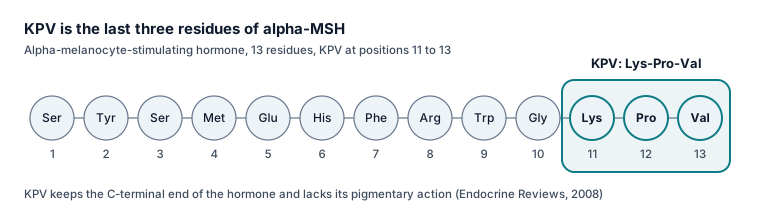
KPV sits at the C-terminal end of the 13-residue hormone. The sections below follow the research on this fragment on its own.
Alpha-melanocyte-stimulating hormone is a 13-residue peptide derived from proopiomelanocortin, and Brzoska and colleagues reviewed its anti-inflammatory and protective effects in Endocrine Reviews in 2008 [1]. The authors noted that the hormone’s pigmentary action limits its use in inflammatory disorders, and they described its C-terminal tripeptide, KPV, as an alternative that keeps the anti-inflammatory effect without the pigmentary action [1].
KPV stands for the one-letter codes of its three amino acids: lysine (K), proline (P) and valine (V), which occupy positions 11 to 13 of the parent hormone [3]. Appendix B of the HHS policy identifies KPV acetate as H-Lys-Pro-Val-OH with acetate, molecular formula C16H30N4O4·CH3COOH and molecular weight 402.5 g/mol, which corresponds to about 342 Da for the free tripeptide [10]. That makes it far smaller than most compounded peptides and small enough to use the gut’s own di- and tripeptide transporter.
The PepT1 Transporter Carries KPV Into Intestinal and Immune Cells in Laboratory Models
Dalmasso and colleagues reported in Gastroenterology in 2008 that KPV acts through PepT1, a transporter expressed in intestinal epithelial and immune cells [2]. The group worked with human intestinal epithelial cell lines and a human T-cell line stimulated with pro-inflammatory cytokines, and concluded that KPV is transported into cells by PepT1 [2].
The finding matters because PepT1 expression changes with disease. The same paper notes that the transporter is not expressed in normal colonic epithelium and appears in chronically inflamed colon [2], and a later study from the group described it as upregulated in inflammatory bowel disease [4]. The proposed mechanism is therefore one in which the tissue of interest is also the tissue that takes the peptide up.
Two Independent Mouse Colitis Studies Reported Lower Inflammatory Activity
In the Dalmasso study, oral KPV reduced the incidence of colitis induced by two chemical agents, DSS and TNBS, with a decrease in pro-inflammatory cytokine expression [2]. Kannengiesser and colleagues, working separately in Münster, tested KPV in DSS colitis and in a T-cell transfer model of colitis in the same year, and reported earlier recovery, stronger regain of body weight, reduced inflammatory infiltrates on histology and lower myeloperoxidase activity in treated animals [3]. The authors also observed that the effects appeared at least partly independent of the melanocortin-1 receptor [3].
Later work from the Merlin laboratory extended the model. Viennois and colleagues reported in 2016 that KPV reduced tumor development in a mouse model of colitis-associated cancer [4], and Xiao and colleagues reported in 2017 that KPV loaded into hyaluronic acid-functionalized nanoparticles reached colonic epithelial cells and macrophages after oral dosing in a mouse model of ulcerative colitis [5]. An earlier study by Laroui and colleagues encapsulated KPV-loaded nanoparticles in an alginate and chitosan hydrogel and reported similar efficacy in mouse colitis at a KPV concentration about 12,000-fold lower than in free solution [6]. These are animal findings from specialized formulations, and they describe a research direction more than a clinical result.
Studies Disagree on Whether KPV Acts Through Melanocortin Receptors
Getting and colleagues compared KPV with other melanocortin peptides in a mouse model of crystal-induced peritonitis in 2003. KPV reduced inflammation, including in mice with a nonfunctional melanocortin-1 receptor, its effect was not blocked by an MC3 and MC4 receptor antagonist, and it did not raise cAMP in macrophages, which led the authors to conclude that KPV is unlikely to act through melanocortin receptors and more likely acts by inhibiting interleukin-1 beta functions [16]. A 2003 review by Luger and colleagues described KPV as able to bind the melanocortin-1 receptor and to modulate antigen-presenting cells [13], and Kannengiesser’s colitis data sit between the two positions [3].
The PepT1 route described above offers one receptor-independent explanation, since the transporter carries the tripeptide into the cell. For a practice, the useful conclusion is that KPV’s receptor profile has not been settled and should not be assumed to match that of full-length melanocortin drugs.
Skin Data Come From Cell Models, and Passage Through Intact Skin Is the Open Question
Moustafa and colleagues reported in the Journal of Investigative Dermatology in 2002 that KPV, its D-valine variant and full-length alpha-MSH each inhibited TNF-alpha-stimulated NF-kappaB activation in HaCaT keratinocytes, which placed the tripeptide within skin-cell biology [7]. In a mouse model of contact hypersensitivity, Luger and colleagues described both systemic and topical application of alpha-MSH or KPV as inhibiting the sensitization and elicitation phases and inducing hapten-specific tolerance [13]. The Endocrine Reviews article also lists contact dermatitis among the animal models in which the parent hormone has shown anti-inflammatory activity [1].
Delivery is the practical limit for a topical preparation. Pawar and colleagues reported in 2017 that KPV did not cross dermatomed human skin in detectable amounts by passive diffusion, and that permeation became measurable only after microneedle treatment, rising further with iontophoresis [8]. A practice considering a topical KPV preparation can reasonably ask its pharmacy which vehicle is used and what permeation data support it.
Human Evidence Sits With the Parent Hormone Family, and KPV Trials Are the Next Step
The strongest human data in this family belong to afamelanotide, a synthetic analog of the full 13-residue alpha-MSH sequence [1]. Langendonk and colleagues reported two multicenter, randomized, double-blind, placebo-controlled trials in erythropoietic protoporphyria in The New England Journal of Medicine in 2015, with 74 patients randomized in the European Union trial and 94 in the United States trial, and the authors described the adverse-event profile as acceptable [9]. FDA later approved afamelanotide as a subcutaneous implant for adults with the condition [17]. Those trials show that melanocortin biology can be carried through to an approved medicine, and they concern a different molecule, a different route and a different condition from KPV.
For KPV itself, the published record as of November 2026 consists of the cell and animal studies above. FDA’s briefing document for the July 2026 advisory committee meeting states that FDA identified no clinical studies or human exposure data for KPV by any route of administration [14], and Appendix B of the HHS policy describes CDER’s safety conclusion as reflecting an absence of information rather than an observed signal [10]. The mechanism is specific enough to test, which is the usual precondition for a first clinical study.
Educational Disclaimer: This article is for educational purposes only and does not constitute medical or legal advice. It does not identify any material, compound, device setting or protocol as safe, effective or appropriate for any patient, and it is not intended to diagnose, treat, cure, or prevent any disease. Questions about a treatment belong with the reader’s own licensed provider. Exosome material is supplied for topical aesthetic use by licensed practitioners. No exosome product is FDA-approved for any use, and ExaVeyra Sciences makes no statement about administration, route, or outcome. Compounded medications are not FDA-approved. They are prepared by a 503A compounding pharmacy licensed by the Texas State Board of Pharmacy for an individual patient against that patient’s prescription, and are available to NPI-verified licensed practitioners only, in the states where the pharmacy is licensed. Product, device and brand names mentioned are trademarks of their respective owners and are used only to identify the products discussed. Their mention is not an endorsement, and those owners have not reviewed or endorsed this article. ExaVeyra Sciences is a supplier and takes no part in any diagnosis, treatment decision, or plan of care. Findings described are attributed to the peer-reviewed literature, trial registries and agencies cited. The content of these guides is provided for general informational purposes only. It does not constitute legal, medical, or regulatory advice, and does not establish that any particular product or practice is compliant. Regulatory requirements vary by state and depend on the circumstances of each practice. Each practitioner should consult their own legal counsel and the applicable state licensing boards before acting on anything stated here.
References
- 1.Brzoska T, Luger TA, Maaser C, Abels C, Böhm M. Alpha-melanocyte-stimulating hormone and related tripeptides: biochemistry, antiinflammatory and protective effects in vitro and in vivo, and future perspectives for the treatment of immune-mediated inflammatory diseases. Endocr Rev. 2008;29(5):581-602. PMID 18612139. doi:10.1210/er.2007-0027Narrative review. Carries in this article: alpha-MSH as a 13-residue peptide, its anti-inflammatory record, and KPV as the tripeptide without pigmentary action. Disclosure: one author held an industry affiliation.
- 2.Dalmasso G, Charrier-Hisamuddin L, Nguyen HTT, Yan Y, Sitaraman S, Merlin D. PepT1-mediated tripeptide KPV uptake reduces intestinal inflammation. Gastroenterology. 2008;134(1):166-178. PMID 18061177. doi:10.1053/j.gastro.2007.10.026Cell and mouse study. Carries in this article: PepT1 transport, the cell lines used, PepT1 expression in inflamed colon, and the DSS and TNBS colitis results.
- 3.Kannengiesser K, Maaser C, Heidemann J, Luegering A, Ross M, Brzoska T, Bohm M, Luger TA, Domschke W, Kucharzik T. Melanocortin-derived tripeptide KPV has anti-inflammatory potential in murine models of inflammatory bowel disease. Inflamm Bowel Dis. 2008;14(3):324-331. PMID 18092346. doi:10.1002/ibd.20334Mouse study. Carries in this article: KPV as alpha-MSH(11-13), the two colitis models, histology and myeloperoxidase findings, and the melanocortin-1 receptor observation.
- 4.Viennois E, Ingersoll SA, Ayyadurai S, Zhao Y, Wang L, Zhang M, Han MK, Garg P, Xiao B, Merlin D. Critical role of PepT1 in promoting colitis-associated cancer and therapeutic benefits of the anti-inflammatory PepT1-mediated tripeptide KPV in a murine model. Cell Mol Gastroenterol Hepatol. 2016;2(3):340-357. PMID 27458604. doi:10.1016/j.jcmgh.2016.01.006Mouse study. Carries in this article: PepT1 upregulation in inflammatory bowel disease and the tumor-model finding.
- 5.Xiao B, Xu Z, Viennois E, Zhang Y, Zhang Z, Zhang M, Han MK, Kang Y, Merlin D. Orally Targeted Delivery of Tripeptide KPV via Hyaluronic Acid-Functionalized Nanoparticles Efficiently Alleviates Ulcerative Colitis. Mol Ther. 2017;25(7):1628-1640. PMID 28143741. doi:10.1016/j.ymthe.2016.11.020Mouse delivery study. Carries in this article: nanoparticle delivery to colonic epithelial cells and macrophages in a mouse model.
- 6.Laroui H, Dalmasso G, Nguyen HTT, Yan Y, Sitaraman SV, Merlin D. Drug-loaded nanoparticles targeted to the colon with polysaccharide hydrogel reduce colitis in a mouse model. Gastroenterology. 2010;138(3):843-853. PMID 19909746. doi:10.1053/j.gastro.2009.11.003Mouse delivery study. Carries in this article: the alginate and chitosan hydrogel delivery study and the 12,000-fold concentration comparison.
- 7.Moustafa M, Szabo M, Ghanem GE, Morandini R, Kemp EH, MacNeil S, Haycock JW. Inhibition of tumor necrosis factor-alpha stimulated NFkappaB/p65 in human keratinocytes by alpha-melanocyte stimulating hormone and adrenocorticotropic hormone peptides. J Invest Dermatol. 2002;119(6):1244-1253. PMID 12485424. doi:10.1046/j.1523-1747.2002.19602.xCell study. Carries in this article: KPV inhibition of NF-kappaB activation in HaCaT keratinocytes.
- 8.Pawar K, Kolli CS, Rangari VK, Babu RJ. Transdermal Iontophoretic Delivery of Lysine-Proline-Valine (KPV) Peptide Across Microporated Human Skin. J Pharm Sci. 2017;106(7):1814-1820. PMID 28343991. doi:10.1016/j.xphs.2017.03.017Laboratory permeation study in dermatomed human skin. Carries in this article: KPV permeation below the detection limit by passive diffusion, and measurable permeation after microneedle poration, increased further by iontophoresis.
- 9.Langendonk JG, Balwani M, Anderson KE, and colleagues. Afamelanotide for Erythropoietic Protoporphyria. N Engl J Med. 2015;373(1):48-59. PMID 26132941. doi:10.1056/NEJMoa1411481Two randomized controlled trials. Carries in this article: two randomized trials of an alpha-MSH analog, 74 and 94 patients randomized, and the reported safety profile. Disclosure: industry-sponsored trials.
- 10.U.S. Department of Health and Human Services. Enforcement Discretion Policy Regarding 503A Compounding Using Certain Peptide Bulk Drug Substances, Appendices A and B. October 2026. https://www.hhs.gov/sites/default/files/hhs-503a-peptide-enforcement-discretion-policy-appendix-b.pdfPrimary source, read in full on hhs.gov 15 Nov 2026. Carries in this article: KPV acetate, the topical and oral routes, the certificate of analysis, bioavailability and single-ingredient conditions, the conditions on a single active ingredient, prescription, adverse event reporting and labeling, the committee vote in favor of inclusion against CDER’s recommendation, CDER’s safety conclusion as an absence of information, and the stated expectation about research-use-only peptides.
- 11.Regulations.gov. Docket HHS-OASH-2026-0496, Enforcement Discretion Policy Regarding 503A Compounding Using Certain Peptide Bulk Drug Substances. Notice HHS-OASH-2026-0496-0002, posted 30 October 2026, comment period ending 13 November 2026 at 11:59 p.m. Eastern. https://www.regulations.gov/docket/HHS-OASH-2026-0496Docket record, read 15 Nov 2026 through the regulations.gov API. Carries in this article: the close of public comment on 13 November 2026.
- 12.U.S. Department of Health and Human Services. Enforcement Discretion Policy Regarding 503A Compounding Using Certain Peptide Bulk Drug Substances; notice of availability. Fed Regist. 2026;91(209):68526-68527. FR Doc. 2026-22192. Docket HHS-OASH-2026-0496. https://www.federalregister.gov/documents/2026/10/30/2026-22192/enforcement-discretion-policy-regarding-503a-compounding-using-certain-peptide-bulk-drug-substancesPrimary source, read in full 15 Nov 2026. Carries in this article: the 28 October 2026 filing date, the publication date, the draft and non-binding status, the two-week comment window, and the statement that future FDA rulemaking may propose adding the peptides to the 503A bulks list.
- 13.Luger TA, Scholzen TE, Brzoska T, Böhm M. New insights into the functions of alpha-MSH and related peptides in the immune system. Ann N Y Acad Sci. 2003;994:133-140. PMID 12851308. doi:10.1111/j.1749-6632.2003.tb03172.xNarrative review. Carries in this article: KPV binding to the melanocortin-1 receptor and the mouse contact hypersensitivity findings.
- 14.U.S. Food and Drug Administration. FDA Briefing Document for KPV-Related Bulk Drug Substances (KPV (free base) and KPV acetate). Pharmacy Compounding Advisory Committee meeting, 23 to 24 July 2026. https://www.fda.gov/media/193346/downloadPrimary source, agency briefing document, read 15 Nov 2026. Carries in this article: FDA’s statement that it identified no clinical studies or human exposure data for KPV by any route of administration.
- 15.U.S. Food and Drug Administration. July 23-24, 2026: Meeting of the Pharmacy Compounding Advisory Committee. Meeting page and materials. https://www.fda.gov/advisory-committees/advisory-committee-calendar/july-23-24-2026-meeting-pharmacy-compounding-advisory-committee-07232026Primary source, agency meeting page, read 15 Nov 2026. Carries in this article: the 23 July 2026 review of KPV and the uses FDA evaluated, wound healing and inflammatory conditions.
- 16.Getting SJ, Schiöth HB, Perretti M. Dissection of the anti-inflammatory effect of the core and C-terminal (KPV) alpha-melanocyte-stimulating hormone peptides. J Pharmacol Exp Ther. 2003;306(2):631-637. doi:10.1124/jpet.103.051623Mouse study. Carries in this article: the peritonitis model, the receptor-antagonist and cAMP findings, and the authors’ interleukin-1 beta conclusion.
- 17.U.S. Food and Drug Administration. Drugs@FDA, New Drug Application 210797, SCENESSE (afamelanotide), Clivunel Inc. https://www.accessdata.fda.gov/scripts/cder/daf/index.cfm?event=overview.process&ApplNo=210797Primary source. Carries in this article: FDA approval of afamelanotide.
Image credits
- Fig. 1ExaVeyra Sciences, original figure. ↩