Epitalon, also spelled Epithalon, is a four-amino-acid peptide, Ala-Glu-Asp-Gly. Cell studies report that it increases telomerase activity and telomere length, and a 2025 independent study reproduced telomere extension in human cell lines. Epitalon is not FDA-approved; an HHS interim policy announced on 28 October 2026 covers 503A compounding of Epitalon acetate by injection, dispensed in intermittent courses.
Regulatory Status
Epitalon is not an FDA-approved drug. The HHS policy is an interim statement of enforcement discretion for 503A pharmacies that meet its conditions, and it does not add Epitalon to the 503A bulks list. ExaVeyra Sciences works with a state-licensed 503A pharmacy partner that compounds against patient-specific prescriptions and releases its formulary after NPI verification. ExaVeyra does not prescribe and makes no efficacy claim for any preparation.
Practitioners usually ask four things about Epitalon: what it is, whether the telomere findings have been reproduced, what the human data consist of, and how it can lawfully be obtained. The sections below take those questions in order and end with a route-by-route table.
Epitalon Is a Four-Residue Peptide, Distinct From the Pineal Extract Epithalamin
Epitalon has the sequence alanine, glutamic acid, aspartic acid and glycine, written Ala-Glu-Asp-Gly or AEDG [2, 5]. The names Epitalon and Epithalon refer to the same sequence, and the spelling varies with transliteration [3]. The material used in the published animal work was made synthetically; the 2003 mouse study reports that its Epitalon was synthesized at the St. Petersburg Institute of Bioregulation and Gerontology at 99.8 percent purity [5].
Both main sources trace Epitalon to the same parent preparation. The 2025 Biogerontology paper calls Epitalon a naturally occurring tetrapeptide first identified in a pineal gland extract and based on the polypeptide preparation epithalamin [3], and FDA’s briefing document for the July 2026 advisory committee meeting describes epithalamin as a polypeptide complex extracted from the pineal gland and Epitalon as a synthetic peptide that may be the putative active component of the bovine extract [9]. The distinction matters for reading the evidence. FDA treats Epitalon and epithalamin as different substances, so results reported for the extract do not transfer automatically to the single synthetic tetrapeptide [9].
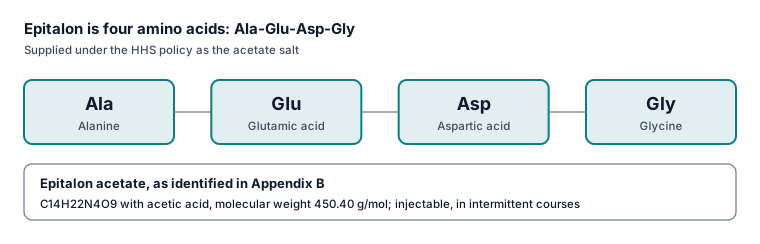
The diagram shows the single synthetic tetrapeptide covered by the HHS policy. Epithalamin, the pineal extract, is a mixture and cannot be drawn this way.
Early Cell Studies Reported Telomerase Activation in Human Fibroblasts
Khavinson, Bondarev and Butyugov reported in the Bulletin of Experimental Biology and Medicine in 2003 that adding Epitalon to telomerase-negative human fetal fibroblasts induced expression of the telomerase catalytic subunit, telomerase enzyme activity and telomere elongation [1]. A follow-up study from the same group in 2004 used fetal lung fibroblasts that stopped dividing at the 34th passage, and reported that Epitalon-treated cells lengthened their telomeres to early-passage size and made 10 extra divisions, reaching 44 passages and continuing [2].
Those studies established the claim that Epitalon can push normal human cells past their usual division limit. Both came from the group that developed the peptide, and both were short reports in a single journal.
A 2025 Independent Study Reproduced Telomere Extension in Cell Lines
Al-dulaimi and colleagues at Brunel University London reported in Biogerontology in September 2025 a study of Epitalon in two breast cancer cell lines (21NT and BT474) and two normal lines, IBR.3 fibroblasts and human mammary epithelial cells [3]. In the normal cells, the authors reported that treatment at 1 microgram per milliliter for three weeks extended telomere length in a dose-dependent manner through increased hTERT mRNA expression and telomerase activity [3]. In the cancer cells, telomere extension also occurred, but through alternative lengthening of telomeres (ALT), a telomerase-independent pathway, and ALT activity was not seen in the normal cells [3].
The authors concluded that Epitalon can extend telomere length in normal human cells through telomerase upregulation [3]. A correction published in November 2025 replaced figures on telomere length and ALT activity, and the conclusions should be read from the corrected version [4]. The cancer-cell finding is relevant to safety review, since a molecule that lengthens telomeres in cancer lines by any route warrants caution in patients with a history of malignancy.
Mouse Lifespan Studies Came From One Research Program
Anisimov and colleagues reported in Biogerontology in 2003 a study in which 54 female SHR mice per group received 1 microgram of Epitalon, about 30 to 40 micrograms per kilogram, by subcutaneous injection on five consecutive days each month from 3 months of age until death [5]. Epitalon did not change food intake, body weight or mean lifespan, but slowed the age-related loss of estrous function, reduced chromosome aberrations in bone marrow cells by 17.1 percent, increased the lifespan of the last 10 percent of survivors by 13.3 percent and maximum lifespan by 12.3 percent, and reduced leukemia 6-fold without changing total tumor incidence [5].
The study gave Epitalon in five-day courses at monthly intervals rather than continuously, a pattern similar in form to the intermittent-course condition in the HHS policy. The mean lifespan result was neutral, and the gains were confined to the longest-lived animals.
Human Cohort Reports Used the Pineal Extract and Come From the Same Program
The longest human studies used epithalamin rather than synthetic Epitalon. Korkushko and colleagues reported a 12-year randomized study in older patients with coronary disease and accelerated cardiovascular aging, in which long-term epithalamin treatment was associated with half the cardiovascular mortality of the control group [6]. The same report states that after 12 years the number of deaths in the epithalamin group was 28 percent lower than in the control group [6]. A 2011 report from the same group reported on 39 treated and 40 control patients followed for 15 years [7]. Khavinson and Morozov reported in 2003 on 266 older adults followed for six to eight years after courses of thymic and pineal peptide preparations, with lower mortality in the treated groups [8].
FDA’s briefing document notes that most pharmacological studies of Epitalon were published by the developer’s research group, and FDA concluded that there are no clinical data to support the safety of Epitalon in humans [9]. The cohorts were small, came from a single research network, and used an extract rather than the tetrapeptide covered by the HHS policy, so they describe the parent preparation’s record more than Epitalon’s.
Educational Disclaimer: This article is for educational purposes only and does not constitute medical or legal advice. It does not identify any material, compound, device setting or protocol as safe, effective or appropriate for any patient, and it is not intended to diagnose, treat, cure, or prevent any disease. Questions about a treatment belong with the reader’s own licensed provider. Exosome material is supplied for topical aesthetic use by licensed practitioners. No exosome product is FDA-approved for any use, and ExaVeyra Sciences makes no statement about administration, route, or outcome. Compounded medications are not FDA-approved. They are prepared by a 503A compounding pharmacy licensed by the Texas State Board of Pharmacy for an individual patient against that patient’s prescription, and are available to NPI-verified licensed practitioners only, in the states where the pharmacy is licensed. Product, device and brand names mentioned are trademarks of their respective owners and are used only to identify the products discussed. Their mention is not an endorsement, and those owners have not reviewed or endorsed this article. ExaVeyra Sciences is a supplier and takes no part in any diagnosis, treatment decision, or plan of care. Findings described are attributed to the peer-reviewed literature, trial registries and agencies cited. The content of these guides is provided for general informational purposes only. It does not constitute legal, medical, or regulatory advice, and does not establish that any particular product or practice is compliant. Regulatory requirements vary by state and depend on the circumstances of each practice. Each practitioner should consult their own legal counsel and the applicable state licensing boards before acting on anything stated here.
References
- 1.Khavinson VKh, Bondarev IE, Butyugov AA. Epithalon peptide induces telomerase activity and telomere elongation in human somatic cells. Bull Exp Biol Med. 2003;135(6):590-592. doi:10.1023/A:1025493705728Cell study. Carries in this article: telomerase subunit expression, enzyme activity and telomere elongation in human fetal fibroblasts. Disclosure: authored by the group that developed the peptide.
- 2.Khavinson VKh, Bondarev IE, Butyugov AA, Smirnova TD. Peptide promotes overcoming of the division limit in human somatic cell. Bull Exp Biol Med. 2004;137(5):503-506. doi:10.1023/B:BEBM.0000038164.49947.8cCell study. Carries in this article: the Ala-Glu-Asp-Gly sequence, and 10 extra divisions past passage 34. Disclosure: authored by the group that developed the peptide.
- 3.Al-dulaimi S, Thomas R, Matta S, Roberts T. Epitalon increases telomere length in human cell lines through telomerase upregulation or ALT activity. Biogerontology. 2025;26(5):178. PMID 40908429. doi:10.1007/s10522-025-10315-xIndependent cell-line study. Carries in this article: the cell lines, dose and duration, telomerase-driven extension in normal cells, ALT in cancer cells, and the naturally occurring description.
- 4.Al-dulaimi S, Thomas R, Matta S, Roberts T. Correction: Epitalon increases telomere length in human cell lines through telomerase upregulation or ALT activity. Biogerontology. 2025. PMC12619744. doi:10.1007/s10522-025-10326-8Published correction. Carries in this article: the November 2025 correction to the telomere length and ALT figures.
- 5.Anisimov VN, Khavinson VKh, Popovich IG, Zabezhinski MA, Alimova IN, Rosenfeld SV, Zavarzina NY, Semenchenko AV, Yashin AI. Effect of Epitalon on biomarkers of aging, life span and spontaneous tumor incidence in female Swiss-derived SHR mice. Biogerontology. 2003;4(4):193-202. PMID 14501183. doi:10.1023/a:1025114230714Mouse lifespan study. Carries in this article: the dosing schedule, the lifespan, chromosome aberration and leukemia results, and the synthesis and purity of the material. Disclosure: co-authored by the group that developed the peptide.
- 6.Korkushko OV, Khavinson VKh, Shatilo VB, and colleagues. Geroprotective effect of epithalamine (pineal gland peptide preparation) in elderly subjects with accelerated aging. Bull Exp Biol Med. 2006;142(3):356-359. PMID 17426848. doi:10.1007/s10517-006-0365-zClinical cohort report. Carries in this article: the 12-year study, the halved cardiovascular mortality, and the 28 percent fewer deaths in the epithalamin group after 12 years, as stated in the PubMed abstract. Disclosure: co-authored by the group that developed the preparation.
- 7.Korkushko OV, Khavinson VKh, Shatilo VB, and colleagues. Peptide geroprotector from the pituitary gland inhibits rapid aging of elderly people: results of 15-year follow-up. Bull Exp Biol Med. 2011;151(3):366-369. PMID 22451889. doi:10.1007/s10517-011-1332-xClinical cohort report. Carries in this article: the 15-year follow-up reported for 39 treated and 40 control patients. The title says "pituitary" as published; the study concerns the pineal preparation epithalamin. Disclosure: co-authored by the group that developed the preparation.
- 8.Khavinson VKh, Morozov VG. Peptides of pineal gland and thymus prolong human life. Neuro Endocrinol Lett. 2003;24(3-4):233. PMID 14523363Clinical cohort report, checked against its PubMed abstract only. Carries in this article: 266 older adults followed for six to eight years after thymic and pineal peptide courses. Disclosure: authored by the group that developed the preparations.
- 9.U.S. Food and Drug Administration. FDA Briefing Document for Epitalon-Related Bulk Drug Substances (Epitalon (free base) and Epitalon acetate). Pharmacy Compounding Advisory Committee meeting, 23 to 24 July 2026. https://www.fda.gov/media/193345/downloadPrimary source, agency briefing document, read 15 Nov 2026. Carries in this article: epithalamin as a polypeptide complex extracted from the pineal gland, Epitalon as a synthetic peptide that may be the putative active component of the bovine extract, FDA’s position that the two are different substances, the concentration of the pharmacological literature in the developer’s research group, and FDA’s conclusion that no clinical data support Epitalon’s safety in humans.
- 10.U.S. Department of Health and Human Services. Enforcement Discretion Policy Regarding 503A Compounding Using Certain Peptide Bulk Drug Substances, Appendices A and B. October 2026. https://www.hhs.gov/sites/default/files/hhs-503a-peptide-enforcement-discretion-policy-appendix-b.pdfPrimary source, read in full on hhs.gov 15 Nov 2026. Carries in this article: Epitalon acetate, the injectable routes, the intermittent-course condition, the certificate, single active ingredient, prescription, adverse event reporting and labeling conditions, the committee vote in favor of inclusion against CDER’s recommendation, and the stated expectation about research-use-only peptides.
- 11.U.S. Department of Health and Human Services. Enforcement Discretion Policy Regarding 503A Compounding Using Certain Peptide Bulk Drug Substances; notice of availability. Fed Regist. 2026;91(209):68526-68527. FR Doc. 2026-22192. Docket HHS-OASH-2026-0496. https://www.federalregister.gov/documents/2026/10/30/2026-22192/enforcement-discretion-policy-regarding-503a-compounding-using-certain-peptide-bulk-drug-substancesPrimary source, read in full 15 Nov 2026. Carries in this article: the 28 October 2026 filing date, the publication date, the draft, non-binding status, and the statement that future FDA rulemaking may propose adding the peptides to the 503A bulks list.
- 12.U.S. Food and Drug Administration. July 23-24, 2026: Meeting of the Pharmacy Compounding Advisory Committee. Meeting page and materials. https://www.fda.gov/advisory-committees/advisory-committee-calendar/july-23-24-2026-meeting-pharmacy-compounding-advisory-committee-07232026Primary source, agency meeting page, read 15 Nov 2026. Carries in this article: the 24 July 2026 review of Epitalon and insomnia as the use FDA evaluated.
- 13.Electronic Code of Federal Regulations. 21 CFR 216.23, Bulk drug substances that can be used to compound drug products in accordance with section 503A of the Federal Food, Drug, and Cosmetic Act. Read 15 November 2026. https://www.ecfr.gov/current/title-21/section-216.23Primary source, regulation. Carries in this article: the codified 503A bulks list, which names no peptide.
Image credits
- Fig. 1ExaVeyra Sciences, original figure. ↩