Peptides are short chains of amino acids joined by amide bonds. FDA classifies chains of 40 amino acids or fewer as peptides and longer chains as proteins. Peptides are a different chemical class from steroids, and their safety record depends on the specific molecule, its purity and its route.
Regulatory Status
Approved peptide drugs carry FDA-reviewed labels. Compounded peptide preparations are not FDA-approved, and the HHS policy on six peptides is an interim statement of enforcement discretion with stated conditions. ExaVeyra Sciences works with a state-licensed 503A pharmacy partner that compounds against patient-specific prescriptions, releases its formulary after NPI verification, and takes no part in the prescribing decision.
Readers usually arrive with three questions, and the sections follow that order: what a peptide is, whether peptides are steroids, and whether they are safe. The article then sets out how peptides reach a practice, how sport rules handle them, and where each named peptide stands.
A Peptide Is a Short Chain of Amino Acids, and FDA Draws the Line With Proteins at 40 Residues
A peptide is built from amino acids linked head to tail by amide bonds, the same bond that holds proteins together. The difference between a peptide and a protein is one of length, and FDA fixed that boundary in a final rule published on 21 February 2020, which defines a protein as an alpha amino acid polymer with a specific, defined sequence that is greater than 40 amino acids in size [2]. Chains at or below that size are regulated as drugs, while longer chains are regulated as biological products.
The rule also explains how FDA counts. Insulin has two chains that total 51 amino acids, FDA counts the amino acids across associated chains, and insulin therefore moved to the biological product framework when the rule took effect on 23 March 2020 [2]. The peptides most often discussed in clinics are far smaller, from the three residues of KPV to the 16 of MOTS-c [7, 12].
Muttenthaler and colleagues reviewed the field in 2021 and counted more than 80 peptide drugs that had reached the market since insulin was introduced about a century earlier, across diabetes, cancer, osteoporosis, multiple sclerosis, HIV infection and chronic pain [1].
Peptides and Steroids Belong to Different Chemical Classes and Different Legal Categories
Steroids are lipids built on a fused four-ring carbon skeleton, and anabolic steroids are the subset related to testosterone. Peptides are chains of amino acids without that ring system, and the body breaks them down into their component amino acids.
The legal definitions track the chemistry. The Controlled Substances Act defines an anabolic steroid as a drug or hormonal substance that is chemically and pharmacologically related to testosterone, other than estrogens, progestins, corticosteroids and dehydroepiandrosterone [3]. DEA has described the test as four criteria and has stated that a substance meeting them is listed in schedule III [4]. A peptide does not meet the first criterion, chemical relation to testosterone, so the anabolic steroid definition does not reach it.
The confusion has an understandable source, since both classes appear in conversations about recovery and body composition, and both include substances restricted in sport. The two are regulated on separate tracks, and the rest of this article concerns only the peptide track.
Approved Peptide Drugs Show What a Completed Evidence Package Looks Like
Semaglutide is a peptide analog of glucagon-like peptide-1, and its STEP 1 trial illustrates the scale behind an approved label. Wilding and colleagues randomized 1,961 adults to once-weekly semaglutide or placebo for 68 weeks alongside lifestyle intervention and reported a mean change in body weight of -14.9 percent with semaglutide and -2.4 percent with placebo [5].
Afamelanotide, an analog of alpha-melanocyte-stimulating hormone, shows the same path in a rare disease. Langendonk and colleagues reported two multicenter, randomized, double-blind, placebo-controlled trials of a subcutaneous implant in erythropoietic protoporphyria, with 74 and 94 patients randomized in the European Union and United States trials, longer pain-free sun exposure in the treated groups and an adverse-event profile the authors described as acceptable [6]. FDA later approved the implant for adults with the condition [19], and the example matters for the peptide cluster because KPV is a three-residue fragment of the same parent hormone [11].
Tesamorelin shows how the 40-residue boundary works in practice. The drug is built on the 44-amino-acid sequence of human growth hormone-releasing factor, which places it above the line, and it was first approved in 2010 [20]. Drugs@FDA now lists Egrifta, tesamorelin acetate from Theratechnologies, under biologics license application 022505 and notes that this former new drug application was deemed a biologics license application on 23 March 2020, the date the 40-residue definition took effect [2, 21]. Tesamorelin is given by subcutaneous injection, and the HHS testing standard describes injection as the standard route for peptides because of their low oral bioavailability, although oral forms of some peptide drugs now exist, such as semaglutide tablets approved in 2019 [7, 16, 20].
Safety Depends on the Specific Molecule, Its Purity and Its Route
A single safety verdict for all peptides is not possible, because the class runs from drugs with trials of thousands of participants to molecules studied mainly in cells and animals. Three factors decide what is known about any one of them.
- The molecule. STEP 1 reported nausea and diarrhea as the most common adverse events with semaglutide, typically transient and mild to moderate, and 4.5 percent of the semaglutide group stopped treatment for gastrointestinal events against 0.8 percent on placebo [5]. That level of detail exists because the trial was large and controlled.
- The evidence tier. For KPV, the published record is built on cell work and mouse colitis models [10, 11]. For MOTS-c, it includes mouse studies and human exercise data on the body’s own peptide [12]. For Epitalon, it includes cell-line studies, most recently in 2025 [13]. Human dosing studies for these molecules remain limited, and the HHS policy attaches conditions to their compounding.
- Purity and route. The HHS policy requires a bulk substance from an FDA-registered manufacturer with a valid certificate of analysis, limits each peptide to named routes, and requires documentation of adequate bioavailability for oral forms [7].
FDA had placed the six peptides in its Category 2 from September 2023 until 22 April 2026, a category for nominated substances with identified safety concerns [7, 8]. For KPV, Appendix B of the policy describes CDER’s safety conclusion as reflecting an absence of information rather than an observed signal [7]. The practical reading is that safety questions for these peptides are open questions, which a prescriber weighs for each patient with the pharmacy’s documentation in hand.
Peptides Reach a Practice Through Three Supply Categories
The same peptide name can describe three very different products, and the category determines the documentation behind the vial. The three categories, with what each one supplies, are set out below.
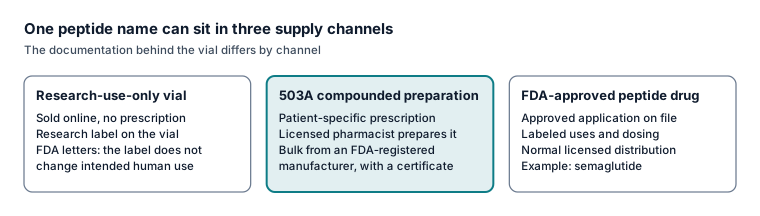
The middle channel is the one the HHS interim policy addresses for six named peptides. The table further down sets out where the most-searched peptides stand in each channel.
- FDA-approved peptide drugs. These are manufactured under an approved application and carry a label reviewed by FDA. Semaglutide and tesamorelin are examples.
- Compounded preparations from a 503A pharmacy. A state-licensed pharmacy prepares these for an individual patient on a prescription. They are not FDA-approved. For six peptides, BPC-157, Epitalon, KPV, MOTS-c, Semax and TB-500, HHS announced an interim policy on 28 October 2026, published in the Federal Register on 30 October, stating that it does not intend to take enforcement action when ten conditions are met, including a registered manufacturer, a valid certificate of analysis and the named routes of administration [7, 23]. The policy does not add these peptides to the 503A bulks list, and formal FDA rulemaking is still ahead [7, 23].
- Vials labeled research-use-only. These are sold online without a prescription. FDA sent seven warning letters to such sellers dated 31 March 2026, including MARCS-CMS 721806 to Gram Peptides, and five more dated 24 August 2026, including reference 733652 to NuScience Peptides, taking the position that a research-only label does not change a product’s status when the surrounding marketing describes use in people [14, 15].
The second category is the one a licensed practice works with, and it is the category the HHS policy addresses, so the documentation questions later in this article concentrate on it. HHS states in the policy that it expects the approach to discourage widespread use of research-use-only peptides [7].
Educational Disclaimer: This article is for educational purposes only and does not constitute medical or legal advice. It does not identify any material, compound, device setting or protocol as safe, effective or appropriate for any patient, and it is not intended to diagnose, treat, cure, or prevent any disease. Questions about a treatment belong with the reader’s own licensed provider. Exosome material is supplied for topical aesthetic use by licensed practitioners. No exosome product is FDA-approved for any use, and ExaVeyra Sciences makes no statement about administration, route, or outcome. Compounded medications are not FDA-approved. They are prepared by a 503A compounding pharmacy licensed by the Texas State Board of Pharmacy for an individual patient against that patient’s prescription, and are available to NPI-verified licensed practitioners only, in the states where the pharmacy is licensed. Product, device and brand names mentioned are trademarks of their respective owners and are used only to identify the products discussed. Their mention is not an endorsement, and those owners have not reviewed or endorsed this article. ExaVeyra Sciences is a supplier and takes no part in any diagnosis, treatment decision, or plan of care. Findings described are attributed to the peer-reviewed literature, trial registries and agencies cited. The content of these guides is provided for general informational purposes only. It does not constitute legal, medical, or regulatory advice, and does not establish that any particular product or practice is compliant. Regulatory requirements vary by state and depend on the circumstances of each practice. Each practitioner should consult their own legal counsel and the applicable state licensing boards before acting on anything stated here.
References
- 1.Muttenthaler M, King GF, Adams DJ, Alewood PF. Trends in peptide drug discovery. Nat Rev Drug Discov. 2021;20(4):309-325. PMID 33536635. doi:10.1038/s41573-020-00135-8Perspective review. Carries in this article: more than 80 marketed peptide drugs, the disease areas, and the century since insulin.
- 2.U.S. Food and Drug Administration. Definition of the Term “Biological Product”; final rule. Fed Regist. 2020;85(35):10057-10063. FR Doc. 2020-03505. https://www.federalregister.gov/d/2020-03505Primary source. Carries in this article: the 40 amino acid boundary, the 23 March 2020 effective date, and how insulin’s chains are counted.
- 3.Anabolic Steroid Control Act of 2004, Public Law 108-358, amending 21 U.S.C. 802(41)(A). https://www.congress.gov/108/plaws/publ358/PLAW-108publ358.htm; codified at https://uscode.house.gov/view.xhtml?req=granuleid:USC-prelim-title21-section802&num=0&edition=prelimPrimary source, statute. Carries in this article: the statutory definition of anabolic steroid.
- 4.Drug Enforcement Administration. Classification of Three Steroids as Schedule III Anabolic Steroids Under the Controlled Substances Act; final rule. Fed Regist. 4 December 2009. FR Doc. E9-28572. https://www.federalregister.gov/documents/2009/12/04/E9-28572/classification-of-three-steroids-as-schedule-iii-anabolic-steroids-under-the-controlled-substancesPrimary source. Carries in this article: the four-criterion test and schedule III listing.
- 5.Wilding JPH, Batterham RL, Calanna S, and colleagues; STEP 1 Study Group. Once-Weekly Semaglutide in Adults with Overweight or Obesity. N Engl J Med. 2021;384(11):989-1002. PMID 33567185. doi:10.1056/NEJMoa2032183. ClinicalTrials.gov NCT03548935Randomized controlled trial. Carries in this article: 1,961 participants, 68 weeks, weight change, adverse events and discontinuation rates. Disclosure: funded by the manufacturer.
- 6.Langendonk JG, Balwani M, Anderson KE, and colleagues. Afamelanotide for Erythropoietic Protoporphyria. N Engl J Med. 2015;373(1):48-59. PMID 26132941. doi:10.1056/NEJMoa1411481Two randomized controlled trials. Carries in this article: two randomized trials of an alpha-MSH analog with 74 and 94 patients randomized. Disclosure: industry-sponsored trials.
- 7.U.S. Department of Health and Human Services. Enforcement Discretion Policy Regarding 503A Compounding Using Certain Peptide Bulk Drug Substances, Appendices A and B. October 2026. https://www.hhs.gov/sites/default/files/hhs-503a-peptide-enforcement-discretion-policy-appendix-b.pdfPrimary source, read in full on hhs.gov 15 Nov 2026. Carries in this article: the six peptides, their routes, the ten conditions, the certificate of analysis contents and bioavailability conditions, the Category 2 dates, CDER’s safety conclusion for KPV, injection as the standard route because of low oral bioavailability, the testing standard, and the stated expectation about research-use-only peptides.
- 8.U.S. Food and Drug Administration. Certain Bulk Drug Substances for Use in Compounding that May Present Significant Safety Risks. Content current as of 22 April 2026. https://www.fda.gov/drugs/human-drug-compounding/certain-bulk-drug-substances-use-compounding-may-present-significant-safety-risksAgency web page, read 15 Nov 2026. Carries in this article: Category 2 as the interim-policy category for nominated substances that may present significant safety risks, and the withdrawn-nominations table in which the six peptides now sit.
- 9.U.S. Food and Drug Administration. Meeting of the Pharmacy Compounding Advisory Committee. Content current as of 15 April 2026. https://www.fda.gov/advisory-committees/pharmacy-compounding-advisory-committee/meeting-pharmacy-compounding-advisory-committeeAgency meeting page, read 15 Nov 2026. Carries in this article: the meeting due before the end of February 2027 on LL-37, GHK-Cu, Dihexa acetate, Melanotan II and PEG-MGF.
- 10.Dalmasso G, Charrier-Hisamuddin L, Nguyen HTT, Yan Y, Sitaraman S, Merlin D. PepT1-mediated tripeptide KPV uptake reduces intestinal inflammation. Gastroenterology. 2008;134(1):166-178. PMID 18061177Cell and mouse study. Carries in this article: the cell and mouse evidence tier for KPV.
- 11.Kannengiesser K, Maaser C, Heidemann J, and colleagues. Melanocortin-derived tripeptide KPV has anti-inflammatory potential in murine models of inflammatory bowel disease. Inflamm Bowel Dis. 2008;14(3):324-331. PMID 18092346. doi:10.1002/ibd.20334Mouse study. Carries in this article: KPV as alpha-MSH residues 11 to 13 and its mouse evidence.
- 12.Reynolds JC, Lai RW, Woodhead JST, and colleagues. MOTS-c is an exercise-induced mitochondrial-encoded regulator of age-dependent physical decline and muscle homeostasis. Nat Commun. 2021;12:470. PMID 33473109Mouse dosing study with human exercise measurements. Carries in this article: the mouse and human exercise evidence tier for MOTS-c.
- 13.Al-dulaimi S, Thomas R, Matta S, Roberts T. Epitalon increases telomere length in human cell lines through telomerase upregulation or ALT activity. Biogerontology. 2025;26(5):178. PMID 40908429. doi:10.1007/s10522-025-10315-xIndependent cell-line study. Carries in this article: the cell-line evidence tier for Epitalon.
- 14.U.S. Food and Drug Administration, CDER. Warning letter to Gram Peptides, MARCS-CMS 721806. 31 March 2026, one of seven letters of that date. https://www.fda.gov/inspections-compliance-enforcement-and-criminal-investigations/warning-letters/gram-peptides-721806-03312026Primary source. Carries in this article: FDA’s position on research-use-only labels.
- 15.U.S. Food and Drug Administration, CDER. Warning letter to NuScience Peptides, reference 733652, and four further letters dated 24 August 2026 (references 735127, 734884, 735063, 735067). https://www.fda.gov/inspections-compliance-enforcement-and-criminal-investigations/warning-letters/nuscience-peptides-llc-733652-08242026Primary source. Carries in this article: the second 2026 set.
- 16.U.S. Food and Drug Administration. Drugs@FDA, New Drug Application 213051, semaglutide tablets for oral use (RYBELSUS), Novo Nordisk; original approval 20 September 2019. https://www.accessdata.fda.gov/scripts/cder/daf/index.cfm?event=overview.process&ApplNo=213051Primary source, read 15 Nov 2026. Carries in this article: an approved oral form of a peptide drug.
- 17.U.S. Food and Drug Administration, CDER. Warning letter to GLP-1 Solution, MARCS-CMS 715883. 9 September 2025. https://www.fda.gov/inspections-compliance-enforcement-and-criminal-investigations/warning-letters/glp-1-solution-715883-09092025Primary source, read on fda.gov 15 Nov 2026. Carries in this article: FDA’s statement that drug products compounded using retatrutide are not eligible for the exemptions in section 503A or 503B.
- 18.World Anti-Doping Agency. The Prohibited List, sections S0 (non-approved substances, naming BPC-157) and S2 (peptide hormones, growth factors and related substances, naming tesamorelin, ipamorelin and TB-500), read 14 November 2026. https://www.wada-ama.org/en/prohibited-listStandards body. Carries in this article: BPC-157’s listing and the peptide hormone class.
- 19.U.S. Food and Drug Administration. Drugs@FDA, New Drug Application 210797, SCENESSE (afamelanotide), Clivunel Inc. https://www.accessdata.fda.gov/scripts/cder/daf/index.cfm?event=overview.process&ApplNo=210797Primary source. Carries in this article: FDA approval of afamelanotide.
- 20.Theratechnologies Inc. EGRIFTA SV (tesamorelin) for injection, for subcutaneous use. Prescribing information, revised March 2024; Initial U.S. Approval 2010. DailyMed set ID 3d783378-b02d-4f19-99dd-0fc91a042224. https://dailymed.nlm.nih.gov/dailymed/drugInfo.cfm?setid=3d783378-b02d-4f19-99dd-0fc91a042224Drug label, read on DailyMed (National Library of Medicine) 15 Nov 2026. Carries in this article: the 44-amino-acid sequence of human growth hormone-releasing factor, the subcutaneous route, and the 2010 initial approval.
- 21.U.S. Food and Drug Administration. Drugs@FDA, Biologics License Application 022505, EGRIFTA (tesamorelin acetate), Theratechnologies. https://www.accessdata.fda.gov/scripts/cder/daf/index.cfm?event=overview.process&ApplNo=022505Primary source. Carries in this article: application 022505 as a biologics license application and its transition from a new drug application on 23 March 2020.
- 22.Sikiric P, and colleagues. Stable Gastric Pentadecapeptide BPC 157 as a Therapy and Safety Key: A Special Beneficial Pleiotropic Effect Controlling and Modulating Angiogenesis and the NO-System. Pharmaceuticals (Basel). 2025;18(6):928. doi:10.3390/ph18060928. https://mdpi.com/1424-8247/18/6/928Narrative review, read on the publisher page. Carries in this article: the BPC-157 sequence and molecular weight. Disclosure: authored by the group that first described the peptide.
- 23.U.S. Department of Health and Human Services. Enforcement Discretion Policy Regarding 503A Compounding Using Certain Peptide Bulk Drug Substances; notice of availability. Fed Regist. 2026;91(209):68526-68527. FR Doc. 2026-22192. Docket HHS-OASH-2026-0496. https://www.federalregister.gov/documents/2026/10/30/2026-22192/enforcement-discretion-policy-regarding-503a-compounding-using-certain-peptide-bulk-drug-substancesPrimary source, read in full 15 Nov 2026. Carries in this article: the 28 October 2026 filing date, the publication date, the draft, non-binding status, and the statement that future FDA rulemaking may propose adding the peptides to the 503A bulks list.
Image credits
- Fig. 1ExaVeyra Sciences, original figure. ↩