A research-use-only peptide is sold without a prescription, a pharmacist or a state-licensed pharmacy, and the FDA treats it as an unapproved drug when the seller’s website shows it is meant for people. A 503A compounded peptide is prepared by a state-licensed pharmacy for a named patient on a prescription, and under the October 2026 HHS interim policy six peptides may be compounded when the bulk substance comes from an FDA-registered manufacturer with a valid certificate of analysis.
Regulatory Status
No peptide sold as “research use only” is approved for human use, and FDA has stated in its 2026 letters that a research label does not change a product’s status when the seller’s own materials show it is meant for people. Compounded preparations are not FDA-approved either; the HHS policy is an interim, non-binding statement of enforcement discretion for 503A pharmacies that meet its conditions. ExaVeyra Sciences works with a state-licensed 503A pharmacy partner that compounds against patient-specific prescriptions and releases its formulary after NPI verification. ExaVeyra does not prescribe and makes no efficacy claim for any preparation.
Practices that already use peptides tend to ask three things: whether a research-grade vial is legally different from a compounded one, what the 2026 letters actually cited, and how to judge the paperwork that comes with a product. The sections below take those questions in order and end with a side-by-side table and a document checklist.
FDA judges a product by its intended use, and a label disclaimer does not settle it
FDA’s regulation on intended use defines it as the objective intent of the people legally responsible for a product’s labeling, and states that this intent may be shown by labeling claims, advertising matter, or oral or written statements by those people or their representatives [1]. A seller’s description of what a product does and how to use it therefore carries weight alongside, and sometimes over, the words printed on the vial.
The 2026 letters apply that rule directly. In its letter to Gram Peptides, FDA noted that the products were labeled “Research Use Only” and “not intended for human consumption, medical use, or veterinary use,” and stated that evidence from the company’s website nonetheless established that they were intended to be drugs for human use [2]. The letter to Prime Sciences records that FDA reviewed the company’s website from January to March 2026 before reaching the same conclusion [3].
Three waves of letters in 2026 quoted website copy as evidence
FDA’s Center for Drug Evaluation and Research issued seven warning letters to online peptide sellers dated 31 March 2026 and posted them on 7 April [2, 3, 4]. The recipients were Gram Peptides, Prime Sciences, Lovega LLC trading as Pink Pony Peptides, Mile High Compounds, PekCura Labs, FormPour and Guangzhou Huli Technology trading as Fantasy Face [2, 3, 4]. The letters read in full concern copies of GLP-1 drugs sold under coded names, such as “GLP-2 TZ” for tirzepatide and “GLP1-R” for retatrutide, along with cagrilintide and mazdutide [2, 3, 4]. Each of those letters also classed the bacteriostatic water sold beside the peptides as a drug, because selling the two together showed it was meant for injection, and the Prime Sciences letter cited a reconstitution kit containing the water and a syringe [2, 3, 4]. A further letter to Wholesale Peptide, dated 17 June 2026, listed website content that the agency treated as evidence of intended use under the same regulation [5].
The third set, dated 24 August 2026 and posted on 1 September, went to five sellers after FDA reviewed their websites in July 2026, under reference numbers 733652, 735127, 734884, 735063 and 735067 [6, 7, 9]. The letter to Tex Peptides named semaglutide, tirzepatide, retatrutide, SS-31 (elamipretide), tesamorelin and PT-141 (bremelanotide), together with bacteriostatic water, which shows the letters moving beyond weight-loss products [6]. In the letters to NuScience Peptides and Royal Peptides, FDA added that the bacteriostatic water was marketed alongside a peptide calculator, which it described as providing the means to prepare an injectable drug for human administration [7, 9].
Every recipient carried some form of research-use or not-for-human-consumption disclaimer. In a footnote to the Tex Peptides letter, FDA listed that seller’s labels, including “research use only” and “not for human or veterinary use,” stated that website evidence established the products were intended to be drugs for human use, and added that marketing bacteriostatic water as a solvent provided the means to prepare an injectable drug for human administration [6]. The other four August letters carry footnotes to the same effect [7, 9]. In a separate federal criminal case, the owner of an online peptide business was sentenced on 30 July 2026 to 70 months in prison after pleading guilty to introducing unapproved new drugs into interstate commerce with intent to defraud and mislead; prosecutors stated that he sold peptides for human consumption without FDA approval and kept selling after FDA warning letters in 2020 and 2022 [8].
The HHS policy ties compounding to a registered manufacturer and a valid certificate
HHS announced its interim enforcement discretion policy for 503A compounding of six peptides on 28 October 2026 and published it in the Federal Register on 30 October as a draft that binds neither HHS nor the public [10, 11]. The six are BPC-157, TB-500, MOTS-c, Epitalon, KPV and Semax, each limited to the salt form and routes named in Appendix B [10]. HHS states in the policy that it expects the approach to discourage widespread use of research-use-only peptides [10].
The conditions turn on documentation. The bulk peptide must come from a manufacturer registered with FDA and arrive with a valid certificate of analysis that identifies the facility’s physical location and reports identity, purity, potency and contaminant testing [10]. The compounded product must contain a single listed peptide as its active ingredient, a patient-specific prescription must be in place, and adverse events must be reported [10]. Section 503A itself already limits compounding to a licensed pharmacist or physician preparing a drug for an identified individual patient on a valid prescription [12].
A certificate of analysis reports identity, purity, potency and contaminants for one lot
A certificate of analysis is a laboratory report for a single manufacturing lot, and each heading on it answers a different question. Identity asks whether the material is the stated sequence. Purity asks how much of what was detected is that sequence. Potency, often reported as assay or peptide content, asks how much peptide the container holds. Contaminant testing asks what else is present that should not be, such as bacterial endotoxin, residual solvents or, for material that will become a sterile preparation, microbial contamination.
The salt form named in the HHS policy matters here. Appendix B lists most of the six peptides as acetate salts, and a peptide salt also carries counterions and water, so a vial can be highly pure by chromatography while containing noticeably less peptide by weight than its label mass suggests [10]. A certificate that reports purity without peptide content leaves that question open.
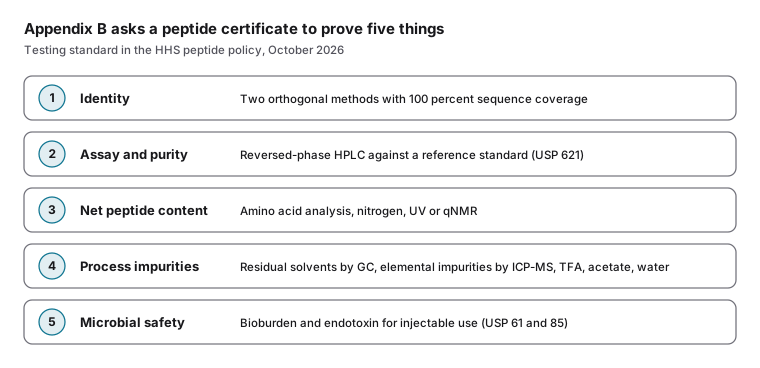
Each attribute answers a different question about the vial, so purity alone leaves identity and safety open. The next section explains how a chemist reads each test.
ExaVeyra connects verified practices with a 503A pharmacy partner and reviews certificates of analysis with any account that asks. The prescribing decision, the route and the dose remain with the licensed prescriber.
Educational Disclaimer: This article is for educational purposes only and does not constitute medical or legal advice. It does not identify any material, compound, device setting or protocol as safe, effective or appropriate for any patient, and it is not intended to diagnose, treat, cure, or prevent any disease. Questions about a treatment belong with the reader’s own licensed provider. Exosome material is supplied for topical aesthetic use by licensed practitioners. No exosome product is FDA-approved for any use, and ExaVeyra Sciences makes no statement about administration, route, or outcome. Compounded medications are not FDA-approved. They are prepared by a 503A compounding pharmacy licensed by the Texas State Board of Pharmacy for an individual patient against that patient’s prescription, and are available to NPI-verified licensed practitioners only, in the states where the pharmacy is licensed. Product, device and brand names mentioned are trademarks of their respective owners and are used only to identify the products discussed. Their mention is not an endorsement, and those owners have not reviewed or endorsed this article. ExaVeyra Sciences is a supplier and takes no part in any diagnosis, treatment decision, or plan of care. Findings described are attributed to the peer-reviewed literature, trial registries and agencies cited. The content of these guides is provided for general informational purposes only. It does not constitute legal, medical, or regulatory advice, and does not establish that any particular product or practice is compliant. Regulatory requirements vary by state and depend on the circumstances of each practice. Each practitioner should consult their own legal counsel and the applicable state licensing boards before acting on anything stated here.
References
- 1.U.S. Food and Drug Administration. 21 CFR 201.128, Meaning of “intended uses.” eCFR. https://www.ecfr.gov/current/title-21/chapter-I/subchapter-C/part-201/subpart-D/section-201.128Primary source. Carries in this article: intended use as objective intent shown by labeling claims, advertising and statements.
- 2.U.S. Food and Drug Administration, CDER. Warning letter to Gram Peptides, MARCS-CMS 721806. 31 March 2026. https://fda.gov/inspections-compliance-enforcement-and-criminal-investigations/warning-letters/gram-peptides-721806-03312026Primary source. Carries in this article: the quoted research-use labels and FDA’s finding of intended human use.
- 3.U.S. Food and Drug Administration, CDER. Warning letter to Prime Sciences, MARCS-CMS 721805. 31 March 2026. https://www.fda.gov/inspections-compliance-enforcement-and-criminal-investigations/warning-letters/prime-sciences-721805-03312026Primary source. Carries in this article: the January to March 2026 website review.
- 4.U.S. Food and Drug Administration, CDER. Warning letters dated 31 March 2026 and posted 7 April 2026 to Lovega LLC dba Pink Pony Peptides (721088, https://www.fda.gov/inspections-compliance-enforcement-and-criminal-investigations/warning-letters/lovega-llc-dba-pink-pony-peptides-721088-03312026), Mile High Compounds LLC (721600), PekCura Labs (721709), FormPour (722215) and Guangzhou Huli Technology Co., Ltd. dba Fantasy Face (722228), as listed in FDA’s warning letter database. https://www.fda.gov/inspections-compliance-enforcement-and-criminal-investigations/compliance-actions-and-activities/warning-lettersPrimary source. Carries in this article: the remaining March recipients, the posting date, and the Pink Pony letter’s GLP-1 products and bacteriostatic water finding.
- 5.U.S. Food and Drug Administration, CDER. Warning letter to Wholesale Peptide, reference 729447. 17 June 2026. https://www.fda.gov/inspections-compliance-enforcement-and-criminal-investigations/warning-letters/wholesale-peptide-729447-06172026Primary source. Carries in this article: the June letter and its reliance on 21 CFR 201.128.
- 6.U.S. Food and Drug Administration, CDER. Warning letter to TXP Innovations LLC dba Tex Peptides, reference 735067. 24 August 2026. https://www.fda.gov/inspections-compliance-enforcement-and-criminal-investigations/warning-letters/txp-innovations-llc-dba-tex-peptides-735067-08242026Primary source. Carries in this article: the July 2026 website review, the products named and the quoted disclaimers in its footnote.
- 7.U.S. Food and Drug Administration, CDER. Warning letters dated 24 August 2026 and posted 1 September 2026 to NuScience Peptides LLC (733652, https://www.fda.gov/inspections-compliance-enforcement-and-criminal-investigations/warning-letters/nuscience-peptides-llc-733652-08242026), Peak Performance Peptides (735127, https://www.fda.gov/inspections-compliance-enforcement-and-criminal-investigations/warning-letters/peak-performance-peptides-735127-08242026) and Peptide Partners LLC (735063, https://www.fda.gov/inspections-compliance-enforcement-and-criminal-investigations/warning-letters/peptide-partners-llc-735063-08242026), as listed in FDA’s warning letter database. https://www.fda.gov/inspections-compliance-enforcement-and-criminal-investigations/compliance-actions-and-activities/warning-lettersPrimary source, each letter read on fda.gov 15 Nov 2026. Carries in this article: the August reference numbers and dates, each letter’s footnote finding human use despite research-use labels, and the NuScience letter’s peptide calculator finding.
- 8.U.S. Attorney’s Office, Northern District of Indiana. Illinois Man and Indiana Woman Sentenced Respectively to 70 Months and 16 Months in Prison For Selling Unapproved Drugs in Interstate Commerce. Press release, 30 July 2026. https://www.justice.gov/usao-ndin/pr/illinois-man-and-indiana-woman-sentenced-respectively-70-months-and-16-months-prisonPrimary source, Department of Justice. Carries in this article: the guilty plea to introducing unapproved new drugs into interstate commerce with intent to defraud and mislead, the 70-month sentence, sales of peptides for human consumption, and the 2020 and 2022 FDA warning letters.
- 9.U.S. Food and Drug Administration, CDER. Warning letter to Royal Peptides LLC, reference 734884. 24 August 2026. https://www.fda.gov/inspections-compliance-enforcement-and-criminal-investigations/warning-letters/royal-peptides-llc-734884-08242026Primary source, read on fda.gov 15 Nov 2026. Carries in this article: the footnote finding human use despite research-use labels, and bacteriostatic water marketed alongside a peptide guide and peptide calculator.
- 10.U.S. Department of Health and Human Services. Enforcement Discretion Policy Regarding 503A Compounding Using Certain Peptide Bulk Drug Substances, Appendices A and B. October 2026. https://www.hhs.gov/sites/default/files/hhs-503a-peptide-enforcement-discretion-policy-appendix-b.pdfPrimary source, read in full on hhs.gov 15 Nov 2026. Carries in this article: the six peptides and their salt forms and routes, the registered manufacturer and certificate conditions, the single active ingredient, prescription, bioavailability and adverse event reporting conditions, the testing standard and certificate contents in Appendix B, and the stated expectation about research-use-only peptides.
- 11.U.S. Department of Health and Human Services. Enforcement Discretion Policy Regarding 503A Compounding Using Certain Peptide Bulk Drug Substances; Notice of availability. Federal Register. 30 October 2026;91(209):68526-68527. FR Doc 2026-22192, filed 28 October 2026. Docket HHS-OASH-2026-0496. https://www.federalregister.gov/documents/2026/10/30/2026-22192/enforcement-discretion-policy-regarding-503a-compounding-using-certain-peptide-bulk-drug-substances (also at https://govinfo.gov/content/pkg/FR-2026-10-30/html/2026-22192.htm)Primary source, read in full 15 Nov 2026. Carries in this article: the 28 October filing and 30 October publication dates and the draft, non-binding status.
- 12.Federal Food, Drug, and Cosmetic Act, section 503A, 21 U.S.C. 353a. https://uscode.house.gov/view.xhtml?req=granuleid:USC-prelim-title21-section353a&num=0&edition=prelimPrimary source. Carries in this article: compounding by a licensed pharmacist or physician for an identified patient on a valid prescription.
Image credits
- Fig. 1ExaVeyra Sciences, original figure. ↩