Under the HHS interim peptide policy of October 2026, the only drug delivery device that may be co-packaged with, or contain, a compounded peptide is an FDA 510(k)-cleared syringe. A vial dispensed with cleared syringes, or a prefilled cleared syringe, fits that condition; pen injectors, pen cartridges and autoinjectors are more complex devices that the policy does not cover.
Regulatory Status
Compounded preparations are not FDA-approved [12]. The HHS policy is an interim, non-binding statement of enforcement discretion for 503A pharmacies that meet all ten of its conditions, and it may change. ExaVeyra Sciences works with a state-licensed 503A pharmacy partner that compounds against patient-specific prescriptions and releases its formulary after NPI verification. ExaVeyra does not prescribe and makes no efficacy claim for any preparation.
Practices that move patients from research vials to compounded peptides often ask whether the pen formats they have seen elsewhere carry over. The sections below set out what the policy says about devices, what FDA’s own definitions add, and how to check the syringe that arrives with a prescription.
Condition 9 limits the device to a 510(k)-cleared syringe
The HHS policy lists ten circumstances that must all be present before HHS will decline to take enforcement action against a 503A compounder using one of the six listed peptides [1]. Condition 9, headed “Drug delivery device,” states that the only drug delivery device co-packaged with or containing the compounded drug is an FDA 510(k)-cleared syringe, and gives the reason in one line: more complex drug delivery devices introduce additional patient risk [1]. HHS published the policy in the Federal Register on 30 October 2026 as a draft that binds neither HHS nor the public [2].
The device condition sits beside others that make each preparation traceable. The compounded product must contain a single listed peptide, its labeling must carry the statement “This is a compounded drug product. Not for resale,” and the compounder’s reports to FDA must include the active ingredient and strength, the original manufacturer and its facility identifier, and the dosage form and route of administration [1].
FDA’s combination product rules explain what co-packaged means
The phrase “co-packaged or containing” follows FDA’s own vocabulary for drug and device combinations. Under 21 CFR 3.2(e), a combination product includes products whose drug and device parts are combined into a single entity and products in which separate drug and device products are packaged together [3]. The FDA’s guidance on combination product types gives vials packaged with empty syringes, auto-injectors or transfer sets as examples of a convenience kit or co-package, and treats prefilled drug delivery devices as a separate type [4].
Read against those definitions, condition 9 covers both arrangements. A compounded peptide in a vial dispensed together with syringes is co-packaged, and a syringe filled with the compounded peptide contains it, so in either case the syringe must be 510(k)-cleared [1, 4]. The condition does not name any other device type as acceptable.
A 510(k)-cleared syringe is a piston syringe cleared under 21 CFR 880.5860
FDA classifies a piston syringe under 21 CFR 880.5860 as a Class II device consisting of a calibrated hollow barrel and a movable plunger, listed under product code FMF [5, 6]. Manufacturers clear these syringes through 510(k) premarket notification, and each clearance carries a K number that can be looked up in FDA’s 510(k) database; a 2019 clearance for Nipro syringes, K191359, is one example under that regulation and product code [6, 7]. Each clearance belongs to a specific manufacturer and product, so a practice confirms clearance product by product.
Pens, cartridges and auto-injectors fall outside the condition
A pen injector is a different device type from a piston syringe. It holds the drug in a cartridge, uses a dose-setting mechanism and is often designed for repeated doses from one cartridge, which is the kind of added complexity the policy’s rationale points to [1]. A compounded peptide supplied in a pen, in a cartridge intended for a pen, or in an auto-injector therefore does not meet condition 9 as written, whatever the device’s own regulatory status [1].
The same reading applies to formats marketed in the research-peptide market, such as multi-dose pens prefilled with a peptide or kits that bundle a peptide with an injection device. Those products already sit outside the policy because they are not compounded by a 503A pharmacy for a named patient, and the device condition adds a second reason [1, 11].
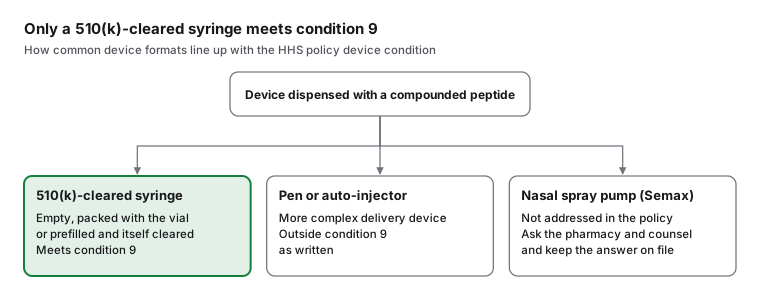
The policy text names only the syringe, so every other format either falls outside the condition or is left unaddressed. The table near the end of this article lists the same formats with their sources.
Routes without injection raise a separate question
The policy covers two peptides without any injectable route. KPV acetate is limited to topical and oral dosage forms, and Semax free base to intranasal use [1, 10]. BPC-157 acetate is covered for oral and topical forms as well as injection [1]. For oral and topical products, the container is not usually described as a drug delivery device. An intranasal preparation is commonly dispensed in a metered spray pump, however, and condition 9 names only a syringe [1].
The policy text does not address that case directly. A practice prescribing compounded Semax should ask its pharmacy how the preparation is packaged and what the pharmacy’s counsel has concluded about condition 9 for nasal containers, and should keep that answer on file.
ExaVeyra connects verified practices with a 503A pharmacy partner and can confirm the syringe supplied with each preparation. The prescribing decision, the route and the dose remain with the licensed prescriber.
Educational Disclaimer: This article is for educational purposes only and does not constitute medical or legal advice. It does not identify any material, compound, device setting or protocol as safe, effective or appropriate for any patient, and it is not intended to diagnose, treat, cure, or prevent any disease. Questions about a treatment belong with the reader’s own licensed provider. Exosome material is supplied for topical aesthetic use by licensed practitioners. No exosome product is FDA-approved for any use, and ExaVeyra Sciences makes no statement about administration, route, or outcome. Compounded medications are not FDA-approved. They are prepared by a 503A compounding pharmacy licensed by the Texas State Board of Pharmacy for an individual patient against that patient’s prescription, and are available to NPI-verified licensed practitioners only, in the states where the pharmacy is licensed. Product, device and brand names mentioned are trademarks of their respective owners and are used only to identify the products discussed. Their mention is not an endorsement, and those owners have not reviewed or endorsed this article. ExaVeyra Sciences is a supplier and takes no part in any diagnosis, treatment decision, or plan of care. Findings described are attributed to the peer-reviewed literature, trial registries and agencies cited. The content of these guides is provided for general informational purposes only. It does not constitute legal, medical, or regulatory advice, and does not establish that any particular product or practice is compliant. Regulatory requirements vary by state and depend on the circumstances of each practice. Each practitioner should consult their own legal counsel and the applicable state licensing boards before acting on anything stated here.
References
- 1.U.S. Department of Health and Human Services. HHS Enforcement Discretion Policy Regarding 503A Compounding Using Certain Peptide Bulk Drug Substances, with Appendices A and B. October 2026. https://www.hhs.gov/sites/default/files/hhs-503a-peptide-enforcement-discretion-policy-appendix-b.pdfPrimary source. Carries in this article: the ten conditions, condition 9 and its rationale, the labeling statement, reporting content and the routes for each peptide.
- 2.U.S. Department of Health and Human Services. Enforcement Discretion Policy Regarding 503A Compounding Using Certain Peptide Bulk Drug Substances; Notice of availability. Federal Register. 30 October 2026;91(209):68526-68527. FR Doc 2026-22192. https://www.federalregister.gov/documents/2026/10/30/2026-22192/enforcement-discretion-policy-regarding-503a-compounding-using-certain-peptide-bulk-drug-substances (also at https://govinfo.gov/content/pkg/FR-2026-10-30/html/2026-22192.htm)Primary source. Carries in this article: the publication date and draft, non-binding status.
- 3.Electronic Code of Federal Regulations. 21 CFR 3.2, Definitions. Checked 14 November 2026. https://www.ecfr.gov/current/title-21/chapter-I/subchapter-A/part-3/subpart-A/section-3.2Primary source. Carries in this article: the definition of a combination product, including co-packaged products.
- 4.U.S. Food and Drug Administration. Combination Product Definition, Combination Product Types. Checked 14 November 2026. https://www.fda.gov/combination-products/about-combination-products/combination-product-definition-combination-product-typesAgency guidance page. Carries in this article: vials packaged with empty syringes or auto-injectors as co-packages, and prefilled delivery devices as a separate type.
- 5.Electronic Code of Federal Regulations. 21 CFR 880.5860, Piston syringe. https://www.ecfr.gov/current/title-21/chapter-I/subchapter-H/part-880/subpart-F/section-880.5860Primary source. Carries in this article: the Class II piston syringe defined as a calibrated hollow barrel with a movable plunger.
- 6.U.S. Food and Drug Administration. 510(k) record K191359, Nipro Syringe, Nipro Medical Corporation, device classification Syringe, Piston, regulation 21 CFR 880.5860, product code FMF, decision of substantially equivalent on 9 October 2019. https://www.accessdata.fda.gov/scripts/cdrh/cfdocs/cfpmn/pmn.cfm?ID=K191359Agency database record, checked 15 November 2026. Carries in this article: an example clearance under product code FMF.
- 7.U.S. Food and Drug Administration. 510(k) Premarket Notification database. https://www.accessdata.fda.gov/scripts/cdrh/cfdocs/cfpmn/pmn.cfmAgency database. Carries in this article: where to verify a syringe’s clearance.
- 8.U.S. Food and Drug Administration. Product Classification database, product code FMF: Syringe, Piston, regulation 21 CFR 880.5860. Checked 15 November 2026. https://www.accessdata.fda.gov/scripts/cdrh/cfdocs/cfPCD/classification.cfm?ID=FMFAgency database. Carries in this article: background on product code FMF for piston syringes; not cited in the body.
- 9.U.S. Food and Drug Administration, CDER. Warning letter to Prime Sciences, MARCS-CMS 721805. 31 March 2026. https://www.fda.gov/inspections-compliance-enforcement-and-criminal-investigations/warning-letters/prime-sciences-721805-03312026Primary source. Carries in this article: the reconstitution kit with bacteriostatic water and a syringe.
- 10.BakerHostetler. HHS Issues Enforcement Discretion Policy Regarding 503A Compounding Using Certain Peptide Bulk Drug Substances. 28 October 2026. https://www.bakerlaw.com/insights/hhs-issues-enforcement-discretion-policy-regarding-503a-compounding-using-certain-peptide-bulk-drug-substances/. Analyzes the HHS policy: https://www.hhs.gov/sites/default/files/hhs-503a-peptide-enforcement-discretion-policy-appendix-b.pdfLegal analysis. Carries in this article: the route parameters.
- 11.Federal Food, Drug, and Cosmetic Act, section 503A, 21 U.S.C. 353a. Checked 14 November 2026. https://uscode.house.gov/view.xhtml?req=granuleid:USC-prelim-title21-section353a&num=0&edition=prelimPrimary source. Carries in this article: compounding for an identified patient on a valid prescription.
- 12.U.S. Food and Drug Administration. Compounding and the FDA: Questions and Answers. Content current as of 16 September 2025. https://www.fda.gov/drugs/human-drug-compounding/compounding-and-fda-questions-and-answersAgency web page. Carries in this article: compounded drugs are not FDA-approved, in the regulatory status callout.
Image credits
- Fig. 1ExaVeyra Sciences, original figure. ↩