Esta referencia está disponible actualmente en inglés. La versión en español está en preparación.
Sham and Placebo Controls in Procedural Research
Por Benn Bluestein-Veyra, M.Sc. en Química Orgánica · Actualizado el 21 de octubre de 2026
ExaVeyra Sciences es un proveedor B2B con sede en Miami que suministra exosomas para uso estético tópico a clínicas con licencia, y remite a los prescriptores con licencia a una farmacia de preparados compuestos 503A que prepara formulaciones según prescripciones individuales.
| Pregunta | Respuesta |
|---|---|
| Qué cubre esta página | How procedure-based studies use sham and placebo controls, what the placebo response measures, and how trial designers keep participants and assessors blinded. |
| Quién puede hacer pedidos | Clínicas y profesionales con licencia profesional activa y NPI verificados por ExaVeyra. Los pedidos de exosomas requieren además un reconocimiento firmado de uso profesional. |
| Qué se envía y cómo | El material de exosomas para uso estético tópico, caracterizado por lote, se envía en cadena de frío por exprés nocturno. La entrega puede tardar 1 a 3 días hábiles. Se emite un certificado de análisis para cada lote y se entrega a solicitud. |
A sham-controlled trial compares an intervention with an imitation procedure that reproduces its steps, sensations and setting while leaving out the element under test. The design separates the specific effect of a procedure from the placebo effect, regression to the mean and natural course.[1][2]
This reference explains how the placebo response and the placebo effect differ, how sham procedures are built and checked, and how ethics codes and federal regulations frame their use. It closes with the alternatives to a sham arm and a guide to reading studies that lack one.[3][4]
Understanding why procedural research calls for a sham-controlled trial
Injections, device sessions, topical procedures and surgery reach participants through a sequence of visible and tactile steps. Each step carries cues about allocation, and those cues can shape how participants report outcomes and how assessors rate them.[5][6]
Schulz and Grimes define blinding as keeping participants, investigators or outcome assessors unaware of the assigned intervention so that this knowledge cannot influence them. They recommend that reports state exactly who was blinded and how.[7]
Drug trials can blind with identical tablets, and a procedure has to be imitated step by step. The CONSORT extension for nonpharmacologic trials, updated by Boutron and colleagues in 2017, asks authors to describe their attempts to limit bias when blinding is not possible.[6]
Wartolowska and colleagues reviewed 53 randomized trials that compared a surgical procedure with a placebo procedure, defining surgery as any procedure that changes the anatomy and requires a skin incision or endoscopic techniques. The placebo arm improved in 39 of the 53 trials (74%), a measure of how much change a control arm can carry on its own.[8]
Decomposing an observed response into its components
The change measured in any arm of a trial combines several components (Fig. 1). Ernst and Resch distinguished the perceived placebo effect, the whole response seen in a placebo arm, from the true placebo effect that remains once other nonspecific effects are subtracted using an untreated control group.[2]
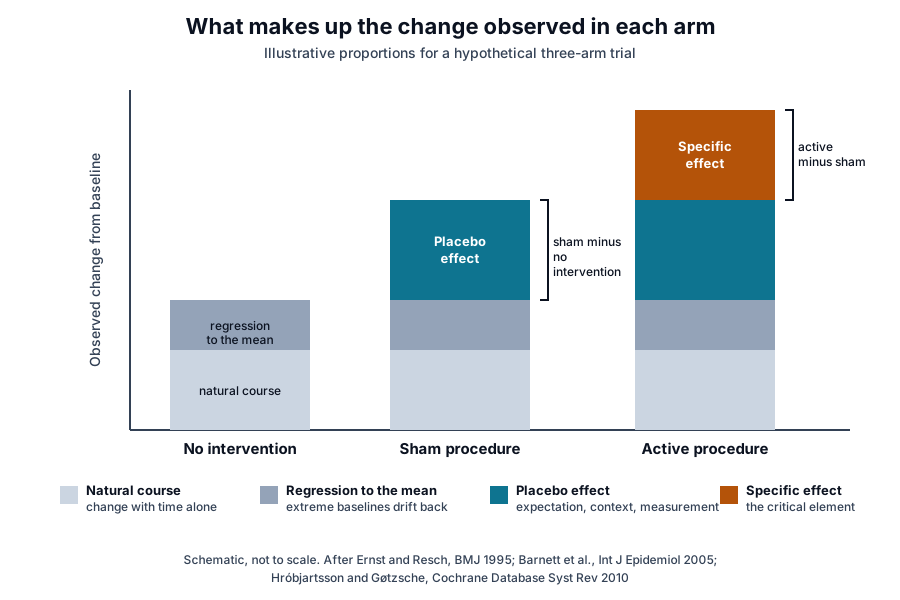
In their review, most authors confused the two, and the true placebo effect proved highly variable and dependent on factors that were incompletely understood. Separating the components therefore calls for a no-intervention arm alongside the sham arm.[2]
This page follows the same distinction. The placebo response is the whole change seen in a placebo or sham arm, natural course and regression to the mean included, and the placebo effect is the one component left once those are set aside, the true placebo effect of Ernst and Resch.[2]
Regression to the mean and natural course
Regression to the mean is the tendency of unusually large or small measurements to be followed by measurements closer to the mean. Barnett and colleagues showed that it can make natural variation in repeated data look like real change.[9]
The effect grows with measurement error and when follow-up is examined only in participants selected for an extreme baseline value. Enrollment criteria that require a high baseline score build regression to the mean into every arm, and a randomized concurrent control lets it cancel in the comparison.[9][10]
Natural course is the change that occurs with time alone. FDA guidance E10 describes five types of control group: placebo, untreated, dose-response, active and external or historical controls, the first four of them concurrent and usually randomized.[10]
Expectation, context and measurement effects
Hróbjartsson and Gøtzsche studied trials that randomized participants to a placebo or to no intervention, where the placebo could be pharmacologic, physical or psychological. In their 2001 analysis of 130 such trials, placebo arms differed from untreated arms on continuous subjective outcomes and showed no significant difference on objective or binary outcomes.[11]
Their 2010 Cochrane update covered 234 trials. Meta-regression associated larger placebo effects with physical placebo interventions such as sham procedures, outcomes that involve participant cooperation, small trials and trials designed to study placebo itself.[12]
The same review noted that participant-reported placebo effects are difficult to separate from biased reporting, a measurement effect.[12] Colagiuri adds that participant expectancies can produce ceiling effects when strong placebo responses occur in every arm of a double-blind trial.[13]
Placebo-controlled surgical trials follow the ASPIRE guidance
Wartolowska and colleagues pooled the placebo arms of 47 surgical trials with 1,744 participants. Outcome subjectivity was the strongest predictor of placebo response: the pooled response was large for subjective outcomes, small for objective ones and stable across the length of follow-up.[14]
The authors concluded that objective outcomes may be preferable as end points. When subjective outcomes are of primary interest, a placebo arm is necessary to control for placebo response.[14]
Beard and colleagues published the ASPIRE guidelines, Applying Surgical Placebo in Randomised Evaluations, in The Lancet in 2020. The review covers when placebo controls are acceptable, how to design them, how to identify and mitigate risk for participants, and how to conduct and interpret the trials.[1]
ASPIRE holds that a placebo control is justified when a strong scientific and ethical rationale exists. Surgical placebos fit best where evidence for a procedure is weak and a trial without one would carry a high risk of bias from the placebo effect.[1][15]
The full ASPIRE report in Health Technology Assessment recommends feasibility work before a main trial and calls for further work on nomenclature.[15] A second workshop, reported by Campbell and colleagues in 2023, added guidance on the purpose and design of invasive placebo controls, participant information and the use of findings in decision-making.[16]
Comparing the control arms available to procedure-based studies
ClinicalTrials.gov classifies each registered arm as experimental, active comparator, placebo comparator, sham comparator, no intervention or other. It records masking separately for the participant, care provider, investigator and outcomes assessor.[17]
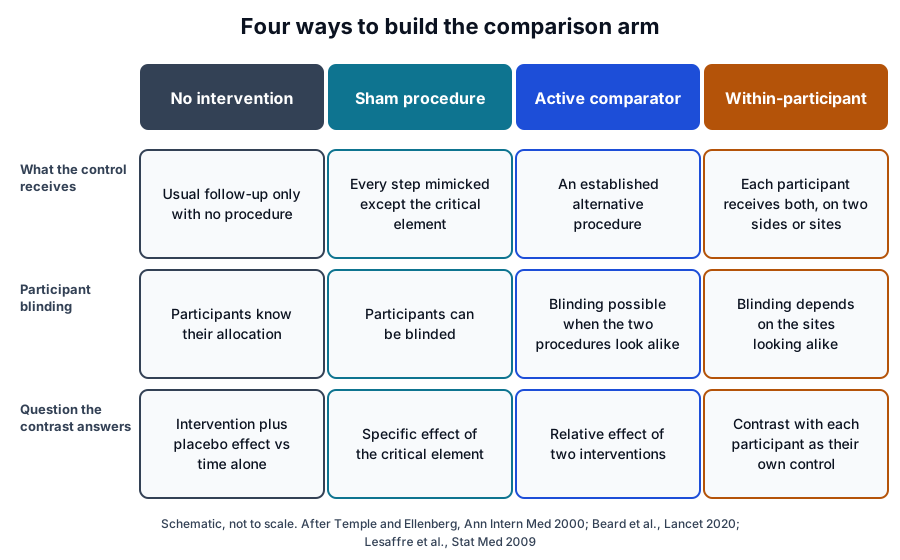
Each control arm answers a different question (Fig. 2). The sham arm isolates the critical element, the untreated arm captures natural course and regression to the mean, and the active comparator estimates one intervention relative to another.[10][18]
| Control arm | What the control group receives | What the comparison estimates | Participant blinding |
|---|---|---|---|
| No intervention | Follow-up with no procedure | Intervention plus placebo effect against time alone | Participants know their allocation |
| Sham procedure | Every step except the critical element | Specific effect of the critical element | Participants can be blinded |
| Active comparator | An established alternative procedure | Relative effect of two interventions | Possible when the procedures look alike |
| Within-participant | Both interventions on different sides or sites | Contrast within each participant | Depends on the sites looking alike |
Active comparator designs
Temple and Ellenberg, writing from FDA, described the limited ability of active-control equivalence trials, also called noninferiority trials, to establish efficacy in many settings. They concluded that active-control trials are valuable and informative yet often cannot provide reliable evidence of the effectiveness of a new intervention on their own.[18]
Split-body and within-participant controls
In a split-body or split-mouth design, each participant receives both interventions, randomly assigned to the left and right sides or to separate sites. Lesaffre and colleagues explain that the design removes much between-participant variability from the estimate and has statistical requirements of its own.[19]
Carry-over effects between sites can bias a split-mouth trial. Smaïl-Faugeron and colleagues compared split-mouth and parallel-arm trials addressing the same questions across 34 meta-analyses and found no evidence of a difference in effect estimates.[20]
Designing a credible sham that matches the experience of the intervention
Campbell and colleagues describe the ideal surgical placebo as the cleanest separation of the critical surgical element, the component the trial tests, with placebo and other nonspecific effects shared by both arms. They weigh this aim against the burden on participants and the clarity of interpretation.[16]
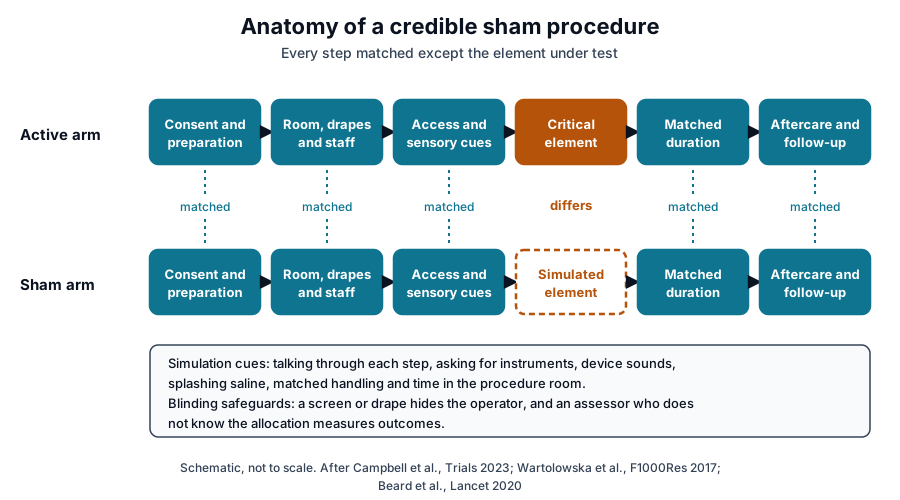
Their components include mimicked timings, so the sham group spends the same time in the procedure room, verbal cues such as talking through the procedure, auditory cues such as splashing saline and physical cues such as manipulating an endoscope (Fig. 3).[16]
Wartolowska and colleagues collected strategies from published placebo-controlled surgical trials. Surgeons talked through each step, asked for instruments, used suction or asked for a device to be activated, and a drape screened the clinical staff from the participant’s view.[5]
The same authors list a less evident benefit of blinding: fewer participants leave the control arm.[5] The ASPIRE authors recommend feasibility work to refine these features before the main trial begins.[1]
Matching sensations with active placebos
Drug trials offer a parallel in the active placebo, which contains ingredients that imitate noticeable effects of the experimental drug so that sensations do not reveal allocation. Laursen and colleagues compared active and standard placebo controls across 123 meta-analyses of 1,698 trials and found no statistically significant average difference, with wide uncertainty and considerable heterogeneity.[21]
For a procedural sham, the same logic applies to pressure, sound, warmth and the look of the procedure site. Matching these cues keeps the sham credible to participants through follow-up.[5][16]
Assessing blinding success with a blinding index
Bang, Ni and Davis proposed a blinding index in 2004 that is calculated for each arm from participants’ guesses about their allocation. It runs from −1 to 1: 1 indicates complete lack of blinding, 0 is consistent with perfect blinding and −1 indicates opposite guessing.[22]
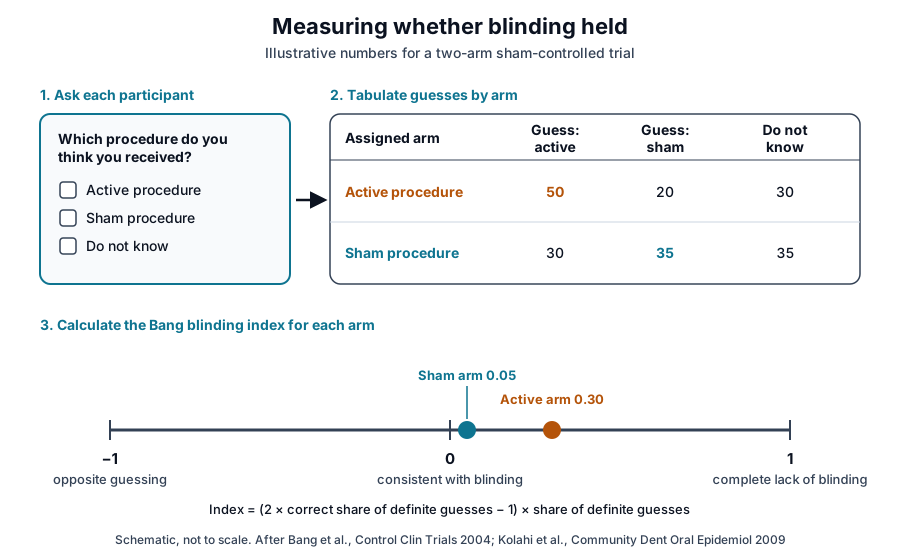
The index can detect a relatively low degree of blinding, response bias and different behavior in the two arms (Fig. 4).[22] Kolahi, Bang and Park reviewed it alongside the earlier James blinding index and described the two as complementary.[23]
Kolahi and colleagues suggest asking participants to guess their assignment, optionally with a degree of certainty. A third party can assess comparability before the trial, an early assessment checks the credibility of the control, and an end-of-trial assessment summarizes how well blinding was maintained.[23]
Muñoz Laguna, Kolahi and Bang compared three indices in 2025, the James, Bang and Simple indices, and applied them to hypothetical and real trial data to show the strengths and limitations of each.[24] Bang and Park offer practical suggestions for handling blinding at each stage of a trial.[25]
Evidence on blinding from meta-epidemiology
Savović and colleagues combined 1,973 trials from seven meta-epidemiological studies. Lack of or unclear double-blinding was associated with an average 13% exaggeration of intervention effects, driven primarily by trials with subjective outcomes.[26]
The MetaBLIND study by Moustgaard and colleagues found no evidence of an average difference between trials with and without blinding, and its authors concluded that blinding should remain a methodological safeguard.[27] Salazar and colleagues compared blinded and nonblinded assessors within the same trials and found that nonblinded assessors of subjective outcomes exaggerated effect estimates by 29% on average.[28]
CONSORT 2025, developed by Hopewell and colleagues, is a 30-item checklist with a participant flow diagram that draws on the extension for nonpharmacological trials. Reports that follow it state the blinding of each group in the trial.[6][29]
Applying ethical principles to sham and placebo arms
Paragraph 33 of the Declaration of Helsinki, revised by the World Medical Association in 2024, requires that a new intervention be tested against the best proven intervention. Placebo or no intervention is acceptable when no proven intervention exists, or when compelling and scientifically sound methodological reasons make it necessary and participants face no additional risk of serious or irreversible harm from forgoing the best proven intervention.[3]
Temple and Ellenberg reached a similar position for regulatory trials, judging a placebo control by the consequences for participants of deferring an established intervention.[18] ASPIRE applies the same reasoning to surgery and asks for a strong scientific and ethical rationale.[1]
In the United States, 21 CFR 50.25 lists the basic elements of informed consent for FDA-regulated research. They include a description of the procedures to be followed with identification of those that are experimental, reasonably foreseeable risks or discomforts, expected benefits and appropriate alternative procedures.[4]
For a sham-controlled trial, these elements mean participants learn that they may receive an imitation procedure and what it involves. Campbell and colleagues devoted part of the second ASPIRE workshop to how this information is given to participants.[4][16]
Reading a study that lacks a sham control
Many procedural studies compare an intervention with no intervention, usual care or a baseline measurement. The questions below help a reader judge how much of a reported change could come from the components in Fig. 1.[2][9]
- Is the outcome subjective? Placebo response in surgical trials was large for subjective outcomes and small for objective ones.[14]
- Were outcome assessors blinded? Nonblinded assessors of subjective outcomes exaggerated effect estimates in a 2025 meta-epidemiological analysis.[28]
- Were participants selected for extreme baseline values? Selection on a baseline value magnifies regression to the mean.[9]
- Is there a randomized concurrent control? FDA guidance E10 names randomization and blinding as the two techniques usually used to minimize bias.[10]
- Does the report state who was blinded and how? Schulz and Grimes recommend naming each blinded group and the method used.[7]
Studies with objective end points depend less on a sham arm, which matches the recommendation by Wartolowska and colleagues to prefer objective outcomes where possible.[14] A study that answers these questions well still adds useful evidence, and its design tells the reader how much weight it can carry.[7]
Where to go from here
The randomized controlled trials reference explains allocation and concealment, and the risk of bias reference shows how reviewers judge blinding domain by domain. The hierarchy of evidence, systematic reviews and meta-analysis, and clinical trial phases references place sham-controlled trials within the wider evidence base.
The reading the evidence guide applies these ideas to clinic decisions, and the exosome clinical trials and remestemcel-L references show how registered trials and approvals are documented. The extracellular vesicle potency assays page and our quality references cover laboratory evidence, and our team is glad to discuss any of the methods on this page.
Referencias comentadas
Numeradas en el orden en que se citan en el texto. Cada fuente lleva una nota sobre lo que respalda en esta página; los artículos revisados por pares se listan con revista, volumen, número y páginas, y las fuentes primarias son regulaciones, documentos de agencias y bases de datos de referencia.
- 1.Peer-reviewedBeard DJ, Campbell MK, Blazeby JM, et al. Considerations and methods for placebo controls in surgical trials (ASPIRE guidelines). Lancet. 2020. https://pubmed.ncbi.nlm.nih.gov/32145797/Annotation: The ASPIRE review and checklist for placebo-controlled surgical trials. Cited for when placebo controls are justified, their design, participant protection, feasibility work and interpretation.
- 2.Peer-reviewedErnst E, Resch KL. Concept of true and perceived placebo effects. BMJ. 1995. https://pubmed.ncbi.nlm.nih.gov/7663213/Annotation: Landmark distinction between the perceived placebo effect in a placebo arm and the true placebo effect estimated against an untreated control. Cited for the components of an observed response.
- 3.Peer-reviewedWorld Medical Association. World Medical Association Declaration of Helsinki: Ethical Principles for Medical Research Involving Human Participants. JAMA. 2025. https://pubmed.ncbi.nlm.nih.gov/39425955/Annotation: The 2024 revision of the Declaration of Helsinki. Cited for paragraph 33 on the use of placebo or no intervention as a comparator.
- 4.RegulatoryeCFR, 21 CFR 50.25, Elements of informed consent. Accessed 20 October 2026. https://www.ecfr.gov/current/title-21/chapter-I/subchapter-A/part-50/subpart-B/section-50.25
- 5.Peer-reviewedWartolowska K, Beard D, Carr A. Blinding in trials of interventional procedures is possible and worthwhile. F1000Research. 2017. https://pubmed.ncbi.nlm.nih.gov/29259763/Annotation: Review of blinding strategies in placebo-controlled surgical trials. Cited for simulation of procedure steps, screening staff from view and lower dropout from the control arm.
- 6.Peer-reviewedBoutron I, Altman DG, Moher D, et al. CONSORT Statement for Randomized Trials of Nonpharmacologic Treatments: A 2017 Update and a CONSORT Extension for Nonpharmacologic Trial Abstracts. Annals of Internal Medicine. 2017. https://pubmed.ncbi.nlm.nih.gov/28630973/Annotation: CONSORT extension for nonpharmacologic trials such as surgery. Cited for the new item on attempts to limit bias when blinding is not possible.
- 7.Peer-reviewedSchulz KF, Grimes DA. Blinding in randomised trials: hiding who got what. Lancet. 2002. https://pubmed.ncbi.nlm.nih.gov/11879884/Annotation: Methods paper defining blinding of participants, investigators and assessors. Cited for the definition and the recommendation to state who was blinded and how.
- 8.Peer-reviewedWartolowska K, Judge A, Hopewell S, et al. Use of placebo controls in the evaluation of surgery: systematic review. BMJ. 2014. https://pubmed.ncbi.nlm.nih.gov/24850821/Annotation: Systematic review of 53 placebo-controlled surgical trials. Cited for the definition of surgery used and the share of trials with improvement in the placebo arm.
- 9.Peer-reviewedBarnett AG, van der Pols JC, Dobson AJ. Regression to the mean: what it is and how to deal with it. International Journal of Epidemiology. 2005. https://pubmed.ncbi.nlm.nih.gov/15333621/Annotation: Methods paper on regression to the mean. Cited for its definition and for the larger effect with measurement error and baseline selection.
- 10.RegulatoryFDA, E10 Choice of Control Group and Related Issues in Clinical Trials (guidance, May 2001). Accessed 20 October 2026. https://www.fda.gov/regulatory-information/search-fda-guidance-documents/e10-choice-control-group-and-related-issues-clinical-trials
- 11.Peer-reviewedHróbjartsson A, Gøtzsche PC. Is the placebo powerless? An analysis of clinical trials comparing placebo with no treatment. New England Journal of Medicine. 2001. https://pubmed.ncbi.nlm.nih.gov/11372012/Annotation: Systematic review of 130 trials randomizing participants to placebo or no intervention. Cited for the contrast between subjective continuous outcomes and objective or binary outcomes.
- 12.Peer-reviewedHróbjartsson A, Gøtzsche PC. Placebo interventions for all clinical conditions. Cochrane Database of Systematic Reviews. 2010. https://pubmed.ncbi.nlm.nih.gov/20091554/Annotation: Cochrane review of 234 placebo versus no-intervention trials. Cited for the meta-regression factors linked to larger placebo effects and the difficulty of separating reported effects from biased reporting.
- 13.Peer-reviewedColagiuri B. Participant expectancies in double-blind randomized placebo-controlled trials: potential limitations to trial validity. Clinical Trials. 2010. https://pubmed.ncbi.nlm.nih.gov/20421243/Annotation: Review of participant expectancies in double-blind placebo-controlled trials. Cited for ceiling effects when strong placebo responses occur in every arm.
- 14.Peer-reviewedWartolowska KA, Feakins BG, Collins GS, et al. The magnitude and temporal changes of response in the placebo arm of surgical randomized controlled trials: a systematic review and meta-analysis. Trials. 2016. https://pubmed.ncbi.nlm.nih.gov/27955685/Annotation: Meta-analysis of placebo arms in 47 surgical trials. Cited for outcome subjectivity as the strongest predictor of placebo response and the preference for objective end points.
- 15.Peer-reviewedBeard DJ, Campbell MK, Blazeby JM, et al. Placebo comparator group selection and use in surgical trials: the ASPIRE project including expert workshop. Health Technology Assessment. 2021. https://pubmed.ncbi.nlm.nih.gov/34505829/Annotation: Full report of the ASPIRE expert workshop. Cited for the scientific and ethical rationale, the settings where surgical placebos fit best, feasibility work and the call for nomenclature work.
- 16.Peer-reviewedCampbell MK, Beard DJ, Blazeby JM, et al. Further considerations for placebo controls in surgical trials. Trials. 2023. https://pubmed.ncbi.nlm.nih.gov/37301819/Annotation: Second ASPIRE workshop report. Cited for the critical surgical element, mimicked timings and verbal, auditory and physical cues, and participant information.
- 17.Official sourceClinicalTrials.gov, Protocol Registration Data Element Definitions (arm types and masking). Accessed 20 October 2026. https://clinicaltrials.gov/policy/protocol-definitions
- 18.Peer-reviewedTemple R, Ellenberg SS. Placebo-controlled trials and active-control trials in the evaluation of new treatments. Part 1: ethical and scientific issues. Annals of Internal Medicine. 2000. https://pubmed.ncbi.nlm.nih.gov/10975964/Annotation: FDA authors on placebo and active-control trials. Cited for the limits of noninferiority trials and the ethical test of deferring an established intervention.
- 19.Peer-reviewedLesaffre E, Philstrom B, Needleman I, et al. The design and analysis of split-mouth studies: what statisticians and clinicians should know. Statistics in Medicine. 2009. https://pubmed.ncbi.nlm.nih.gov/19536744/Annotation: Statistical introduction to split-mouth designs. Cited for random assignment to sides and the removal of between-participant variability.
- 20.Peer-reviewedSmaïl-Faugeron V, Fron-Chabouis H, Courson F, et al. Comparison of intervention effects in split-mouth and parallel-arm randomized controlled trials: a meta-epidemiological study. BMC Medical Research Methodology. 2014. https://pubmed.ncbi.nlm.nih.gov/24886043/Annotation: Meta-epidemiological comparison of split-mouth and parallel-arm trials across 34 meta-analyses. Cited for carry-over effects as a source of bias and the absence of a difference in effect estimates.
- 21.Peer-reviewedLaursen DRT, Broager MI, Damkjær MW, et al. Impact of active placebo controls on estimated drug effects in randomized trials: a meta-epidemiological study. Journal of Clinical Epidemiology. 2025. https://pubmed.ncbi.nlm.nih.gov/41005463/Annotation: Meta-epidemiological study of 1,698 trials comparing active and standard placebo controls. Cited for the definition of an active placebo and the uncertain average difference.
- 22.Peer-reviewedBang H, Ni L, Davis CE. Assessment of blinding in clinical trials. Controlled Clinical Trials. 2004. https://pubmed.ncbi.nlm.nih.gov/15020033/Annotation: Original description of the Bang blinding index. Cited for its scale from −1 to 1, its interpretation and its arm-specific calculation.
- 23.Peer-reviewedKolahi J, Bang H, Park J. Towards a proposal for assessment of blinding success in clinical trials: up-to-date review. Community Dentistry and Oral Epidemiology. 2009. https://pubmed.ncbi.nlm.nih.gov/19758415/Annotation: Review of the James and Bang blinding indices. Cited for guessing questions with certainty levels and the purposes of assessment at different time points.
- 24.Peer-reviewedMuñoz Laguna J, Kolahi J, Bang H. Unmasking three blinding indices for randomized controlled trials: comparison and application. Contemporary Clinical Trials Communications. 2025. https://pubmed.ncbi.nlm.nih.gov/41142043/Annotation: Tutorial comparing the James, Bang and Simple blinding indices. Cited for their application to hypothetical and real trial data and their strengths and limitations.
- 25.Peer-reviewedBang H, Park JJ. Blinding in clinical trials: a practical approach. Journal of Alternative and Complementary Medicine. 2013. https://pubmed.ncbi.nlm.nih.gov/23140113/Annotation: Practical commentary on blinding across the stages of a clinical trial. Cited for suggestions on handling blinding-related issues in design, conduct and reporting.
- 26.Peer-reviewedSavović J, Jones HE, Altman DG, et al. Influence of reported study design characteristics on intervention effect estimates from randomized, controlled trials. Annals of Internal Medicine. 2012. https://pubmed.ncbi.nlm.nih.gov/22945832/Annotation: Combined analysis of seven meta-epidemiological studies with 1,973 trials. Cited for the 13% average exaggeration linked to lack of double-blinding, driven by subjective outcomes.
- 27.Peer-reviewedMoustgaard H, Clayton GL, Jones HE, et al. Impact of blinding on estimated treatment effects in randomised clinical trials: meta-epidemiological study. BMJ. 2020. https://pubmed.ncbi.nlm.nih.gov/31964641/Annotation: The MetaBLIND meta-epidemiological study. Cited for the absence of an average difference by blinding status and the conclusion that blinding remains a safeguard.
- 28.Peer-reviewedSalazar J, Moustgaard H, Bracchiglione J, et al. Empirical evidence of observer bias in randomized clinical trials: updated and expanded analysis of trials with both blinded and non-blinded outcome assessors. Journal of Clinical Epidemiology. 2025. https://pubmed.ncbi.nlm.nih.gov/40258524/Annotation: Meta-epidemiological study of trials with both blinded and nonblinded outcome assessors. Cited for the 29% average exaggeration by nonblinded assessors of subjective outcomes.
- 29.Peer-reviewedHopewell S, Chan AW, Collins GS, et al. CONSORT 2025 statement: updated guideline for reporting randomised trials. BMJ. 2025. https://pubmed.ncbi.nlm.nih.gov/40228833/Annotation: Current CONSORT reporting guideline. Cited for the 30-item checklist, the participant flow diagram and its use of the nonpharmacologic extension.
Cite this page
ExaVeyra Sciences Editorial Team. Sham and Placebo Controls in Procedural Research. ExaVeyra Sciences; 21 October 2026. Available from: https://exaveyra.com/science/research-methods/sham-placebo-controls. Accessed [date accessed].