An exosome manufacturer is evaluated on what it can document. That record covers how it labels each product, how it screens and records its source donors, what each lot certificate measures, and how the material is stored and shipped.
ExaVeyra Sciences sources its exosome catalog from qualified partner manufacturers and works through six checks before a product is onboarded (Fig. 1). A practice can apply the same checks to any supplier it is weighing.
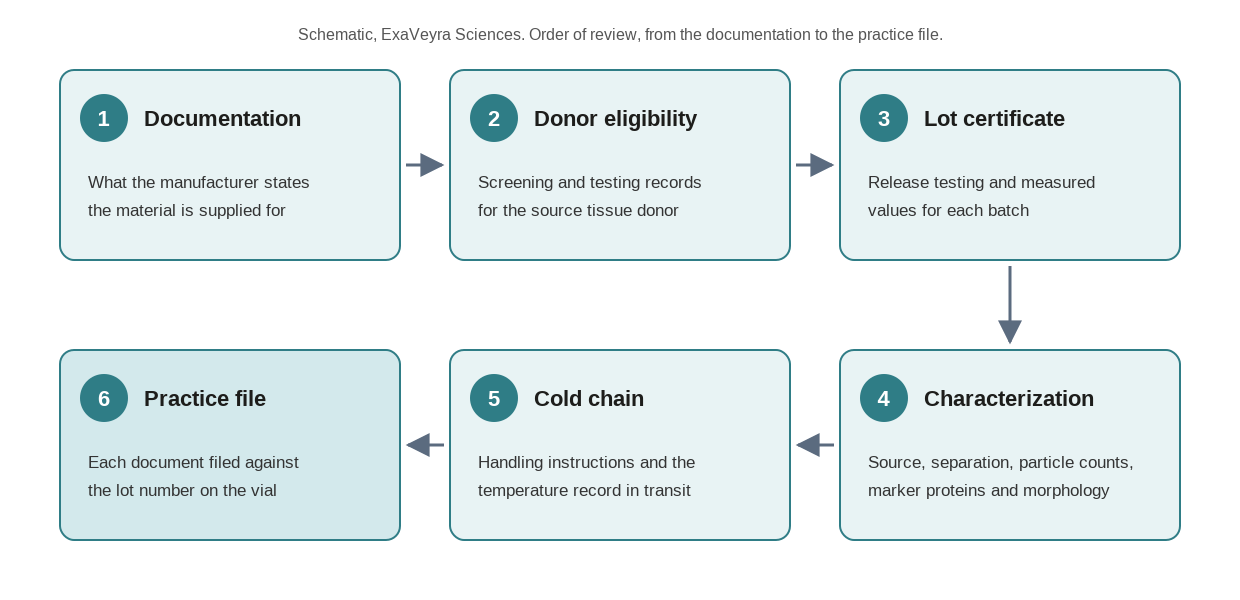
Regulatory status
The FDA stated in its 2019 public safety notification, and again in its consumer alert, that there are currently no FDA-approved exosome products [17, 18]. ExaVeyra supplies exosome material for topical aesthetic use by licensed practitioners and describes it by its available formats. Whether, when and how to use it is the practitioner’s decision.
Manufacturer documentation states what a product is supplied for
The FDA explains that a product’s regulatory category follows its intended use, which is established in part by the claims made for it [19]. A manufacturer’s documentation therefore sets the frame inside which a supplier and a practice describe the product, and ExaVeyra’s descriptions follow each manufacturer’s documentation.
The FDA’s consumer alert explains why the wording matters: the agency describes its concern about misleading statements on the conditions regenerative medicine products can address [18]. A practice therefore asks for the current label, any insert and the manufacturer’s statement of what the material is supplied for.
Donor eligibility records show where the source cells came from
Federal rules for establishments that manufacture human cells and tissues require a donor eligibility determination based on screening and testing, a distinct identification code and a summary of records that accompany the product without the donor’s name, and records kept for at least 10 years [15]. The FDA’s 2007 guidance sets out the agency’s own reading of those rules [14].
Donor testing under the same rules uses FDA-licensed, approved or cleared screening tests in a CLIA-certified laboratory, and for a donor one month of age or younger the birth mother’s specimen is tested [16]. That last rule is the one that applies to perinatal source tissue such as placenta, so a practice asks which source tissue a manufacturer uses and whether a donor eligibility summary is available for the lot.
A lot certificate of analysis records what was measured in each batch
Knauer and colleagues surveyed 20 commercial topical exosome products in 2026 and reported that they carried minimal information on isolation, processing or shelf life [5]. A lot-level file closes that gap for the practice, because each document in it is tied to the lot number printed on the vial.
| Document | What it records | Where it goes in the practice file |
|---|---|---|
| Label and insert | The product identification, storage and handling the manufacturer states | With the product record, updated when the label changes |
| Donor eligibility summary | The determination and the screening and testing behind it, without the donor’s name | With the supplier qualification file |
| Certificate of analysis | Measured values and release testing for the lot | With the lot number, for comparison across lots |
| Characterization panel | Particle count and size, marker proteins and imaging, or total protein for a secretome | Mapped where possible to MISEV2023 headings |
| Handling instructions | Storage temperature, thawing and use after thawing | At the freezer, with the receiving log |
| Cold-chain record | Temperature history from dispatch to arrival | With the receiving log and the indicator reading |
The certificate is the document a practice compares from one lot to the next. A manufacturer that issues one for every lot, and can explain each value on it, gives the practice a fixed point for every other record.
Characterization should map to the MISEV2023 headings
The MISEV2023 guideline from the International Society for Extracellular Vesicles, described by Welsh and colleagues, sets the reporting frame for vesicle preparations: the source, the separation method, particle measurement, marker proteins and morphology [6]. Reading a certificate against those headings shows at a glance what each lot was tested for (Fig. 2).
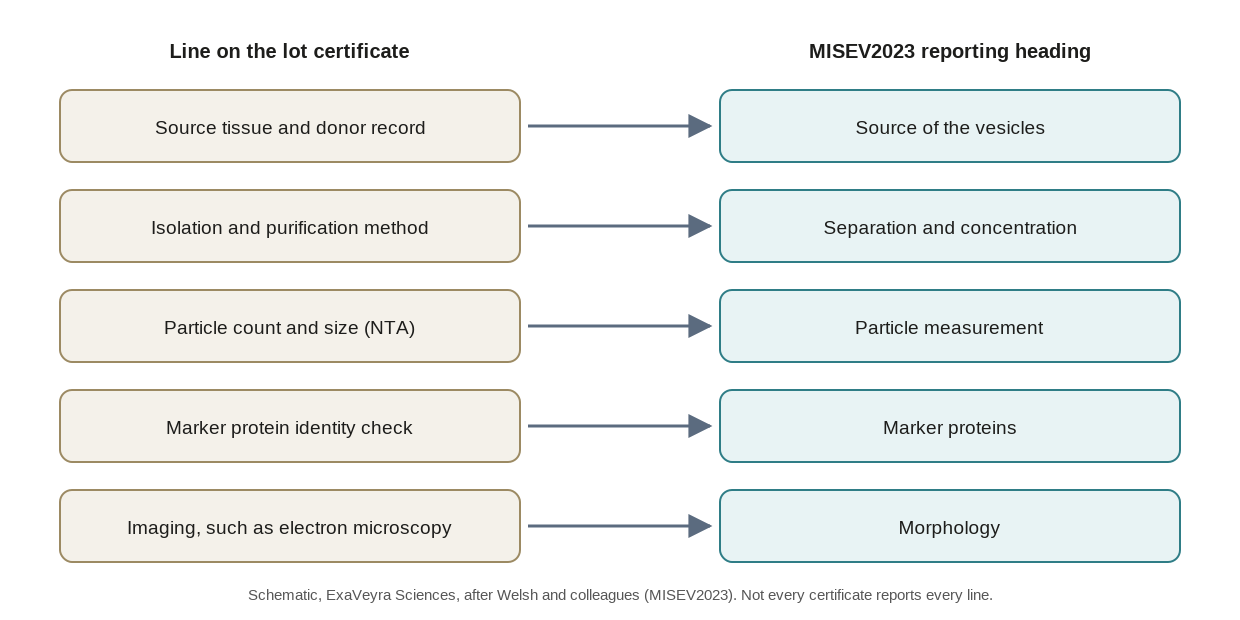
Dragovic and colleagues described nanoparticle tracking analysis (NTA) in 2011 as a method that sizes and counts vesicles down to about 50 nanometers [7]. Gardiner and colleagues reported in a 2016 worldwide survey that 72 percent of respondents used single-particle tracking for characterization, and 80 percent of those who named their instrument used NTA [21].
A purified vesicle fraction is usually reported by particle count and size, and a secretome by total protein. A comparison between manufacturers therefore pairs products of the same kind.
Storage follows each manufacturer’s handling instructions
Laboratory studies explain why the handling instructions matter. Gelibter and colleagues reported in 2022 that vesicle numbers fell after the first freeze-thaw cycle and that storage reduced purity over time [9], and Görgens and colleagues reported the same year that the buffer and diluent changed how many vesicles survived storage [8].
Those studies used vesicles from other sources, and Lőrincz and colleagues and Jeyaram and Jay described how storage effects vary with the source and the conditions [10, 11]. A practice follows each product’s own instructions, records the thaw date on the vial log, and asks the manufacturer before any step the instructions do not cover.
ExaVeyra exosome material ships frozen from the manufacturing facility on dry ice by overnight carrier with temperature monitoring, and per the manufacturer’s handling instructions it is stored at -20°C long term and at 4°C once thawed. The temperature indicator in the shipment is checked on arrival, before the vials go into storage.
Systematic and scoping reviews describe an early evidence base
Al Shammrie and colleagues reviewed six human studies of MSC-derived exosomes with 99 participants in 2025 and concluded that the evidence remains preliminary [3]. Stack and colleagues reviewed 39 human studies in a 2026 systematic review and meta-analysis that pooled facial wrinkle measures, while noting heterogeneous and nonstandardized protocols [2].
| Source | Design | Material | Size | Funding or disclosure |
|---|---|---|---|---|
| Gaebe 2026 [1] | Systematic review with GRADE | Extracellular vesicle products, several sources | 16 studies; 503 participants | Academic authors |
| Stack 2026 [2] | Systematic review and meta-analysis | Exosome products, several sources | 39 studies | Published in an industry-sponsored supplement |
| Al Shammrie 2025 [3] | Systematic review of human studies | MSC-derived exosomes, several sources | 6 studies; 99 participants | No competing interests declared |
| Wang 2026 [4] | Scoping review with trial registries | Exosome products in dermatology | 17 studies | No statement in the PubMed record |
| Knauer 2026 [5] | Scoping review and market survey | Commercial topical exosome products | 18 studies; 20 products | Academic authors |
Understanding the scope of the current evidence
Gaebe and colleagues applied GRADE to 16 facial vesicle studies with 503 participants in 2026 and rated the certainty of evidence low or very low, with risk of bias moderate to critical, although most studies reported improvement and no serious adverse events [1]. Wang, Bajwa and Rivers mapped 17 human dermatology studies in a 2026 scoping review and described small samples, single-arm designs and potential conflicts of interest [4].
- The located storage studies use laboratory vesicle preparations, so product-specific stability data comes from the manufacturer [8, 9, 10, 11].
- Commercial topical products surveyed in 2026 carried little information on isolation, processing or shelf life, so the lot file is where a practice finds that detail [5].
- The FDA states that there are currently no FDA-approved exosome products, so the manufacturer’s documentation is where a practice reads what a product is supplied for [17].
The serious adverse events described in these sources followed injection, a route outside topical use. Wang and colleagues recorded them after injection in their 2026 map [4]; Park reported persistent skin reactions in four women after intradermal injection, in nonclinical settings, of exosome-containing cosmetic products sold for topical use [12], and AlBargawi reported a single case after intradermal injection of a lyophilized exosome product [13].
Adverse events are reported to the FDA through MedWatch, with the lot number of the material used [20].
Ordering through a verified practice account
ExaVeyra supplies licensed practitioners and the practices that employ them. Any practice can apply or send a question, verification of its National Provider Identifier (NPI) and professional license unlocks the practitioner portal and pricing, and licensure is confirmed for the destination state before a first order ships.
Once verified, a practice orders by product type and format, and the account manager confirms current formats, documentation and availability for the practice’s state. The certificate of analysis for any lot is available on request through the portal.
Questions a practice can ask an exosome manufacturer
- What does the manufacturer’s documentation state the product is supplied for, and is there an insert we should file?
- Which source tissue is used, and is a donor eligibility summary available for the lot?
- Can we see a recent certificate of analysis and characterization panel, and which MISEV2023 headings do they cover?
- Which method produced the particle count, and what size range does the certificate report?
- What are the handling instructions for storage, thawing and use after thawing?
- How is the shipment packed, what does the temperature indicator show, and whom do we call if it reads outside range?
- How do we report an adverse event to the supplier and to the FDA through MedWatch?
A manufacturer that answers each of these questions from its own records gives a practice a file it can stand behind. ExaVeyra supplies its exosome catalog to NPI-verified practices with the lot number on every vial and a certificate of analysis generated for every lot, available on request with the cold-chain records.
The scientific team can walk a practice through each document before its first order. Practices can apply for a verified account or send a question about a certificate through the contact page.
Educational Disclaimer: This article is for educational purposes only and does not constitute medical or legal advice. It does not identify any material, compound, device setting or protocol as safe, effective or appropriate for any patient, and it is not intended to diagnose, treat, cure, or prevent any disease. Questions about a treatment belong with the reader’s own licensed provider. Exosome material is supplied for topical aesthetic use by licensed practitioners. No exosome product is FDA-approved for any use, and ExaVeyra Sciences makes no statement about administration, route, or outcome. Compounded medications are not FDA-approved. They are prepared by a 503A compounding pharmacy licensed by the Texas State Board of Pharmacy for an individual patient against that patient’s prescription, and are available to NPI-verified licensed practitioners only, in the states where the pharmacy is licensed. Product, device and brand names mentioned are trademarks of their respective owners and are used only to identify the products discussed. Their mention is not an endorsement, and those owners have not reviewed or endorsed this article. ExaVeyra Sciences is a supplier and takes no part in any diagnosis, treatment decision, or plan of care. Findings described are attributed to the peer-reviewed literature, trial registries and agencies cited. The content of these guides is provided for general informational purposes only. It does not constitute legal, medical, or regulatory advice, and does not establish that any particular product or practice is compliant. Regulatory requirements vary by state and depend on the circumstances of each practice. Each practitioner should consult their own legal counsel and the applicable state licensing boards before acting on anything stated here.
References
- 1.Gaebe K, Lowe K, Bosnalie D, Khoury S, Villemure Poliquin N, Nichols A. Effectiveness and Safety of Extracellular Vesicle-Based Therapies for Nonsurgical Facial Rejuvenation: A Systematic Review. Facial Plast Surg Aesthet Med. 2026. Published online ahead of print. PMID 42487416. doi:10.1177/26893614261457879PRISMA systematic review with risk-of-bias and GRADE assessment, searches to June 2025; 16 studies, 503 participants. Carries in this article: the most rigorous located certainty rating for facial vesicle studies; most studies reported improvement in at least one skin-quality outcome and no serious adverse events, risk of bias was moderate to critical, and certainty was low or very low. Disclosure: academic authors (Canada); no COI statement in the PubMed record.
- 2.Stack ER, Spongberg C, Braud SC, Stanton WN, Elway M. Clinical Advances in Exosome-Based Therapies for Aesthetic Medicine: A Systematic Review and Meta-analysis of Human Clinical Trials. Aesthet Surg J. 2026;46(12 Suppl 2):S13-S25. PMID 41800726. doi:10.1093/asj/sjaf178Systematic review and random-effects meta-analysis, searches to February 2025; 39 human studies. Carries in this article: a pooled analysis of facial wrinkle measures, with heterogeneity and nonstandardized protocols noted by the authors. Disclosure: published in an industry-sponsored journal supplement on exosomes; the PubMed record carries no funding or COI statement.
- 3.Al Shammrie FF, Alhemshy LZ, Althawy MM, Alfaraj MM, Alotaibi AS, Alali DS, et al. The Efficacy of MSC-Derived Exosome-Based Therapies in Treating Scars, Aging and Hyperpigmentation: A Systematic Review of Human Clinical Outcomes. Reports (MDPI). 2025;8(4):268. PMID 41441544. PMC12736761. doi:10.3390/reports8040268PRISMA systematic review of human studies published January 2010 to July 2025; six studies, 99 participants aged 19 to 72, including randomized trials, pilot studies, case series and case reports. Carries in this article: an independent summary of MSC-derived exosome studies on skin outcomes, which the authors concluded remain preliminary because of small samples, heterogeneous designs and short follow-up. Disclosure: academic authors (Saudi Arabia) declared no competing interests.
- 4.Wang OJE, Bajwa BB, Rivers JK. Exosome-Based Therapies in Dermatology: A Scoping Review. J Drugs Dermatol. 2026;25(4):368-376. PMID 41931695. doi:10.36849/jdd.9610Scoping review (PRISMA-ScR) including US and EU trial registries; 17 human studies from 2020 to 2025. Carries in this article: an evidence map that reported improvement in most studies alongside limits of small samples, single-arm designs and potential conflicts of interest. Disclosure: no COI statement in the PubMed record.
- 5.Knauer G, Chang A, Gupta A, Brownstone N, Mejia N, Bauman S, et al. Clinical Evidence and Commercial Landscape of Topical Exosomes for Skin Rejuvenation: A Scoping Review. Aesthet Surg J. 2026;46(11):NP148-NP157. PMID 42411735. doi:10.1093/asj/sjag141Scoping review with a librarian-reviewed search plus a market survey of 20 commercial products; 18 human studies. Carries in this article: commercial topical exosome products carried minimal information on isolation, processing or shelf life, the reason this guide asks practices to request lot documentation from any manufacturer. Disclosure: academic authors (USA); no COI statement in the PubMed record.
- 6.Welsh JA, Goberdhan DCI, O’Driscoll L, Buzas EI, Blenkiron C, Bussolati B, et al. Minimal information for studies of extracellular vesicles (MISEV2023): From basic to advanced approaches. J Extracell Vesicles. 2024;13(2):e12404. PMID 38326288. PMC10850029. doi:10.1002/jev2.12404International Society for Extracellular Vesicles reporting guideline, compiled with ISEV task forces and more than 1,000 researchers. Carries in this article: the frame for reading a certificate of analysis (source, separation, particle measurement, marker proteins, morphology). Disclosure: many consortium authors list EV company affiliations, declared in full in the article.
- 7.Dragovic RA, Gardiner C, Brooks AS, Tannetta DS, Ferguson DJ, Hole P, et al. Sizing and phenotyping of cellular vesicles using Nanoparticle Tracking Analysis. Nanomedicine. 2011;7(6):780-8. PMID 21601655. PMC3280380. doi:10.1016/j.nano.2011.04.003Methods study using human placental vesicles and plasma. Carries in this article: nanoparticle tracking analysis sizes and counts vesicles down to about 50 nm, the method behind the particle counts reported on vesicle certificates. Disclosure: not stated in the PubMed record.
- 8.Görgens A, Corso G, Hagey DW, Jawad Wiklander R, Gustafsson MO, Felldin U, et al. Identification of storage conditions stabilizing extracellular vesicles preparations. J Extracell Vesicles. 2022;11(6):e12238. PMID 35716060. PMC9206228. doi:10.1002/jev2.12238In vitro stability study up to two years across buffers and temperatures, vesicles from several cell sources. Carries in this article: the vehicle and diluent change how many vesicles survive storage and freeze-thaw, which is why each manufacturer’s handling instructions govern its own product. Disclosure: several authors list affiliation with an EV therapeutics company.
- 9.Gelibter S, Marostica G, Mandelli A, Siciliani S, Podini P, Finardi A, Furlan R. The impact of storage on extracellular vesicles: A systematic study. J Extracell Vesicles. 2022;11(2):e12162. PMID 35102719. PMC8804350. doi:10.1002/jev2.12162Systematic laboratory study of eight storage strategies at minus 80 degrees and of freeze-thaw cycles, vesicles from human plasma and murine microglia. Carries in this article: storage reduced concentration and purity over time, and freeze-thaw reduced vesicle numbers after the first cycle, the basis for recording thaw dates. Disclosure: one author reported advisory and speaker honoraria and research funding from pharmaceutical companies.
- 10.Lőrincz ÁM, Timár CI, Marosvári KA, Veres DS, Otrokocsi L, Kittel Á, Ligeti E. Effect of storage on physical and functional properties of extracellular vesicles derived from neutrophilic granulocytes. J Extracell Vesicles. 2014;3:25465. PMID 25536933. PMC4275651. doi:10.3402/jev.v3.25465Laboratory study of storage at +20, +4, -20 and -80 degrees over 28 days, vesicles from human neutrophils. Carries in this article: vesicle number and function changed with temperature and time, so storage conditions belong in the practice file; the vesicle source differs from MSC material. Disclosure: academic authors (Hungary); no COI statement in the PubMed record.
- 11.Jeyaram A, Jay SM. Preservation and Storage Stability of Extracellular Vesicles for Therapeutic Applications. AAPS J. 2017;20(1):1. PMID 29181730. PMC6582961. doi:10.1208/s12248-017-0160-yMini-review of vesicle preservation and storage. Carries in this article: storage effects vary with the vesicle source and remain incompletely standardized, so product-specific instructions take precedence over general findings. Disclosure: academic authors (University of Maryland); no COI statement in the PubMed record.
- 12.Park KY. Adverse Reactions Following Intradermal Injection of Exosome-Based Formulations: A Case Series. J Cosmet Dermatol. 2025;24(10):e70520. PMID 41097876. PMC12528963. doi:10.1111/jocd.70520Case series; adult women in South Korea; n = 4. Carries in this article: persistent erythema, nodules and granulomatous inflammation after intradermal injection, in nonclinical settings, of exosome-containing cosmetic products sold for topical use. Disclosure: the author declared no conflicts of interest.
- 13.AlBargawi S. Necrosis Following Dermal Injection of Lyophilized Exosomes: A Case Report. J Cosmet Dermatol. 2025;24(8):e70387. PMID 40820962. PMC12359287. doi:10.1111/jocd.70387Case report from Saudi Arabia; n = 1. Carries in this article: a serious adverse event after multiple intradermal injections of a lyophilized exosome product, a route outside topical use. Disclosure: the author declared no conflicts of interest.
- 14.U.S. Food and Drug Administration, Center for Biologics Evaluation and Research. Eligibility Determination for Donors of Human Cells, Tissues, and Cellular and Tissue-Based Products (HCT/Ps): Guidance for Industry. August 2007; page content current as of 05/02/2024; verified 16 November 2026. Docket FDA-2004-D-0225. https://www.fda.gov/regulatory-information/search-fda-guidance-documents/eligibility-determination-donors-human-cells-tissues-and-cellular-and-tissue-based-productsFinal agency guidance. Carries in this article: the FDA issued it to help establishments making donor eligibility determinations comply with 21 CFR part 1271 subpart C, which sets out donor screening and testing for donors of human cells and tissues. Cited as the agency’s own reading of the rule.
- 15.21 CFR 1271.45 to 1271.65, Donor eligibility: requirements, procedures, determination, accompanying records and quarantine. U.S. Food and Drug Administration CFR database: https://www.accessdata.fda.gov/scripts/cdrh/cfdocs/cfcfr/CFRSearch.cfm?fr=1271.45 (text checked against eCFR, 16 November 2026)Federal regulation for establishments that manufacture human cells and tissues. Carries in this article: a donor eligibility determination based on screening and testing is required for donors of cells or tissue (1271.45); a distinct identification code and a summary of records accompany the product, with no donor name (1271.55); records are kept at least 10 years (1271.55); and material is held in quarantine until the determination is complete (1271.60).
- 16.21 CFR 1271.80 and 1271.85, Donor testing: general requirements and tests required for different types of cells and tissues. U.S. Food and Drug Administration CFR database: https://www.accessdata.fda.gov/scripts/cdrh/cfdocs/cfcfr/CFRSearch.cfm?fr=1271.85 (text checked against eCFR, 16 November 2026)Federal regulation. Carries in this article: tests must be FDA-licensed, approved or cleared donor screening tests run in a CLIA-certified laboratory, and for a donor 1 month of age or younger the birth mother’s specimen is tested, the rule that applies to perinatal source tissue.
- 17.U.S. Food and Drug Administration. Public Safety Notification on Exosome Products. December 6, 2019; verified 16 November 2026. https://www.fda.gov/vaccines-blood-biologics/safety-availability-biologics/public-safety-notification-exosome-productsAgency safety notification (CBER). Carries in this article: the agency statement that there are currently no FDA-approved exosome products, and the MedWatch route for adverse event reports.
- 18.U.S. Food and Drug Administration. Consumer Alert on Regenerative Medicine Products Including Stem Cells and Exosomes. July 22, 2020; content current as of 04/09/2024; verified 16 November 2026. https://www.fda.gov/vaccines-blood-biologics/consumers-biologics/consumer-alert-regenerative-medicine-products-including-stem-cells-and-exosomesAgency consumer alert (CBER). Carries in this article: the FDA states it regulates exosome products, that there are currently no FDA-approved exosome products, and that it is concerned about misleading statements on the conditions such products can address.
- 19.U.S. Food and Drug Administration. Is It a Cosmetic, a Drug, or Both? (Or Is It Soap?). Content current as of 09/11/2024; verified 16 November 2026. https://www.fda.gov/cosmetics/cosmetics-laws-regulations/it-cosmetic-drug-or-both-or-it-soapAgency guidance page on the FD&C Act definitions. Carries in this article: a product’s regulatory category follows its intended use, established in part by the claims made for it, which is why supplier language follows each manufacturer’s documentation.
- 20.U.S. Food and Drug Administration. MedWatch: The FDA Safety Information and Adverse Event Reporting Program. Content current as of 11/20/2026; verified 22 November 2026. https://www.fda.gov/safety/medwatch-fda-safety-information-and-adverse-event-reporting-programAgency reporting program page. Carries in this article: the route a practice uses to report an adverse event, recorded with the lot number in the practice file.
- 21.Gardiner C, Di Vizio D, Sahoo S, Théry C, Witwer KW, Wauben M, Hill AF. Techniques used for the isolation and characterization of extracellular vesicles: results of a worldwide survey. J Extracell Vesicles. 2016;5:32945. PMID 27802845. PMC5090131. doi:10.3402/jev.v5.32945Worldwide online survey of extracellular vesicle researchers. Carries in this article: single-particle tracking was used for characterization by 72 percent of respondents, and 80 percent of those who named their instrument used nanoparticle tracking analysis, the basis for describing NTA as the most widely used single-particle method behind vesicle particle counts. Funding: the authors reported no industry funding or benefits.