Randomized Controlled Trials: Randomization and Blinding
By Benn Bluestein-Veyra, M.Sc. Organic Chemistry · Updated 21 October 2026
ExaVeyra Sciences is a Miami-based B2B supplier of exosomes for topical aesthetic use to licensed clinics, and it refers licensed prescribers to a 503A compounding pharmacy that prepares formulations against individual prescriptions.
| Question | Answer |
|---|---|
| What this page covers | What makes a randomized controlled trial credible: random sequence generation, allocation concealment, blinding, intention-to-treat analysis and CONSORT reporting. |
| Who can order | Licensed clinics and practitioners whose active professional license and NPI ExaVeyra has verified. Exosome orders also require a signed professional-use acknowledgment. |
| What ships, and how | Exosome material for topical aesthetic use, characterized by lot, ships overnight in a cold chain. Delivery can take 1 to 3 business days. A certificate of analysis is issued for every lot and provided on request. |
A randomized controlled trial assigns participants to groups by chance, so the groups differ only by the intervention under study and random variation. Hopewell and colleagues describe well designed and properly executed randomized trials as the most reliable evidence on the benefits of healthcare interventions.[1]
This reference covers sequence generation, allocation concealment, blinding, design choice, sample size and registration, analysis by assigned group and the CONSORT 2025 statement. Critical appraisal of a trial is possible only when its design, conduct, analysis and results are completely reported, so each feature here can be checked in a published report.[2]
Randomization balances known and unknown factors between groups
Random assignment gives every participant the same chance of entering each group, which spreads measured and unmeasured characteristics evenly on average. Schulz and Grimes note that anything short of proper randomization invites selection and confounding biases, and they ask investigators to avoid systematic, non-random methods of allocation.[3]
The groups therefore start alike, and differences in outcome reflect the intervention or chance. Schulz and Grimes recommend reporting baseline comparisons on important prognostic variables and describe hypothesis tests of baseline characteristics as superfluous.[4]
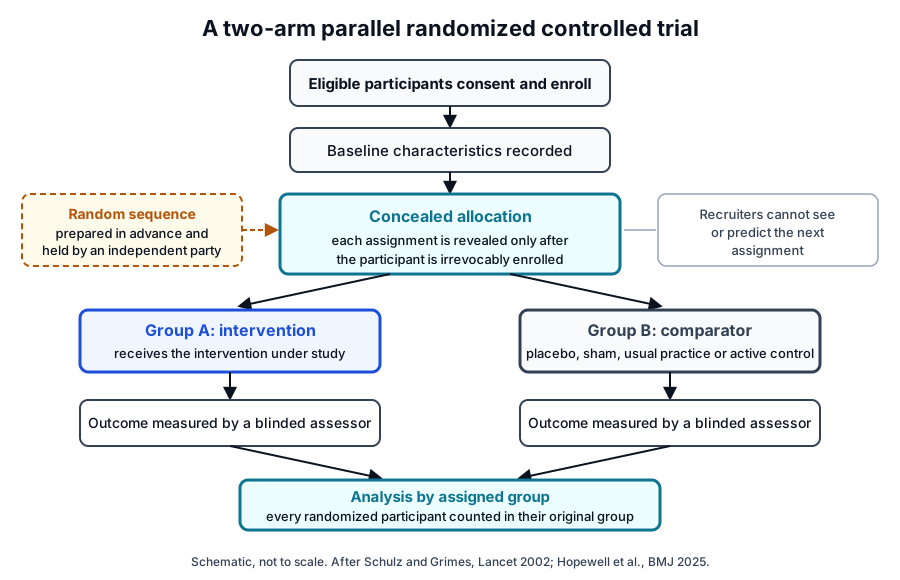
In a two-arm parallel trial, enrolled participants pass through a concealed allocation step into an intervention group and a comparator group, blinded assessors measure the outcomes, and the analysis keeps each participant in the assigned group (Fig. 1). The CONSORT 2025 checklist and flow diagram ask reports to document each of these steps.[1][5]
Generating the allocation sequence with simple, block, stratified and minimization methods
The allocation sequence is the list that decides which group each successive participant enters. Schulz and Grimes ask that it come from a random process and that reports describe the method clearly.[3]
Simple randomization
Simple, or unrestricted, randomization is analogous to repeated fair coin tossing. Schulz and Grimes state that no other approach surpasses it for preventing bias, and that readers should expect and accept the disparities in group size it produces.[3]
Block and stratified randomization
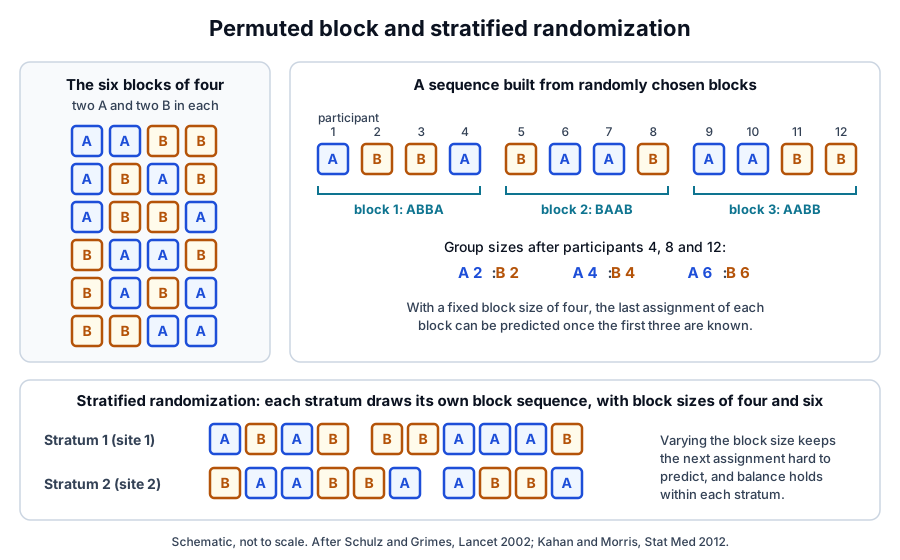
Blocked randomization restricts the sequence so that group sizes balance at the end of every block; with blocks of four, each block holds two assignments to each group (Fig. 2). Schulz and Grimes advise varying block sizes at random and using larger blocks, particularly in an unblinded trial.[3]
With a fixed block of four, the last assignment of each block can be deduced once the first three are known, which is why varied block sizes matter.[3] Stratified randomization prepares a separate sequence within each stratum, such as a recruiting site, and works only when the sequence within each stratum is itself restricted.[3]
Kahan and Morris showed that balancing groups with stratified blocks or minimization makes the groups correlated. An analysis that ignores the balancing variables gives confidence intervals that are too wide and loses power, while an adjusted analysis gives valid inference.[6]
Minimization
Minimization assigns each new participant so that predefined factors and group sizes stay as balanced as possible, a method proposed by Taves and by Pocock and Simon. In the simulations reviewed by Scott and colleagues, it produced better balanced groups than restricted or unrestricted randomization and handled more prognostic factors than stratified blocks.[7]
Scott and colleagues describe minimization as a largely nonrandom method whose assignments can sometimes be predicted with certainty. The review also reports the recommendation that analyses adjust for the minimization factors.[6][7]
Allocation concealment protects the sequence until each assignment is made
Allocation concealment keeps the clinicians and participants involved in enrollment unaware of upcoming assignments. Schulz and Grimes call it the basis of proper randomization, since without it even a properly generated sequence can be subverted by anyone who deciphers it.[4]
Concealment acts up to the moment of assignment, and blinding acts afterward, during delivery of the interventions, measurement and analysis. Schulz and Grimes report that many medical researchers confuse the two, a confusion that indicates misunderstanding of both.[8]
Common mechanisms are a central randomization service contacted after enrollment and sequentially numbered, opaque, sealed envelopes, and a report should name the mechanism used.[2][4] The concealment step sits between enrollment and the two groups in a parallel trial (Fig. 1).[4]
Concealment and effect size
In a 1995 study, Schulz and colleagues analyzed 250 controlled trials from 33 meta-analyses. Compared with adequately concealed trials, odds ratios were exaggerated by 41% in trials with inadequate concealment and by 30% in trials with unclear concealment.[9]
Savović and colleagues later combined 1,973 trials from seven meta-epidemiological studies and found exaggerated effect estimates with inadequate or unclear sequence generation and concealment, driven mainly by subjectively assessed outcomes.[10] A systematic review of 24 meta-epidemiological studies by Page and colleagues reached a similar conclusion.[11]
Blinding works best when each blinded group is named
Blinding keeps trial participants, investigators or outcome assessors unaware of the assigned intervention so that the knowledge cannot influence them. Schulz and Grimes explain that it reduces differential assessment of outcomes and can also improve adherence and retention and limit co-intervention.[8]
Four groups that can be blinded
- Participants, whose adherence and retention blinding can support.[8]
- Clinicians and other care providers, whose knowledge of the assignment can lead to supplemental care, called co-intervention.[8]
- Outcome assessors, the people who collect or adjudicate outcome data.[8]
- Data analysts, one of the six groups Devereaux and colleagues listed when asking physicians what blinding terms mean.[12]
Why "double blind" needs a definition
Devereaux and colleagues surveyed 91 physicians and 25 textbooks and found 17 physician interpretations and nine textbook definitions of double blinding. They concluded that explicit statements about the blinding status of each group should replace the ambiguous terms.[12]
Schulz and Grimes ask reports to state who was blinded and how. They recommend placing greater credence in results when at least the outcome assessment was blinded, with objective outcomes leaving little room for bias.[8]
What meta-epidemiological studies report about blinding
Hróbjartsson and colleagues reviewed 21 trials that assessed the same binary outcome with both blinded and non-blinded assessors. Non-blinded assessors exaggerated odds ratios by 36% on average.[13]
In the MetaBLIND study of 1,153 trials, Moustgaard and colleagues found no evidence of an average difference in estimated effects by blinding status. The authors suggested replication and advised that blinding remain a methodological safeguard in trials.[14]
Parallel, crossover, factorial, cluster and split-body designs suit different questions
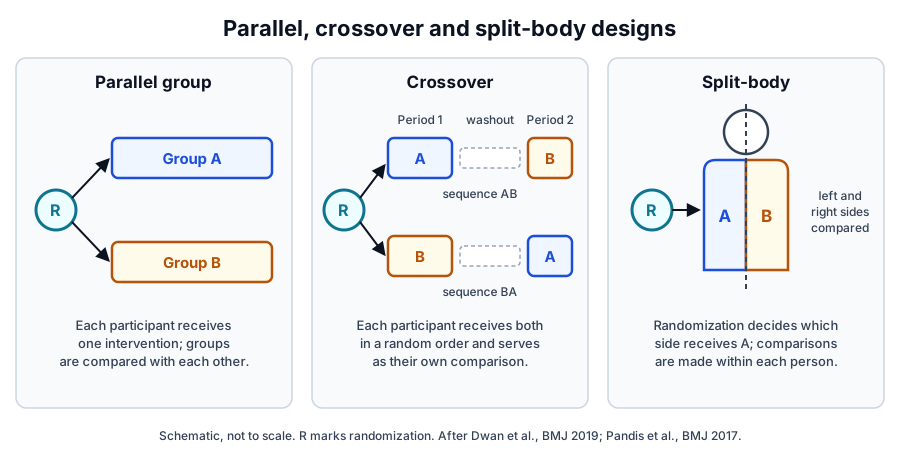
Most trials use a parallel group design, in which each participant receives one intervention and the groups are compared with each other (Fig. 3). The CONSORT statement was written mainly for two-group parallel trials, and extensions cover the other designs.[15]
| Design | Unit randomized | Comparison | Reporting guidance |
|---|---|---|---|
| Parallel group | Individual participant | Between groups | CONSORT 2025 |
| Crossover | Participant, to a sequence | Within each participant across periods | CONSORT crossover extension |
| Factorial | Participant, once per intervention | Each main comparison and the interaction | CONSORT factorial extension |
| Cluster | Intact group, such as a clinic | Between clusters | CONSORT cluster extension |
| Split-body or within-person | Body site within a participant | Between sites in the same person | CONSORT within-person extension |
Crossover trials
In a crossover trial, participants are randomized to a sequence of interventions and so act as their own control. Dwan and colleagues describe the design as useful and efficient, and their CONSORT extension adds a modified flowchart and baseline table.[15]
Factorial trials
A factorial trial assesses two or more interventions in the same set of participants. Kahan and colleagues ask authors to report why the design was chosen, whether an interaction was hypothesized and, for each main comparison, the estimated interaction effect and its precision.[16]
Cluster randomized trials
Cluster randomized trials assign intact groups, such as clinics, to the interventions. Hemming and colleagues show that intracluster correlation gives diminishing returns in power and precision as clusters grow, so the number of clusters and the cluster size should be set together.[17]
Ivers and colleagues reviewed 300 cluster randomized trials published from 2000 to 2008. Reporting improved on five of 14 criteria after the 2004 CONSORT cluster extension, including identification as cluster randomized and the number of clusters randomized.[18]
Split-body and other within-person trials
Within-person trials compare interventions applied to two or more body sites of the same participant, as in split-body designs where randomization decides which side receives which intervention. Pandis and colleagues note that these trials are most common in ophthalmology, dentistry and dermatology.[19]
Because each comparison is made within a person, the design is efficient. The CONSORT within-person extension extends 16 checklist items and introduces a modified flowchart and baseline table.[19]
Sample size, primary outcome and registration are fixed before enrollment
The primary outcome is the outcome of greatest importance specified in the protocol, and federal regulation notes that it is usually the one used in the power calculation.[20] SPIRIT 2025 sets out 34 minimum items for a trial protocol, with a new open science section.[21]
Charles and colleagues reviewed 215 two-arm parallel trials and found that 43% did not report all the parameters needed for the sample size calculation. Only 34% reported all the data, calculated accurately and used accurate assumptions for the control group.[22]
Trial registration
Registration makes the design and primary outcome public before results exist. The International Committee of Medical Journal Editors announced in 2004 that member journals would require registration in a public registry, and from 2005 trials had to register before enrollment to be published in those journals.[23][24]
In the United States, 42 CFR Part 11 sets requirements for submitting registration and results information for applicable clinical trials to ClinicalTrials.gov, the registry and results database established by the National Library of Medicine.[20] The NIH defines a clinical trial as a study in which participants are prospectively assigned to one or more interventions to evaluate their effects on health-related outcomes.[25]
Zarin and colleagues found that 61% of a sample of registered outcome measures lacked specificity about the metric used in the planned analysis.[26] A precise registry entry names the measure, the time point and the analysis metric.[21][26]
Comparing the registry with the report
Chan and colleagues compared protocols with published articles for 102 trials and found that 62% had at least one primary outcome changed, introduced or omitted.[27] Mathieu and colleagues found discrepancies between registered and published outcomes in 31% of adequately registered trials.[24]
The COMPare project assessed 67 trials in five major journals against their protocols or registry entries, and 58 of them needed a correction letter.[28] Any reader can repeat this comparison by opening the trial record on ClinicalTrials.gov.[20]
Analysis by assigned group preserves the randomized comparison
Intention-to-treat analysis, also called analysis by assigned group, includes every randomized participant in the group to which they were allocated. Schulz and Grimes state that in principle no exclusions after randomization are allowed in the primary analysis.[5]
Exclusions before randomization leave the comparison unbiased, though they can limit generalizability. Per-protocol analyses keep only participants who followed the protocol, and Schulz and Grimes ask that they be described as secondary, non-randomized comparisons.[5]
Hollis and Campbell surveyed trial reports published in 1997 in four general medical journals. Of these, 48% mentioned intention-to-treat analysis, the approach was often inadequately described and applied, and 75% of trials had some missing data on the primary outcome.[29]
Estimands state the question precisely
The ICH E9(R1) addendum, issued by FDA as guidance, presents a structured framework for describing the effect of interest that a clinical trial should address.[30] Kahan and colleagues explain that estimands clarify the exact research question and align study design, data collection and estimation methods with it.[31]
CONSORT 2025 defines the complete report of a randomized controlled trial
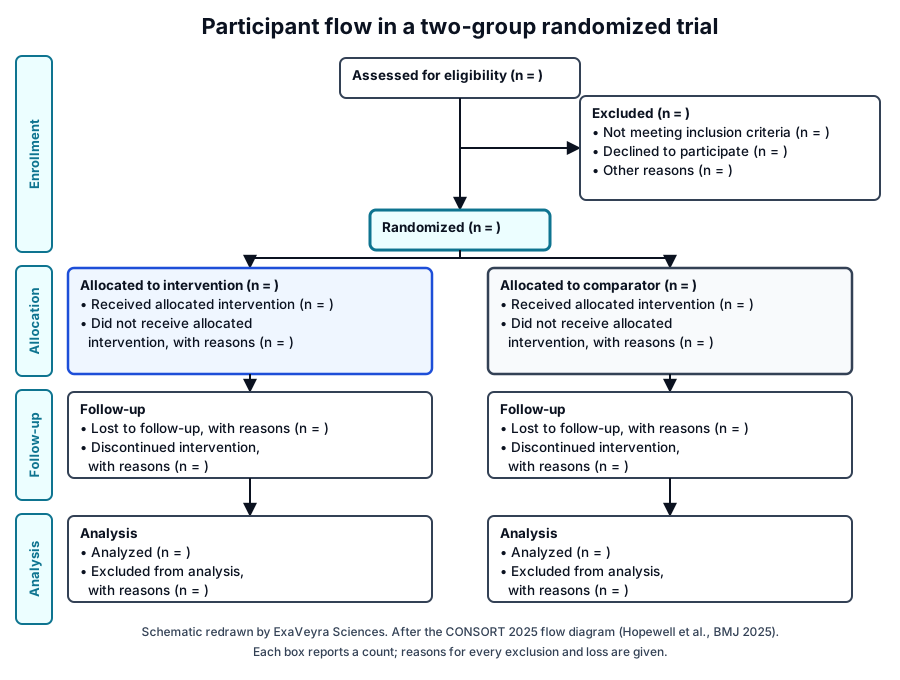
The CONSORT 2025 statement, published by Hopewell and colleagues, consists of a 30-item checklist and a diagram of participant flow through the trial (Fig. 4). It updates CONSORT 2010 after a three-round Delphi survey of 317 participants and a consensus meeting of 30 experts.[1]
The update added seven items, revised three, deleted one and introduced a section on open science. The explanation and elaboration document gives the rationale for each item with published examples of good reporting.[1][2]
The flow diagram counts participants at enrollment, allocation, follow-up and analysis and gives reasons for each exclusion and loss. Schulz and Grimes recommended such a trial profile to show the progress of all randomized participants.[1][5]
Common weaknesses readers should spot
Meta-epidemiological research points to a short list of features linked to exaggerated effect estimates, with the largest average bias in trials of subjective outcomes.[11] Each item below maps to the CONSORT 2025 checklist.[1]
- A sequence generation method left undescribed, or a systematic, non-random method of allocation.[3][10]
- No description of the allocation concealment mechanism.[4][9]
- Blinding described only as "double blind", with no statement of who was blinded.[8][12]
- A primary outcome that differs from the registry entry or protocol.[27][28]
- Registration dated after the trial was completed.[24]
- Participants excluded after randomization, or flow diagram counts that fail to reconcile.[5]
- A sample size calculation with missing parameters.[22]
- Stratified or minimized allocation analyzed without the balancing factors.[6]
Where to go from here
The hierarchy of evidence reference places the randomized controlled trial among other study designs, and the sham and placebo controls reference covers comparator arms for procedure-based research. The bias assessment reference applies these checks domain by domain, and the systematic reviews and meta-analysis reference shows how trials are pooled.
The clinical trial phases reference explains how trials are staged, and the exosome clinical trials and remestemcel-L references show these methods in the regulatory record. The clinic launch guide to reading the evidence, the extracellular vesicle potency assay reference and our quality references carry them into sourcing decisions, and our team is glad to discuss any of these methods.
Annotated References
Numbered in the order they are cited in the text. Each source is annotated with what it supports on this page; peer-reviewed articles are listed with journal, volume, issue and pages, and primary sources are regulations, agency documents and reference databases.
- 1.Peer-reviewedHopewell S, Chan AW, Collins GS, et al. CONSORT 2025 statement: updated guideline for reporting randomised trials. BMJ. 2025. https://pubmed.ncbi.nlm.nih.gov/40228833/Annotation: The current reporting guideline for randomized trials. Cited for the 30-item checklist and flow diagram, the Delphi and consensus process, the seven added, three revised and one deleted items, and the open science section.
- 2.Peer-reviewedHopewell S, Chan AW, Collins GS, et al. CONSORT 2025 explanation and elaboration: updated guideline for reporting randomised trials. BMJ. 2025. https://pubmed.ncbi.nlm.nih.gov/40228832/Annotation: Companion document to CONSORT 2025. Cited for the point that appraisal depends on complete reporting and for the rationale and examples given for each checklist item.
- 3.Peer-reviewedSchulz KF, Grimes DA. Generation of allocation sequences in randomised trials: chance, not choice. Lancet. 2002. https://pubmed.ncbi.nlm.nih.gov/11853818/Annotation: Lancet methods series on sequence generation. Cited for selection and confounding biases, simple randomization, blocked randomization with varied and larger blocks, and stratification within restricted sequences.
- 4.Peer-reviewedSchulz KF, Grimes DA. Allocation concealment in randomised trials: defending against deciphering. Lancet. 2002. https://pubmed.ncbi.nlm.nih.gov/11867132/Annotation: Lancet methods series on allocation concealment. Cited for concealment as the basis of randomization, subversion by deciphering, concealment mechanisms and the reporting of baseline comparisons without hypothesis tests.
- 5.Peer-reviewedSchulz KF, Grimes DA. Sample size slippages in randomised trials: exclusions and the lost and wayward. Lancet. 2002. https://pubmed.ncbi.nlm.nih.gov/11888606/Annotation: Lancet methods series on exclusions and losses. Cited for analysis of all randomized participants in their assigned groups, per-protocol analyses as secondary comparisons and the trial profile.
- 6.Peer-reviewedKahan BC, Morris TP. Improper analysis of trials randomised using stratified blocks or minimisation. Statistics in Medicine. 2012. https://pubmed.ncbi.nlm.nih.gov/22139891/Annotation: Literature review and simulation study. Cited for the correlation that stratification induces between groups and the wide intervals and lost power of unadjusted analyses.
- 7.Peer-reviewedScott NW, McPherson GC, Ramsay CR, et al. The method of minimization for allocation to clinical trials. a review. Controlled Clinical Trials. 2002. https://pubmed.ncbi.nlm.nih.gov/12505244/Annotation: Systematic literature review of minimization. Cited for its origins with Taves and with Pocock and Simon, its balance in simulations, predictability and the recommendation to adjust for minimization factors.
- 8.Peer-reviewedSchulz KF, Grimes DA. Blinding in randomised trials: hiding who got what. Lancet. 2002. https://pubmed.ncbi.nlm.nih.gov/11879884/Annotation: Lancet methods series on blinding. Cited for the definition of blinding, its effects on outcome assessment, adherence, retention and co-intervention, confusion with concealment, and stating who was blinded and how.
- 9.Peer-reviewedSchulz KF, Chalmers I, Hayes RJ, et al. Empirical evidence of bias. Dimensions of methodological quality associated with estimates of treatment effects in controlled trials. JAMA. 1995. https://pubmed.ncbi.nlm.nih.gov/7823387/Annotation: Methodological study of 250 trials from 33 meta-analyses. Cited for odds ratios exaggerated by 41% with inadequate and 30% with unclear allocation concealment.
- 10.Peer-reviewedSavović J, Jones HE, Altman DG, et al. Influence of reported study design characteristics on intervention effect estimates from randomized, controlled trials. Annals of Internal Medicine. 2012. https://pubmed.ncbi.nlm.nih.gov/22945832/Annotation: Combined analysis of seven meta-epidemiological studies covering 1,973 trials. Cited for exaggerated estimates with inadequate or unclear sequence generation and concealment, driven by subjective outcomes.
- 11.Peer-reviewedPage MJ, Higgins JP, Clayton G, et al. Empirical Evidence of Study Design Biases in Randomized Trials: Systematic Review of Meta-Epidemiological Studies. PLoS One. 2016. https://pubmed.ncbi.nlm.nih.gov/27398997/Annotation: Systematic review of 24 meta-epidemiological studies. Cited for exaggerated estimates linked to sequence generation and concealment, with the largest average bias in trials of subjective outcomes.
- 12.Peer-reviewedDevereaux PJ, Manns BJ, Ghali WA, et al. Physician interpretations and textbook definitions of blinding terminology in randomized controlled trials. JAMA. 2001. https://pubmed.ncbi.nlm.nih.gov/11308438/Annotation: Survey of 91 physicians and review of 25 textbooks. Cited for the 17 physician interpretations and nine textbook definitions of double blinding, the groups surveyed, and the call for explicit statements.
- 13.Peer-reviewedHróbjartsson A, Thomsen AS, Emanuelsson F, et al. Observer bias in randomised clinical trials with binary outcomes: systematic review of trials with both blinded and non-blinded outcome assessors. BMJ. 2012. https://pubmed.ncbi.nlm.nih.gov/22371859/Annotation: Systematic review of 21 trials with blinded and non-blinded assessment of the same binary outcome. Cited for the 36% average exaggeration of odds ratios by non-blinded assessors.
- 14.Peer-reviewedMoustgaard H, Clayton GL, Jones HE, et al. Impact of blinding on estimated treatment effects in randomised clinical trials: meta-epidemiological study. BMJ. 2020. https://pubmed.ncbi.nlm.nih.gov/31964641/Annotation: MetaBLIND study of 142 meta-analyses and 1,153 trials. Cited for finding no evidence of an average difference by blinding status and for the advice that blinding remain a methodological safeguard.
- 15.Peer-reviewedDwan K, Li T, Altman DG, et al. CONSORT 2010 statement: extension to randomised crossover trials. BMJ. 2019. https://pubmed.ncbi.nlm.nih.gov/31366597/Annotation: CONSORT extension for crossover trials. Cited for randomization to a sequence of interventions, participants as their own control, and the focus of the main statement on two-group parallel trials.
- 16.Peer-reviewedKahan BC, Hall SS, Beller EM, et al. Reporting of Factorial Randomized Trials: Extension of the CONSORT 2010 Statement. JAMA. 2023. https://pubmed.ncbi.nlm.nih.gov/38051324/Annotation: CONSORT extension for factorial trials. Cited for the definition of the design and the recommendations on reasons for the design, hypothesized interaction and the reported interaction effect.
- 17.Peer-reviewedHemming K, Eldridge S, Forbes G, et al. How to design efficient cluster randomised trials. BMJ. 2017. https://pubmed.ncbi.nlm.nih.gov/28710062/Annotation: Methods article on cluster trial design. Cited for diminishing returns in power and precision with cluster size and for setting cluster number and size together.
- 18.Peer-reviewedIvers NM, Taljaard M, Dixon S, et al. Impact of CONSORT extension for cluster randomised trials on quality of reporting and study methodology: review of random sample of 300 trials, 2000-8. BMJ. 2011. https://pubmed.ncbi.nlm.nih.gov/21948873/Annotation: Methodological review of 300 cluster randomized trials. Cited for improvement on five of 14 reporting criteria after the 2004 CONSORT cluster extension.
- 19.Peer-reviewedPandis N, Chung B, Scherer RW, et al. CONSORT 2010 statement: extension checklist for reporting within person randomised trials. BMJ. 2017. https://pubmed.ncbi.nlm.nih.gov/28667088/Annotation: CONSORT extension for within-person trials. Cited for comparisons between body sites in the same participant, the fields where the design is most common and the 16 extended checklist items.
- 20.Regulatory42 CFR Part 11, Clinical Trials Registration and Results Information Submission (eCFR). Accessed 20 October 2026. https://www.ecfr.gov/current/title-42/chapter-I/subchapter-A/part-11
- 21.Peer-reviewedChan AW, Boutron I, Hopewell S, et al. SPIRIT 2025 statement: updated guideline for protocols of randomised trials. BMJ. 2025. https://pubmed.ncbi.nlm.nih.gov/40294953/Annotation: The current protocol guideline for randomized trials. Cited for the 34 minimum protocol items and the new open science section.
- 22.Peer-reviewedCharles P, Giraudeau B, Dechartres A, et al. Reporting of sample size calculation in randomised controlled trials: review. BMJ. 2009. https://pubmed.ncbi.nlm.nih.gov/19435763/Annotation: Review of 215 two-arm parallel trials in six general medical journals. Cited for the 43% missing required parameters and the 34% with complete, accurate calculations and assumptions.
- 23.Peer-reviewedDe Angelis C, Drazen JM, Frizelle FA, et al. Clinical trial registration: a statement from the International Committee of Medical Journal Editors. Lancet. 2004. https://pubmed.ncbi.nlm.nih.gov/15364170/Annotation: ICMJE statement on trial registration. Cited for the requirement that trials be registered in a public registry to be considered for publication in member journals.
- 24.Peer-reviewedMathieu S, Boutron I, Moher D, et al. Comparison of registered and published primary outcomes in randomized controlled trials. JAMA. 2009. https://pubmed.ncbi.nlm.nih.gov/19724045/Annotation: Review of 323 published trials and their registry entries. Cited for the 2005 ICMJE registration requirement, registration after study completion and discrepancies in 31% of adequately registered trials.
- 25.Official sourceNIH Definition of a Clinical Trial (National Institutes of Health, Grants and Funding). Accessed 20 October 2026. https://grants.nih.gov/policy-and-compliance/policy-topics/clinical-trials/definition
- 26.Peer-reviewedZarin DA, Tse T, Williams RJ, et al. The ClinicalTrials.gov results database--update and key issues. New England Journal of Medicine. 2011. https://pubmed.ncbi.nlm.nih.gov/21366476/Annotation: Analysis of public ClinicalTrials.gov records from 2009 to 2010. Cited for the 61% of sampled outcome measures lacking specificity about the analysis metric.
- 27.Peer-reviewedChan AW, Hróbjartsson A, Haahr MT, et al. Empirical evidence for selective reporting of outcomes in randomized trials: comparison of protocols to published articles. JAMA. 2004. https://pubmed.ncbi.nlm.nih.gov/15161896/Annotation: Cohort of 102 trial protocols and their publications. Cited for the 62% of trials with at least one primary outcome changed, introduced or omitted.
- 28.Peer-reviewedGoldacre B, Drysdale H, Dale A, et al. COMPare: a prospective cohort study correcting and monitoring 58 misreported trials in real time. Trials. 2019. https://pubmed.ncbi.nlm.nih.gov/30760329/Annotation: Prospective assessment of 67 trials in five journals against protocols or registry entries. Cited for the 58 trials whose outcome reporting needed a correction letter.
- 29.Peer-reviewedHollis S, Campbell F. What is meant by intention to treat analysis? Survey of published randomised controlled trials. BMJ. 1999. https://pubmed.ncbi.nlm.nih.gov/10480822/Annotation: Survey of trial reports in four general medical journals in 1997. Cited for the 48% that mentioned intention-to-treat analysis, its inadequate description and application, and missing primary outcome data in 75%.
- 30.RegulatoryFDA guidance, E9(R1) Statistical Principles for Clinical Trials: Addendum: Estimands and Sensitivity Analysis in Clinical Trials. Accessed 20 October 2026. https://www.fda.gov/regulatory-information/search-fda-guidance-documents/e9r1-statistical-principles-clinical-trials-addendum-estimands-and-sensitivity-analysis-clinical
- 31.Peer-reviewedKahan BC, Hindley J, Edwards M, et al. The estimands framework: a primer on the ICH E9(R1) addendum. BMJ. 2024. https://pubmed.ncbi.nlm.nih.gov/38262663/Annotation: Primer on the estimands framework. Cited for estimands clarifying the research question and aligning design, data collection and estimation methods with it.
Cite this page
ExaVeyra Sciences Editorial Team. Randomized Controlled Trials: Randomization and Blinding. ExaVeyra Sciences; 21 October 2026. Available from: https://exaveyra.com/science/research-methods/randomized-controlled-trials. Accessed [date accessed].