Remestemcel-L: The First FDA-Approved MSC Product
By Benn Bluestein-Veyra, M.Sc. Organic Chemistry · Updated 20 October 2026
ExaVeyra Sciences is a Miami-based B2B supplier of exosomes for topical aesthetic use to licensed clinics, and it refers licensed prescribers to a 503A compounding pharmacy that prepares formulations against individual prescriptions.
| Question | Answer |
|---|---|
| What this page covers | How remestemcel-L became the first mesenchymal stromal cell product approved by FDA through a biologics license application, and what the approval record documents. |
| Who can order | Licensed clinics and practitioners whose active professional license and NPI ExaVeyra has verified. Exosome orders also require a signed professional-use acknowledgment. |
| What ships, and how | Exosome material for topical aesthetic use, characterized by lot, ships overnight in a cold chain. Delivery can take 1 to 3 business days. A certificate of analysis is issued for every lot and provided on request. |
Remestemcel-L, licensed by FDA on December 18, 2024 through a biologics license application, is the first mesenchymal stromal cell product approved in the United States.[1][2] FDA approved it under section 351(a) of the Public Health Service Act as remestemcel-L-rknd, proprietary name RYONCIL, for the pediatric indication in FDA’s approved labeling.[1][3]
This reference reads the public approval record as FDA wrote it: the license, the product description, the regulatory history, and the potency and manufacturing questions that shaped the review.[4][5] Each statement is attributed to an FDA document or to the peer-reviewed literature on MSC manufacturing and regulatory science.
Identifying remestemcel-L in the FDA approval record
The approval letter from the Center for Biologics Evaluation and Research (CBER) issued U.S. License No. 2140 to Mesoblast, Inc. under STN BL 125706/0 and approved manufacture at Lonza Bioscience Singapore Pte Ltd.[1] The application was received on January 31, 2020, and FDA’s 2024 list of biological license approvals records the action date as December 18, 2024 (Fig. 1).[1][6]

FDA’s approved labeling describes the active ingredient as culture-expanded MSCs isolated from the bone marrow of healthy adult human donors.[3] FDA’s summary lists orphan drug, fast track and priority review designations in the regulatory history.[4] The ISCT MSC committee described the approval as ending a long wait for an approved MSC product in the United States.[2] CBER’s product page gathers the approval letter, package insert, Summary Basis for Regulatory Action and review memoranda in one place.[7]
Bone marrow MSCs of this kind were first characterized by Pittenger and colleagues, who isolated them from volunteer donors’ marrow aspirates and induced them toward adipocytic, chondrocytic and osteocytic lineages.[8] FDA’s summary records that product development began under an investigational new drug application filed by the product’s original developer.[4]
Distinguishing a 351 biologics license from a 361 HCT/P
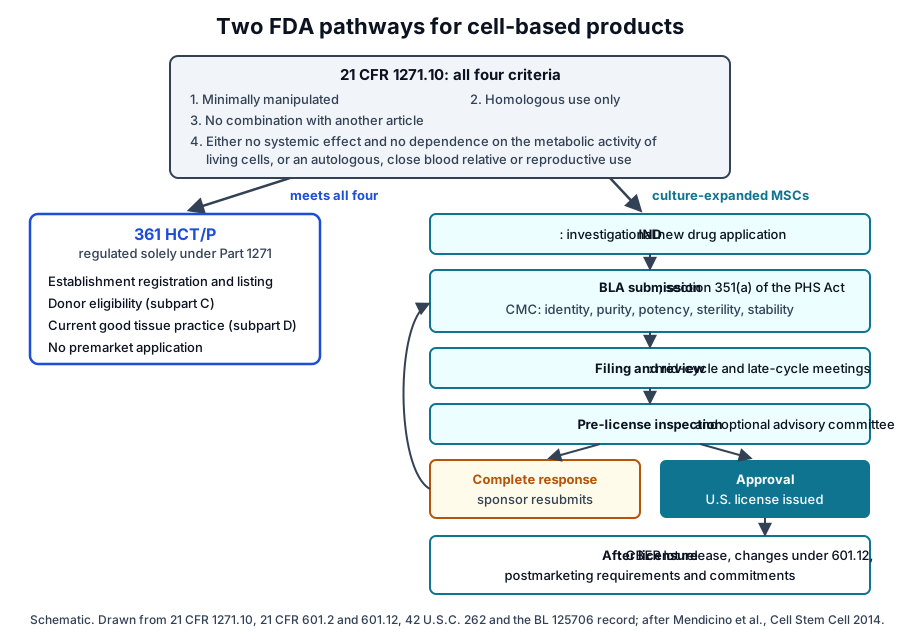
A human cell or tissue product is regulated solely under section 361 and 21 CFR Part 1271 when it meets all four criteria in 21 CFR 1271.10(a): minimal manipulation, homologous use, no combination with another article, and either no systemic effect and no dependence on the metabolic activity of living cells, or an autologous, close blood relative or reproductive use.[9] The 361 versus 351 reference on this site quotes the criteria in full and walks through each one.
For cells, minimal manipulation means processing that does not alter the relevant biological characteristics of the cells, as defined in 21 CFR 1271.3(f).[10] Culture expansion exceeds minimal manipulation, which places culture-expanded MSCs on the 351 pathway. That pathway runs from an investigational new drug application to a biologics license application (Fig. 2).[4][9]
Under 42 U.S.C. 262(a)(2)(C), FDA approves a biologics license on a demonstration that the product is safe, pure and potent, and that its facility meets standards designed to keep it so.[11] Under 21 CFR 601.2(d), approval is a determination that the establishment and the product meet the requirements that ensure continued safety, purity and potency.[12]
FDA scientists Mendicino, Bailey, Wonnacott, Puri and Bauer described MSC-based proposals reaching the agency with growing variability in donor and tissue sources, manufacturing processes, proposed mechanisms and characterization methods.[13] That variability is the setting in which the remestemcel-L record was built.
Describing the product as FDA’s labeling presents it
The package insert describes remestemcel-L as a frozen cell suspension in a cryogenic vial whose active ingredient is culture-expanded MSCs isolated from the bone marrow of healthy adult donors.[3] The cells are formulated in Plasma-Lyte A with human serum albumin and dimethyl sulfoxide, then thawed and combined with Plasma-Lyte A as the labeling describes.[3]
The approval letter sets a dating period of 60 months from the date of final fill when stored at or below −135 °C in liquid nitrogen vapor.[1] The package insert states that the product ships in a liquid nitrogen dry shipper and stays frozen in the vapor phase until it is thawed for use.[3]
FDA’s summary outlines the process: MSCs are isolated from bone marrow aspirate, culture-expanded and cryopreserved as a donor cell bank, and the contents of a single bank bag are thawed and expanded three further passages before harvest, formulation and fill.[4] Lot release covers identity by cell surface markers, potency, viability, cell concentration, appearance, residual trypsin and bovine serum albumin, sterility, mycoplasma and endotoxin.[4]
Reading identity against the ISCT marker panel
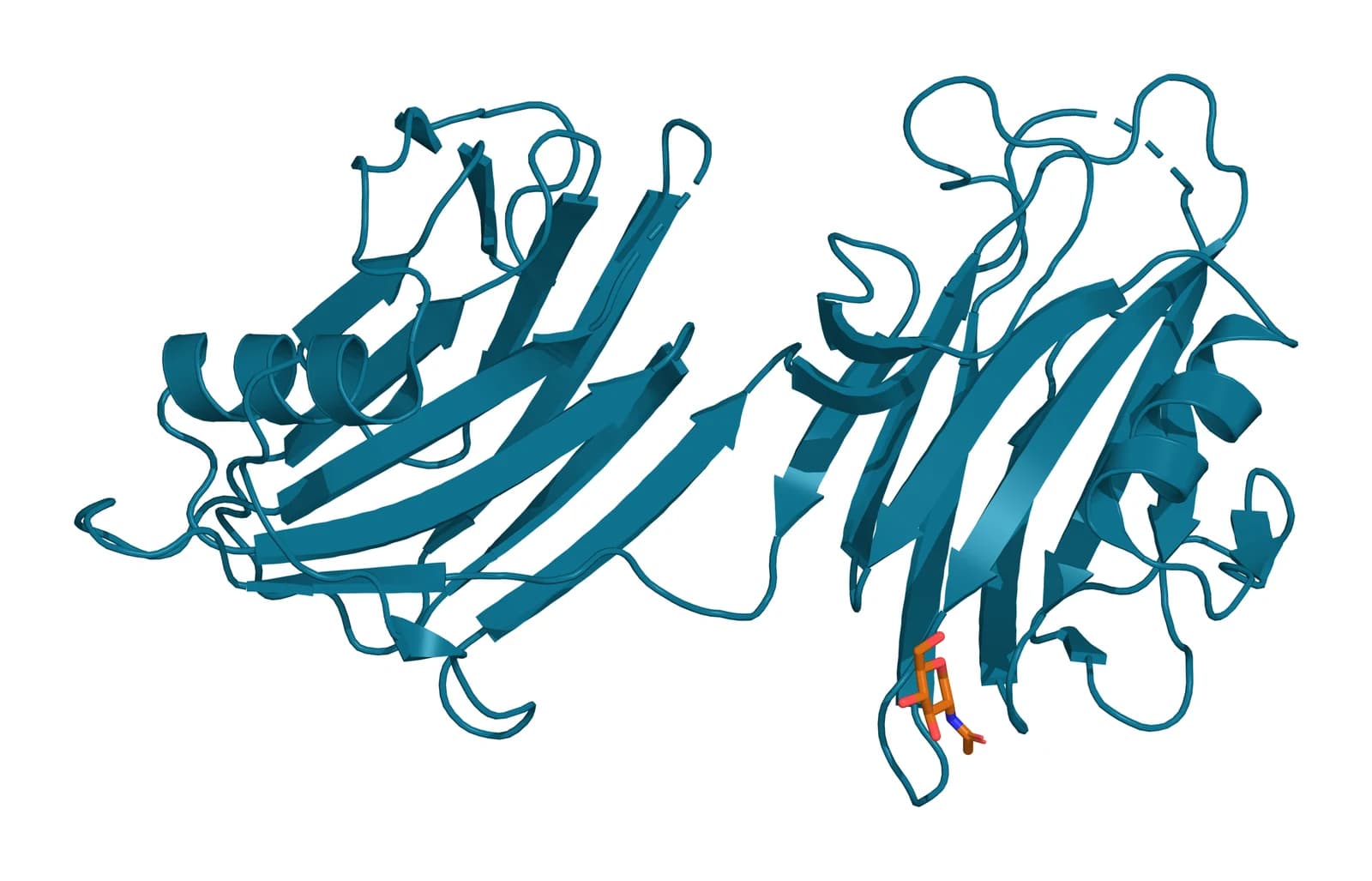
The commercial specification table in FDA’s summary lists CD166, CD105 and CD45 under identity.[4] The ISCT panel published by Dominici and colleagues defines MSCs by plastic adherence, expression of CD105, CD73 and CD90, absence of hematopoietic markers including CD45, and trilineage differentiation in vitro.[14]
CD105 is endoglin, one of the three positive markers in that panel (Fig. 3).[14] Viswanathan and colleagues, for the ISCT MSC committee, recommended naming MSCs with their tissue source and pairing them with a matrix of functional assays chosen for the intended mode of action.[15]
Tracing the regulatory history FDA documents
FDA’s summary lists the milestones: an investigational new drug application in October 1998, orphan drug designation in December 2005, fast track designation in February 2017, a pre-BLA meeting in April 2019 and filing with priority review in March 2020 (Fig. 4).[4] An FDA advisory committee met on August 13, 2020, and its morning session addressed chemistry, manufacturing and controls (CMC) questions.[4]
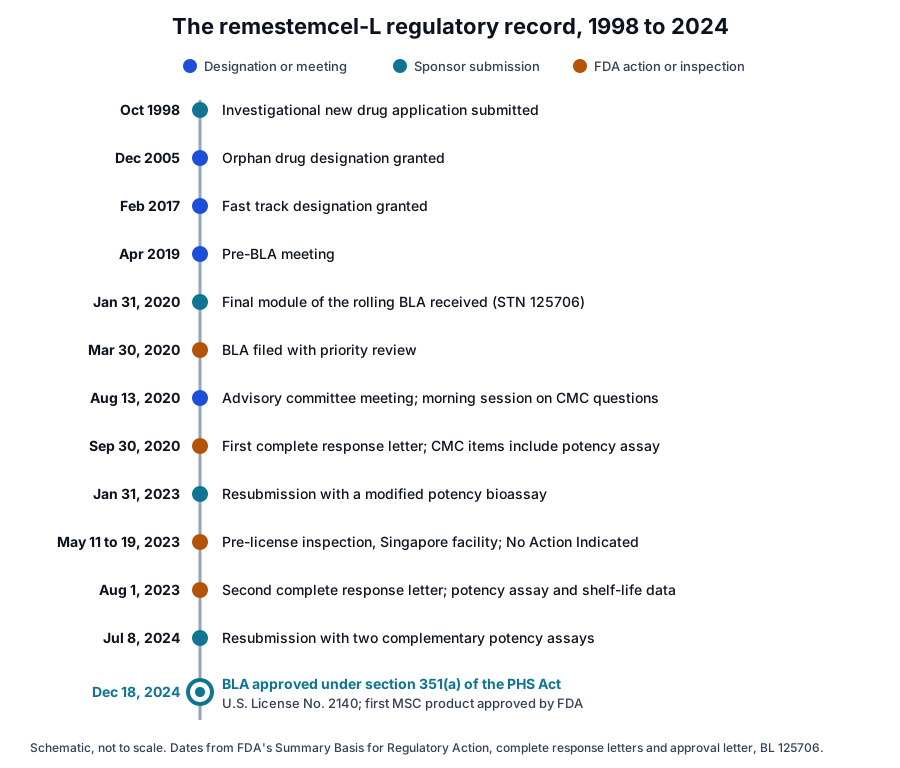
FDA issued complete response letters on September 30, 2020 and August 1, 2023, each listing clinical and CMC items for the sponsor to address.[5] Mesoblast resubmitted on January 31, 2023 and on July 8, 2024, and FDA’s summary describes the history as several cycles of BLA submissions and complete response actions.[4]
CBER inspected the Singapore drug product facility from May 11 to 19, 2023, issued no Form FDA 483, and classified the inspection No Action Indicated.[4] The summary records that the July 2024 resubmission addressed the CMC items by implementing two complementary potency assays that support lot release and shelf-life determination.[4]
| Date | Event in the FDA record |
|---|---|
| October 1998 | Investigational new drug application submitted |
| December 2005 | Orphan drug designation granted |
| February 2017 | Fast track designation granted |
| January 31, 2020 | Final module of the rolling BLA received |
| March 30, 2020 | BLA filed with priority review |
| August 13, 2020 | Advisory committee meeting with a CMC session |
| September 30, 2020 | First complete response letter |
| January 31, 2023 | First resubmission |
| August 1, 2023 | Second complete response letter |
| July 8, 2024 | Second resubmission |
| December 18, 2024 | Approval and U.S. License No. 2140 |
Defining potency for a living cell product
Federal regulation defines potency as the specific ability or capacity of the product, indicated by appropriate laboratory tests or adequately controlled clinical data, to effect a given result.[16] Under 21 CFR 610.10, potency tests are in vitro or in vivo tests designed specifically for each product.[17] FDA’s 2011 guidance on potency tests for cellular and gene products expands on both rules.[18]
The first complete response letter addressed an analytical potency assay that measured TNFR1 in the cells.[5] FDA asked for a demonstrated relationship between that attribute and a product-specific biological activity, and both the sponsor and FDA read 2020 knockdown experiments as showing that suppression of activated T cell proliferation in vitro was independent of TNFR1.[5]
The second letter reviewed a modified bioassay measuring inhibition of IL-2Rα, a T cell activation marker, and asked for data linking its acceptance criterion to the potency of lots used in clinical studies.[5] It also asked for stability studies with at least one quantitative potency test, citing 21 CFR 211.137(a) and 211.166(a)(3) on reliable, meaningful and specific test methods.[5]
Placing the record within MSC potency science
Bravery and colleagues, reviewing industry experience for ISCT, described a potency assay as the basis for lot release, stability and comparability after process changes such as site transfer or a new donor.[20] Galipeau and colleagues proposed an assay matrix combining quantitative RNA analysis, flow cytometry of functional surface markers and secretome protein assays, measured after in vitro licensing.[21]
Krampera and colleagues, for the ISCT MSC committee, put forward standardized immune assays for MSC characterization.[22] Dutch regulators de Wolf, van de Bovenkamp and Hoefnagel reported that in vitro inhibition of T cell proliferation was the release assay most often proposed for MSC medicinal products, with biological relevance substantiated by product-specific data.[23]
Bloom and colleagues built a reproducible assay of CD4+ T cell suppression and found values from 27% to 88% across eleven MSC products from three centers.[24] Ketterl and colleagues pooled responder leukocytes to reduce assay variability and reported marked donor variation in MSC immunomodulatory capacity.[25]
In FDA’s own laboratories, Klinker and colleagues found that MSC morphology after IFN-γ stimulation predicted the immunosuppressive capacity of MSC lines from different donors and manufacturing conditions.[26] Chinnadurai and colleagues reported that thawed MSCs suppressed T cell proliferation across a transwell membrane, and that IFN-γ licensing before banking supported post-thaw function in co-culture.[27]
Capelli and colleagues reviewed potency assays across cell-based advanced medicinal products and the biomarkers proposed to complement complex functional tests.[28] The extracellular vesicle potency reference on this site applies the same principles to vesicle preparations.
Controlling manufacturing consistency across lots and sites
FDA’s summary lists five elements of the control strategy: raw material and reagent qualification, chain of identity and custody, in-process monitoring, process validation and release testing.[4] Donor screening and eligibility determination open the strategy at the bone marrow aspirate, and segregation of lots, equipment and personnel prevents mix-ups at the Singapore facility.[4]
The record also documents manufacturing transfers. Drug product manufacture moved from the original developer to Lonza Walkersville and, in 2014, to Lonza Singapore, which began production in 2015 from donor cell bank material made in 2008.[4] The first complete response letter noted that new donor cell banks would call for a comparability exercise supported by attributes associated with potency.[5]
| Release attribute | Tests named in FDA’s summary |
|---|---|
| Identity | Cell surface markers |
| Potency | IL-2Rα inhibition and a second potency assay |
| Viability and concentration | Cell viability and cell concentration |
| Purity | Residual trypsin and bovine serum albumin |
| Microbial testing | Sterility, mycoplasma and endotoxin |
| Appearance | Particulates and container integrity |
The literature shows why these controls matter. Stroncek and colleagues sent aliquots of the same marrow to five laboratories and found that the manufacturing center contributed more to MSC transcriptome variability than the source material did.[29] Liu and colleagues surveyed seven GMP centers, found that no two used the same method, and reported differences in bone formation in vivo across their products.[30]
Fekete and colleagues compared five GMP-compliant protocols using platelet lysate and obtained products meeting the ISCT minimal criteria.[31] A German consensus led by Wuchter set out quality criteria for bone marrow MSC production, including immunophenotype, medium composition, aging and immunosuppressive potential.[32]
Stultz and colleagues at FDA used spectral karyotyping across ten donors and recommended karyotypic monitoring of MSCs during expansion.[33] Marklein and colleagues showed that early morphological profiles predicted later mineralization capacity across donors and passages.[34] Lipsitz, Timmins and Zandstra argued for quality-by-design principles that link measurable cell attributes to final product quality.[35]
Robb and colleagues built a matrix of genes, secreted factors and morphometric features to define putative critical quality attributes, and found that culture process parameters drove immunomodulatory fitness.[36] These approaches give manufacturers quantitative handles on the consistency that FDA’s review emphasized.
Reading the postmarketing obligations in the approval letter
The approval letter requires CBER lot release: the sponsor submits protocols with results of all applicable release tests, and distributes a lot only after the Director of CBER notifies release.[1] Changes in manufacturing, testing, packaging, labeling or facilities are submitted for approval under 21 CFR 601.12, and biological product deviations are reported under 21 CFR 600.14.[1]
One postmarketing requirement under section 505(o) asks for completion of a cumulative leachables study across manufacturing and storage, with a toxicological assessment and a final report scheduled for October 31, 2030.[1] Three CMC postmarketing commitments cover an additional potency assay, an assay suitability study and an in-use stability study of critical quality attributes after simulated formulation, with final reports due December 31, 2027.[1]
Interpreting what the approval documents for the MSC field
The record shows a culture-expanded allogeneic MSC product completing the full 351 pathway, from an investigational application to a U.S. license with CBER lot release.[1][4] It also places potency control at the center of the CMC review, settled with two complementary assays and a commitment to a further one.[4] FDA’s 2023 draft guidance on potency assurance points the field toward an integrated potency strategy.[19]
Where to go from here
The 361 versus 351 reference explains the classification at the start of this record, and the ISCT minimal criteria reference covers the marker panel behind identity testing. The MSC source tissues reference compares bone marrow with perinatal and adipose sources, and the perinatal tissue donor eligibility reference describes how donors are qualified.
The extracellular vesicle potency reference carries the potency discussion into vesicle preparations, and the MSC immunobiology reference explains the HLA, IDO and PGE2 biology that many assays measure. ExaVeyra Sciences has no affiliation with remestemcel-L or its manufacturer; this page summarizes the public regulatory record.
This article summarizes publicly available FDA records and federal regulation for licensed practitioner education. It is not legal advice, medical advice, or regulatory guidance, and it does not establish that any particular product or practice is compliant. Confirm current federal and state obligations with qualified counsel.
Annotated References
Numbered in the order they are cited in the text. Each source is annotated with what it supports on this page; peer-reviewed articles are listed with journal, volume, issue and pages, and primary sources are regulations, agency documents and reference databases.
- 1.RegulatoryFDA, CBER, Approval letter for RYONCIL (remestemcel-L-rknd), STN BL 125706/0, December 18, 2024. Accessed 20 October 2026. https://www.fda.gov/media/184605/download
- 2.Peer-reviewedLe Blanc K, Dazzi F, English K, et al. ISCT MSC committee statement on the US FDA approval of allogenic bone-marrow mesenchymal stromal cells. Cytotherapy. 2025;27(4):413-416. https://pubmed.ncbi.nlm.nih.gov/39864015/Annotation: ISCT MSC committee statement on the December 2024 approval. Cited for the approval being the first of an MSC product in the United States, after other jurisdictions had approved MSC products.
- 3.RegulatoryFDA, RYONCIL (remestemcel-L-rknd) package insert, approved labeling. Accessed 20 October 2026. https://www.fda.gov/media/184603/download
- 4.RegulatoryFDA, CBER, Summary Basis for Regulatory Action, RYONCIL, December 18, 2024. Accessed 20 October 2026. https://www.fda.gov/media/185192/download
- 5.RegulatoryFDA, Approval History, Letters, Reviews, and Related Documents, RYONCIL (includes the complete response letters of September 30, 2020 and August 1, 2023) (ZIP archive). Accessed 20 October 2026. https://www.fda.gov/media/184954/download
- 6.RegulatoryFDA, CBER, 2024 Biological License Application Approvals. Accessed 20 October 2026. https://www.fda.gov/vaccines-blood-biologics/development-approval-process-cber/2024-biological-license-application-approvals
- 7.RegulatoryFDA, CBER, RYONCIL product page. Accessed 20 October 2026. https://www.fda.gov/vaccines-blood-biologics/cellular-gene-therapy-products/ryoncil
- 8.Peer-reviewedPittenger MF, Mackay AM, Beck SC, et al. Multilineage potential of adult human mesenchymal stem cells. Science. 1999;284(5411):143-147. https://pubmed.ncbi.nlm.nih.gov/10102814/Annotation: Isolation of human MSCs from volunteer donors’ marrow aspirates. Cited for the bone marrow origin and adipocytic, chondrocytic and osteocytic differentiation of the cells.
- 9.Regulatory21 CFR 1271.10, HCT/Ps regulated solely under section 361 of the PHS Act. Accessed 20 October 2026. https://www.ecfr.gov/current/title-21/chapter-I/subchapter-L/part-1271/subpart-A/section-1271.10
- 10.Regulatory21 CFR 1271.3, definitions. Accessed 20 October 2026. https://www.ecfr.gov/current/title-21/chapter-I/subchapter-L/part-1271/subpart-A/section-1271.3
- 11.Regulatory42 U.S.C. 262, Regulation of biological products (PHS Act section 351). Accessed 20 October 2026. https://www.govinfo.gov/content/pkg/USCODE-2024-title42/html/USCODE-2024-title42-chap6A-subchapII-partF-subpart1-sec262.htm
- 12.Regulatory21 CFR 601.2, Applications for biologics licenses; procedures for filing. Accessed 20 October 2026. https://www.ecfr.gov/current/title-21/chapter-I/subchapter-F/part-601/subpart-A/section-601.2
- 13.Peer-reviewedMendicino M, Bailey AM, Wonnacott K, et al. MSC-based product characterization for clinical trials: an FDA perspective. Cell Stem Cell. 2014;14(2):141-145. https://pubmed.ncbi.nlm.nih.gov/24506881/Annotation: CBER perspective on MSC product proposals. Cited for growing variability in donor and tissue sources, manufacturing, proposed mechanisms and characterization methods.
- 14.Peer-reviewedDominici M, Le Blanc K, Mueller I, et al. Minimal criteria for defining multipotent mesenchymal stromal cells. The International Society for Cellular Therapy position statement. Cytotherapy. 2006;8(4):315-317. https://pubmed.ncbi.nlm.nih.gov/16923606/Annotation: ISCT minimal criteria. Cited for plastic adherence, the CD105, CD73 and CD90 positive and hematopoietic negative marker panel, and trilineage differentiation.
- 15.Peer-reviewedViswanathan S, Shi Y, Galipeau J, et al. Mesenchymal stem versus stromal cells: International Society for Cell & Gene Therapy (ISCT®) Mesenchymal Stromal Cell committee position statement on nomenclature. Cytotherapy. 2019;21(10):1019-1024. https://pubmed.ncbi.nlm.nih.gov/31526643/Annotation: ISCT MSC committee nomenclature statement. Cited for naming MSCs with their tissue source and pairing them with a matrix of functional assays.
- 16.Regulatory21 CFR 600.3, definitions (potency, 600.3(s)). Accessed 20 October 2026. https://www.ecfr.gov/current/title-21/chapter-I/subchapter-F/part-600/subpart-A/section-600.3
- 17.Regulatory21 CFR 610.10, Potency. Accessed 20 October 2026. https://www.ecfr.gov/current/title-21/chapter-I/subchapter-F/part-610/subpart-A/section-610.10
- 18.RegulatoryFDA guidance for industry, Potency Tests for Cellular and Gene Therapy Products, January 2011. Accessed 20 October 2026. https://www.fda.gov/regulatory-information/search-fda-guidance-documents/potency-tests-cellular-and-gene-therapy-products
- 19.RegulatoryFDA draft guidance for industry, Potency Assurance for Cellular and Gene Therapy Products, December 2023. Accessed 20 October 2026. https://www.fda.gov/regulatory-information/search-fda-guidance-documents/potency-assurance-cellular-and-gene-therapy-products
- 20.Peer-reviewedBravery CA, Carmen J, Fong T, et al. Potency assay development for cellular therapy products: an ISCT review of the requirements and experiences in the industry. Cytotherapy. 2013;15(1):9-19. https://pubmed.ncbi.nlm.nih.gov/23260082/Annotation: ISCT review of potency assay expectations. Cited for potency assays as the basis of lot release, stability and comparability after process changes such as site transfer or a new donor.
- 21.Peer-reviewedGalipeau J, Krampera M, Barrett J, et al. International Society for Cellular Therapy perspective on immune functional assays for mesenchymal stromal cells as potency release criterion for advanced phase clinical trials. Cytotherapy. 2016;18(2):151-159. https://pubmed.ncbi.nlm.nih.gov/26724220/Annotation: ISCT workshop consensus on MSC potency release assays. Cited for the assay matrix of RNA analysis, flow cytometry of functional markers and secretome protein assays after in vitro licensing.
- 22.Peer-reviewedKrampera M, Galipeau J, Shi Y, et al. Immunological characterization of multipotent mesenchymal stromal cells--The International Society for Cellular Therapy (ISCT) working proposal. Cytotherapy. 2013;15(9):1054-1061. https://pubmed.ncbi.nlm.nih.gov/23602578/Annotation: ISCT MSC committee working proposal. Cited for its call for standardized immune assays in MSC characterization.
- 23.Peer-reviewedde Wolf C, van de Bovenkamp M, Hoefnagel M. Regulatory perspective on in vitro potency assays for human mesenchymal stromal cells used in immunotherapy. Cytotherapy. 2017;19(7):784-797. https://pubmed.ncbi.nlm.nih.gov/28457740/Annotation: Review by the Dutch Medicines Evaluation Board. Cited for T cell proliferation inhibition as the most often proposed MSC release assay and for product-specific substantiation of biological relevance.
- 24.Peer-reviewedBloom DD, Centanni JM, Bhatia N, et al. A reproducible immunopotency assay to measure mesenchymal stromal cell-mediated T-cell suppression. Cytotherapy. 2015;17(2):140-151. https://pubmed.ncbi.nlm.nih.gov/25455739/Annotation: Quality control T cell suppression assay across three production centers. Cited for assay values from 27% to 88% across eleven MSC products.
- 25.Peer-reviewedKetterl N, Brachtl G, Schuh C, et al. A robust potency assay highlights significant donor variation of human mesenchymal stem/progenitor cell immune modulatory capacity and extended radio-resistance. Stem Cell Research & Therapy. 2015;6:236. https://pubmed.ncbi.nlm.nih.gov/26620155/Annotation: Potency assay with pooled responder leukocytes. Cited for reduced assay variability and marked donor variation in MSC immunomodulatory capacity.
- 26.Peer-reviewedKlinker MW, Marklein RA, Lo Surdo JL, et al. Morphological features of IFN-γ-stimulated mesenchymal stromal cells predict overall immunosuppressive capacity. Proceedings of the National Academy of Sciences of the United States of America. 2017;114(13):E2598-E2607. https://pubmed.ncbi.nlm.nih.gov/28283659/Annotation: FDA CBER laboratory study. Cited for MSC morphology after IFN-γ stimulation predicting immunosuppressive capacity across donors and manufacturing conditions.
- 27.Peer-reviewedChinnadurai R, Copland IB, Garcia MA, et al. Cryopreserved Mesenchymal Stromal Cells Are Susceptible to T-Cell Mediated Apoptosis Which Is Partly Rescued by IFNγ Licensing. Stem Cells. 2016;34(9):2429-2442. https://pubmed.ncbi.nlm.nih.gov/27299362/Annotation: Study of MSC function after freeze and thaw. Cited for transwell suppression of T cell proliferation by thawed MSCs and for IFN-γ licensing before banking supporting post-thaw function in co-culture.
- 28.Peer-reviewedCapelli C, Cuofano C, Pavoni C, et al. Potency assays and biomarkers for cell-based advanced therapy medicinal products. Frontiers in Immunology. 2023;14:1186224. https://pubmed.ncbi.nlm.nih.gov/37359560/Annotation: Review of potency assays for GMP-manufactured cell products. Cited for potency assays across advanced medicinal products and biomarkers proposed alongside functional tests.
- 29.Peer-reviewedStroncek DF, Jin P, McKenna DH, et al. Human Mesenchymal Stromal Cell (MSC) Characteristics Vary Among Laboratories When Manufactured From the Same Source Material: A Report by the Cellular Therapy Team of the Biomedical Excellence for Safer Transfusion (BEST) Collaborative. Frontiers in Cell and Developmental Biology. 2020;8:458. https://pubmed.ncbi.nlm.nih.gov/32612991/Annotation: Five laboratories expanding MSCs from the same marrow aliquots. Cited for center effects exceeding source-material effects on MSC transcriptomes.
- 30.Peer-reviewedLiu S, de Castro LF, Jin P, et al. Manufacturing Differences Affect Human Bone Marrow Stromal Cell Characteristics and Function: Comparison of Production Methods and Products from Multiple Centers. Scientific Reports. 2017;7:46731. https://pubmed.ncbi.nlm.nih.gov/28447618/Annotation: Survey and comparison of bone marrow stromal cell lots from GMP centers. Cited for no two centers sharing a method and for variable bone formation in vivo.
- 31.Peer-reviewedFekete N, Rojewski MT, Fürst D, et al. GMP-compliant isolation and large-scale expansion of bone marrow-derived MSC. PLoS One. 2012;7(8):e43255. https://pubmed.ncbi.nlm.nih.gov/22905242/Annotation: Comparison of five GMP-compliant expansion protocols with platelet lysate. Cited for final products meeting the ISCT minimal criteria.
- 32.Peer-reviewedWuchter P, Bieback K, Schrezenmeier H, et al. Standardization of Good Manufacturing Practice-compliant production of bone marrow-derived human mesenchymal stromal cells for immunotherapeutic applications. Cytotherapy. 2015;17(2):128-139. https://pubmed.ncbi.nlm.nih.gov/24856898/Annotation: German consensus of researchers, clinicians and regulators. Cited for quality criteria in bone marrow MSC production: immunophenotype, medium composition, aging and immunosuppressive potential.
- 33.Peer-reviewedStultz BG, McGinnis K, Thompson EE, et al. Chromosomal stability of mesenchymal stromal cells during in vitro culture. Cytotherapy. 2016;18(3):336-343. https://pubmed.ncbi.nlm.nih.gov/26780865/Annotation: FDA laboratory spectral karyotyping of MSCs from ten donors. Cited for karyotypic monitoring of genetic stability during expansion.
- 34.Peer-reviewedMarklein RA, Lo Surdo JL, Bellayr IH, et al. High Content Imaging of Early Morphological Signatures Predicts Long Term Mineralization Capacity of Human Mesenchymal Stem Cells upon Osteogenic Induction. Stem Cells. 2016;34(4):935-947. https://pubmed.ncbi.nlm.nih.gov/26865267/Annotation: FDA laboratory high content imaging study. Cited for early morphology predicting later mineralization capacity across donors and passages.
- 35.Peer-reviewedLipsitz YY, Timmins NE, Zandstra PW. Quality cell therapy manufacturing by design. Nature Biotechnology. 2016;34(4):393-400. https://pubmed.ncbi.nlm.nih.gov/27054995/Annotation: Perspective on quality by design in cell manufacturing. Cited for linking measurable cell attributes to final product quality.
- 36.Peer-reviewedRobb KP, Audet J, Gandhi R, et al. Putative critical quality attribute matrix identifies mesenchymal stromal cells with potent immunomodulatory and angiogenic "fitness" ranges in response to culture process parameters. Frontiers in Immunology. 2022;13:972095. https://pubmed.ncbi.nlm.nih.gov/36532069/Annotation: Multivariate quality attribute matrix for adipose MSCs. Cited for culture process parameters as the main driver of immunomodulatory fitness.
Cite this page
ExaVeyra Sciences Editorial Team. Remestemcel-L: The First FDA-Approved MSC Product. ExaVeyra Sciences; 20 October 2026. Available from: https://exaveyra.com/science/regulatory/remestemcel-l-first-fda-approved-msc. Accessed [date accessed].
Figure sources
- 37.PDB 5I04, Orphan region of human endoglin/CD105. ExaVeyra Sciences, rendered in PyMOL from PDB 5I04. Structure data: RCSB Protein Data Bank (rcsb.org), CC0. Structure publication: Saito T, Bokhove M, Croci R, et al. Structural Basis of the Human Endoglin-BMP9 Interaction: Insights into BMP Signaling and HHT1. Cell Rep. 2017;19(9):1917-1928.