MSC Exosome Concentrate, High Load
The highest microvesicle load in the collection.
MSC exosomes with amino acids in normal saline: 3 trillion microvesicles in the 1.0 mL vial and 15 trillion in the 5.0 mL vial, as stated by the manufacturer.
Manufactured by a qualified partner manufacturer. Supplied by ExaVeyra Sciences to licensed clinics.
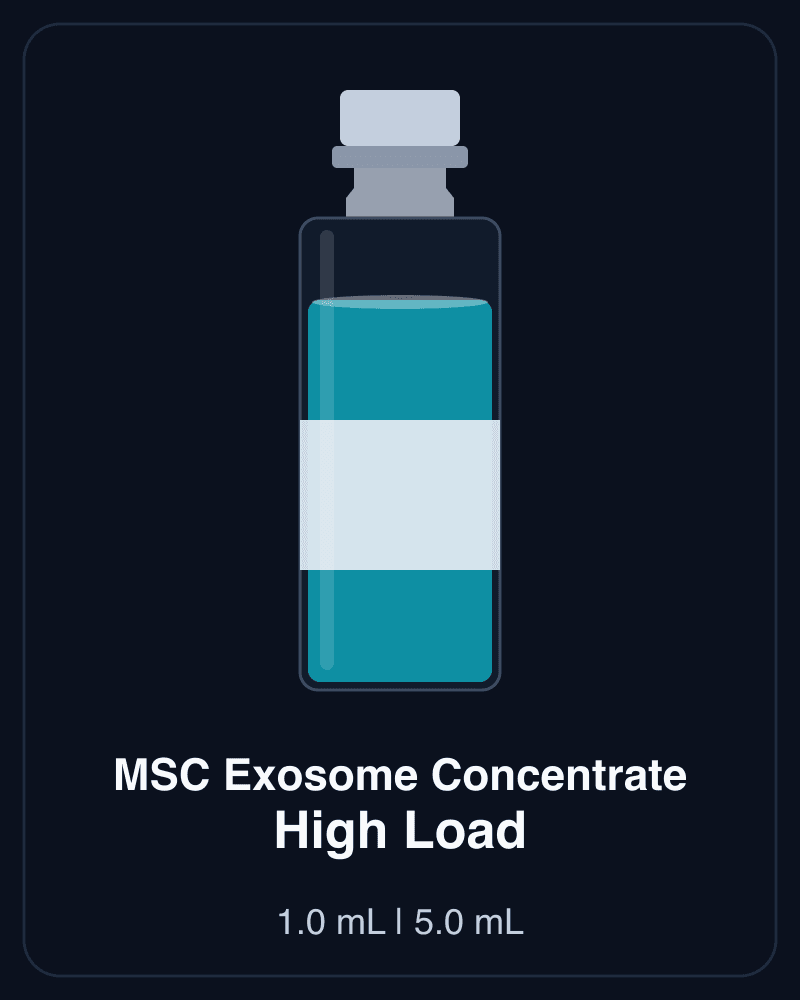
- 15 trillion microvesicles in the 5.0 mL vial
- Frozen cold-chain delivery
- Lot certificate of analysis on request
Available formats
Each format has its own reference number. Figures are as stated by the manufacturer; lot-specific values are on the certificate of analysis.
| Format | Reference | Manufacturer-stated content per vial |
|---|---|---|
| MSC Exosome Concentrate, High Load 1.0 mL | EXV-MEH-01 | 3 trillion microvesicles |
| MSC Exosome Concentrate, High Load 5.0 mL | EXV-MEH-05 | 15 trillion microvesicles |
Where it fits in your suite
Practices place the high-load concentrate in the same finishing step as the standard concentrate, applied topically once the device work is complete.
After microneedling
Applied topically once the microneedling pass is complete.
After fractional laser
Applied topically as the closing step of a fractional laser session.
After RF microneedling
Applied topically after radiofrequency microneedling, as the final step of the session.
This describes where practices place it in a session, not what it does. Whether and how it is used is the licensed practitioner's decision.
What sets it apart
Qualified partner manufacturer
Manufactured by a qualified partner manufacturer and shipped in the manufacturer's labeled packaging.
Lot certificate of analysis on request
Every lot is issued a certificate of analysis, provided on request before or with your order.
Frozen cold-chain delivery
Shipped frozen on cold chain. Stored at -20°C long term and 4°C once thawed, per the manufacturer's handling instructions.
Lot traceability
Every vial carries its lot number, which ties it to that lot's certificate of analysis.
A scientific review of exosome concentration in published research
Laboratory studies consistently report that the amount of extracellular vesicle (exosome) material applied changes how cells respond [1, 2]. Studies often express that amount as a particle count, such as vesicles per cell [2], the same kind of figure the manufacturer states on each vial's label.
Cell studies
What the research shows
Human skin fibroblasts exposed to more mesenchymal stem cell exosome material proliferated and migrated more, and secreted more type I and III collagen and elastin, in a dose-dependent way [3, 4]. In a study of vesicles from 12 cell sources, given at 20 to 200,000 vesicles per cell, dose shaped the response more than the source did [2].
Where research is heading
Researchers are now mapping how vesicle amount and cell source work together, with distinct cellular response profiles observed across the concentration range [2].
Animal studies
What the research shows
A systematic review of 39 animal studies found that vesicles from stem cells sped skin closure and re-epithelialization in a dose-dependent manner [5].
Where research is heading
A review of 64 preclinical studies describes the field moving toward potency-based dosing, which measures the active cargo a preparation carries [1]. International guidelines set out complementary methods for characterizing vesicles, from particle counts to marker profiles [6].
Human studies
What the research shows
A 2026 systematic review of 16 studies with 503 participants found that most facial studies reported improvement in at least one skin quality measure, and none reported a serious adverse event [7].
Where research is heading
Clinical research in aesthetics is building quickly: 16 studies with 503 participants met the criteria for the 2026 review, with facial skin quality as a leading focus [7].
This review summarizes the published research literature on exosome material. The catalog gives the manufacturer's particle count for each MSC exosome format, the same metric researchers report, so practices can compare formats on the scientific terms the literature uses. How much material is used in a session is the licensed practitioner's decision.
References
- 1.Gupta D, Zickler AM, El Andaloussi S. Dosing extracellular vesicles. Adv Drug Deliv Rev. 2021;178:113961. DOI article · PubMed record
- 2.Hagey DW, Ojansivu M, Bostancioglu BR, et al. The cellular response to extracellular vesicles is dependent on their cell source and dose. Sci Adv. 2023;9(35):eadh1168. DOI article · PubMed record
- 3.Shabbir A, Cox A, Rodriguez-Menocal L, Salgado M, Badiavas EV. Mesenchymal stem cell exosomes induce proliferation and migration of normal and chronic wound fibroblasts, and enhance angiogenesis in vitro. Stem Cells Dev. 2015;24(14):1635-1647. DOI article · PubMed record
- 4.Zhang J, Guan J, Niu X, et al. Exosomes released from human induced pluripotent stem cells-derived MSCs facilitate cutaneous wound healing by promoting collagen synthesis and angiogenesis. J Transl Med. 2015;13:49. DOI article · PubMed record
- 5.Dalirfardouei R, Gholoobi A, Vahabian M, et al. Therapeutic role of extracellular vesicles derived from stem cells in cutaneous wound models: a systematic review. Life Sci. 2021;273:119271. DOI article · PubMed record
- 6.Welsh JA, Goberdhan DCI, O'Driscoll L, et al. Minimal information for studies of extracellular vesicles (MISEV2023): from basic to advanced approaches. J Extracell Vesicles. 2024;13(2):e12404. DOI article · PubMed record
- 7.Gaebe K, Lowe K, Bosnalie D, et al. Effectiveness and safety of extracellular vesicle-based therapies for nonsurgical facial rejuvenation: a systematic review. Facial Plast Surg Aesthet Med. Published online July 22, 2026. DOI article · PubMed record
What's in the vial
The high-load concentrate carries MSC-derived exosomes with amino acids in normal saline. Each 1.0 mL vial contains approximately 3 trillion microvesicles and each 5.0 mL vial approximately 15 trillion, as stated by the manufacturer, three times the load of the MSC Exosome Concentrate.
Vesicles are characterized by particle count and size, with a certificate of analysis issued for every lot and available on request.
Manufactured by a qualified partner manufacturer and shipped in the manufacturer's labeled packaging.
A practice comparing the two concentrates can read the particle counts on each lot's certificate of analysis side by side.
Characterization
Particle count and size · lot certificate of analysis
Request or reserve MSC Exosome Concentrate, High Load
MSC Exosome Concentrate, High Load 1.0 mL
3 trillion microvesicles
Ref: EXV-MEH-01
MSC exosomes with amino acids in normal saline, at 3 trillion microvesicles per 1.0 mL vial. Cold-chain shipped.
MSC Exosome Concentrate, High Load 5.0 mL
15 trillion microvesicles
Ref: EXV-MEH-05
5.0 mL high-load format for larger surface areas. 15 trillion microvesicles. Pricing available on request.
How every lot is tested
Each lot of exosome material is documented by a certificate of analysis that covers three stages, from the tissue donor to the finished vial. The tests are listed here; the acceptance criteria and results are shared with verified practices on request.
Donor screening
The placental tissue donor is screened before any cells are banked.
- Microbial testing with strain typing
- HIV-1 and HIV-2, by antibody and nucleic acid testing
- Hepatitis B, by core antibody, surface antigen and nucleic acid testing
- Hepatitis C, by antibody and nucleic acid testing
- HTLV I and II
- Syphilis
- West Nile virus
- Cytomegalovirus
- Risk assessment for Zika, Ebola, malaria, Chagas disease and CJD
Cell bank safety
The master cell bank is tested for contamination and adventitious agents.
- Sterility by membrane filtration
- Mycoplasma
- Adventitious viruses, in vitro on three cell lines and in vivo
- Bovine and porcine agents
- Hepatitis A, B and C
- HIV-1 and HIV-2, and HTLV I and II
- Cytomegalovirus and human herpesviruses
- Parvovirus B19 and papillomavirus
Final vial release
Every lot of finished vials is tested before release.
- Sterility by direct inoculation
- Endotoxin
- Mycoplasma
- Zika virus, JC virus and SARS-CoV-2
- Vesicle particle size
- Particle count per vial
- CD81 identity by Western blot
- Purity by SEC-HPLC
- Total RNA concentration
- Osmolality and pH
- Appearance
A certificate of analysis is issued for every lot and provided on request. Requests are reviewed for NPI-verified practices in the practitioner portal.
A concierge service for standing accounts
Verified clinics that order on a schedule are looked after by name. Allocation, reorders and paperwork are handled for you, so the vial is in the freezer before the session is on the book.
Dedicated contact
One named person at ExaVeyra handles your account, from verification to every reorder.
Priority allocation
Standing accounts are first in line when a new lot is allocated.
Standing orders
Set a recurring order on your schedule and it ships on cold chain without a new request each time.
Documentation sessions
A walkthrough for your team of lot certificates, storage and handling records.
Choose your signature
Three vials in the collection, each with its own place in the suite.
MSC Exosome Concentrate
MSC exosomes in normal saline, for the laser and microneedling suite.
View MSC Exosome Concentrate
Placental MSC Secretome
The whole conditioned medium, in one vial.
View Placental MSC SecretomeCompare the collection
The concentrates and the secretome side by side: formats, content per vial and where each one fits.
Regulatory & handling
Cold-chain shipped frozen. Stored at −20°C long term and 4°C once thawed, per the manufacturer's handling instructions. Supplied for topical aesthetic use by licensed practitioners, as labeled by the manufacturer, and for laboratory and IND-authorized clinical research. Not sold for injection, infusion or any other route into the body, and not intended to diagnose, treat, cure or prevent any disease. The higher loading is a property of the supplied material; the amount used in a session is the licensed practitioner’s decision.
Frequently asked questions
- How does the high-load concentrate differ from the MSC Exosome Concentrate?
- It carries three times the microvesicle load per vial, as stated by the manufacturer, with amino acids in normal saline. Each lot's certificate of analysis reports its particle count, so the two can be compared lot to lot.
- What documentation ships with an order?
- Every vial carries its lot number, and a Certificate of Analysis is issued for every lot and provided on request. Practices with their own documentation requirements should raise them at account setup so we can confirm what we are able to supply before a first order ships.
- How should this material be handled on arrival?
- Check the temperature indicator included with the shipment before the vials go into storage, and move them to their storage condition promptly. If the indicator reads outside range, contact us before use rather than storing the shipment. Storage and handling conditions follow the manufacturer's handling instructions, which ship with each order.
- Who can open a wholesale account?
- NPI-verified licensed practitioners. Verification happens before pricing is released, and professional licensure is confirmed for the destination state before a first order ships.
- What is the regulatory status of this material?
- No exosome product has been approved by the FDA for administration to humans. Material is supplied for topical aesthetic use in clinics and for medical, molecular biology and biochemistry research applications, and is not a tissue product as defined by FDA guidelines. Whether and how it is used in a given session is the licensed practitioner's decision.
Ready to order MSC Exosome Concentrate, High Load?
NPI-verified wholesale accounts unlock full pricing across every format. Request a quote for any format above or apply for a full wholesale account.
Important regulatory notice
Product status. Biomolecular signaling vesicles (exosomes) supplied by ExaVeyra Sciences are not approved, cleared, or licensed by the United States Food and Drug Administration. No exosome product has been approved by the FDA for administration to humans for any indication. Statements on this page have not been evaluated by the FDA.
Use and responsibility. Supplied for topical aesthetic use by licensed practitioners, as labeled by the manufacturer, and for laboratory and IND-authorized clinical research. Not for injection, infusion, intranasal or any other route into the body. The licensed practitioner is solely responsible for whether, how and in what setting the material is used.