Esta referencia está disponible actualmente en inglés. La versión en español está en preparación.
Clinical Trial Phases: From IND to FDA Approval
Por Benn Bluestein-Veyra, M.Sc. en Química Orgánica · Actualizado el 21 de octubre de 2026
ExaVeyra Sciences es un proveedor B2B con sede en Miami que suministra exosomas para uso estético tópico a clínicas con licencia, y remite a los prescriptores con licencia a una farmacia de preparados compuestos 503A que prepara formulaciones según prescripciones individuales.
| Pregunta | Respuesta |
|---|---|
| Qué cubre esta página | What happens in phase 1, 2, 3 and 4 clinical trials, how an IND opens clinical research under 21 CFR 312, and where cell and vesicle products sit. |
| Quién puede hacer pedidos | Clínicas y profesionales con licencia profesional activa y NPI verificados por ExaVeyra. Los pedidos de exosomas requieren además un reconocimiento firmado de uso profesional. |
| Qué se envía y cómo | El material de exosomas para uso estético tópico, caracterizado por lote, se envía en cadena de frío por exprés nocturno. La entrega puede tardar 1 a 3 días hábiles. Se emite un certificado de análisis para cada lote y se entrega a solicitud. |
The phases of clinical trials are the regulated steps through which an investigational drug or biologic moves from first human use to marketing approval and beyond. Under 21 CFR 312.21, phase 1 studies metabolism and pharmacologic action, phase 2 evaluates effectiveness in controlled studies, and phase 3 gathers the expanded evidence for the overall benefit-risk evaluation.[1]
An Investigational New Drug application (IND) opens the sequence, and a marketing application, an NDA or a BLA, closes it before phase 4 begins.[2][3] This reference explains each gate, each phase and the record fields that let a reader place any study in the sequence.[4]
Mapping the phases of clinical trials from preclinical research to phase 4
FDA describes drug development in five steps: discovery and development, preclinical research, clinical research, FDA review and postmarket safety monitoring. Its Step 3 page explains that preclinical research answers basic questions about safety and that clinical research means studies done in people.[3]
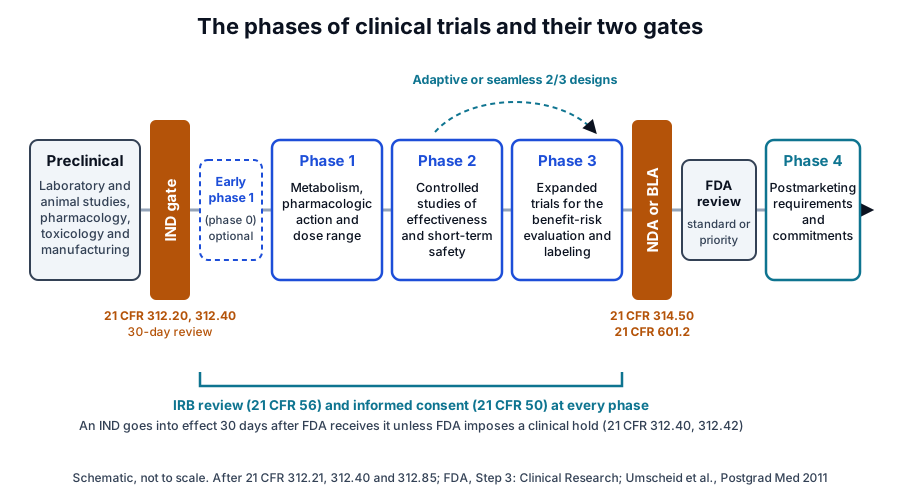
The sequence runs from preclinical work through the IND gate, three investigational phases and the marketing application gate to phase 4 (Fig. 1).[1][3] The regulation adds that the phases are generally conducted in order and may overlap.[1]
Umscheid and colleagues trace the same path in their review of key trial concepts, from the preclinical stage to postmarketing surveillance, with ethical foundations and oversight throughout.[4] Van Norman reported an average of about 12 years from preclinical testing to approval for a new drug in the United States.[5]
Measuring progression between phases in large datasets
Wong, Siah and Lo estimated success rates and durations from 406,038 trial entries covering more than 21,143 compounds between 2000 and 2015, broken down by clinical phase, sponsor type and biomarker use. Trials that used biomarkers in participant selection had higher overall success probabilities.[6]
FDA gives approximate shares of drugs that move on: about 70% after phase 1, about 33% after phase 2 and about 25 to 30% after phase 3.[3] DiMasi and colleagues linked the costs of compounds discontinued during testing to approved ones and estimated a capitalized pre-approval cost of $2,558 million per approved compound in 2013 dollars.[7]
Fogel reviewed literature from the past 30 years on what distinguishes successful trials. The review identified recurring patterns tied to the study site, the coordinator and investigator, and the participant experience.[8]
Preclinical studies and the IND under 21 CFR 312 open human research
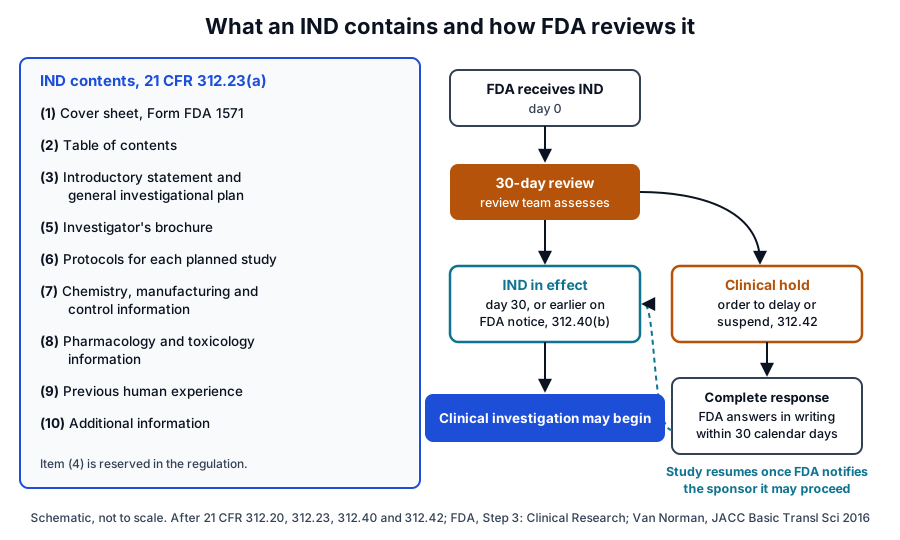
A sponsor submits an IND before starting a clinical investigation of an investigational new drug, and may begin only once the IND is in effect under 21 CFR 312.40.[2] FDA summarizes the application as animal study and toxicity data, manufacturing information, clinical protocols, data from prior human research and information about the investigator.[3]
Understanding the contents of an IND
21 CFR 312.23(a) lists the sections in order: a cover sheet on Form FDA 1571, a table of contents, an introductory statement and general investigational plan, the investigator’s brochure and a protocol for each planned study (Fig. 2).[9] Chemistry, manufacturing and control information, pharmacology and toxicology information, previous human experience and additional information follow.[9]
The cover sheet identifies the phase or phases to be conducted and commits the sponsor to IRB review under 21 CFR 56.[9] Phase 1 protocols may be less detailed and more flexible, and phase 2 and 3 protocols describe all aspects of the study in detail.[9]
Applying the 30-day review and clinical holds
An IND goes into effect 30 days after FDA receives it, or earlier on FDA notification, unless FDA notifies the sponsor of a clinical hold.[10] FDA describes an IND review team of a project manager, medical officer, statistician, pharmacologist, pharmacokineticist, chemist and, for antimicrobial products, a microbiologist.[3]
A clinical hold is an FDA order to delay a proposed investigation or suspend an ongoing one, and 21 CFR 312.42(b) lists the grounds for each phase.[11] Those grounds address participant protection, investigator qualifications, the accuracy of the investigator’s brochure and whether the IND holds enough information to assess the proposed studies.[11]
After a sponsor submits a complete response to a hold, FDA answers in writing within 30 calendar days, and the study resumes once FDA notifies the sponsor that it may proceed.[11] FDA notes that a clinical hold is rare and that the agency often provides comments intended to improve the quality of a trial.[3]
Phase 1, 2 and 3 answer distinct questions under 21 CFR 312.21
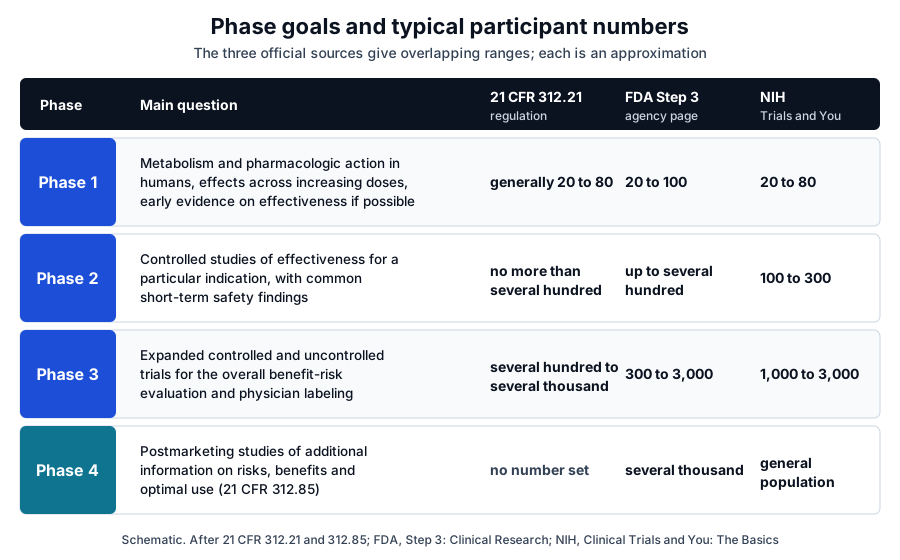
21 CFR 312.21 defines the three investigational phases by purpose, and FDA, NIH and ClinicalTrials.gov describe them with typical participant numbers (Fig. 3).[1][3][12] The ranges differ between sources, so each is best read as an approximation.[13]
Phase 1 studies metabolism, pharmacology and dose
Phase 1 includes the initial introduction of an investigational drug into humans. It studies metabolism and pharmacologic actions, the side effects associated with increasing doses and, if possible, early evidence on effectiveness, in a total that is generally 20 to 80 subjects.[1]
Storer compared the standard dose-escalation design with simple alternatives in small samples, and found that two-stage designs reduced bias in maximum likelihood estimates of the maximum tolerable dose in less than ideal dose-response settings.[14] ClinicalTrials.gov describes phase 1 trials as usually conducted with healthy volunteers and a small number of participants.[13]
Phase 2 gathers controlled evidence on effectiveness
Phase 2 comprises controlled clinical studies that evaluate effectiveness for a particular indication and determine common short-term side effects, usually in no more than several hundred subjects.[1] NIH gives a typical range of 100 to 300 participants, and FDA describes phase 2 data as the basis for refining research questions and designing phase 3 protocols.[3][12]
Simon published two-stage phase 2 designs that minimize the expected sample size, or the maximum sample size, within set limits on type 1 and type 2 errors. In these designs a first stage enrolls a small group, and the study continues to the second stage when the observed activity meets a prespecified threshold.[15]
Phase 3 provides the expanded evidence for approval
Phase 3 trials are expanded controlled and uncontrolled trials, performed after preliminary evidence of effectiveness, that gather the information needed to evaluate the overall benefit-risk relationship and to support physician labeling.[1] The regulation gives several hundred to several thousand subjects, and FDA calls these studies pivotal.[1][3]
Downing and colleagues characterized 448 pivotal efficacy trials behind 188 novel agents approved from 2005 to 2012. Most were randomized and double-blinded, the median enrollment per indication was 760 participants, and 36.8% of indications rested on a single pivotal trial.[16]
Reports of randomized phase 3 trials are read against the CONSORT 2025 statement, a 30-item checklist with a diagram of participant flow developed by Hopewell and colleagues.[17] Its companion, SPIRIT 2025, sets the minimum content of the trial protocol.[18]
Phase 0 and adaptive designs extend the classic sequence
FDA’s 2006 guidance on exploratory IND studies describes trials conducted early in phase 1 with very limited human exposure, before the traditional dose escalation studies, such as screening and microdose studies.[19] ClinicalTrials.gov records these as Early Phase 1, formerly listed as Phase 0.[13]
Burt and colleagues reviewed phase 0 and microdosing approaches, whose uses now extend beyond pharmacokinetics to mechanism of action and pharmacodynamics. They proposed that phase 0 approaches be considered in most drug development programs.[20]
Adaptive and seamless designs follow prespecified rules
Pallmann and colleagues define adaptive designs as trials that use accumulating results to modify the trial’s course under prespecified rules, and note that they apply across all phases, from early dose escalation to confirmatory trials. Their tutorial centers on the interpretation and transparent reporting of such trials.[21]
Seamless phase 2/3 designs select a dose or arm at an interim analysis and compare it with control in the same study. Stallard and Todd reviewed the group-sequential, combination test and adaptive Dunnett approaches to these designs in one framework.[22]
The Adaptive designs CONSORT Extension (ACE), developed by Dimairo and colleagues through a Delphi process and consensus meeting, adds seven new items and modifies nine for reporting randomized adaptive trials.[23] Park and colleagues identified 83 master protocols (49 basket, 18 umbrella and 16 platform trials), and four of the platform trials used a seamless phase 2/3 design.[24]
IRB review and informed consent protect participants at every phase
21 CFR 56.103 requires that a clinical investigation needing prior FDA submission be reviewed and approved by an IRB, and remain under its continuing review, before it starts.[25] Each IRB has at least five members with varying backgrounds, and it may approve, require modifications in or disapprove the research.[25]
Under 21 CFR 50.20, no investigator may involve a person as a subject without legally effective informed consent, sought under circumstances that minimize coercion or undue influence.[26] Section 50.25 lists the basic elements, including the purposes, procedures and expected duration of the research and whom to contact with questions.[26]
The IND links the two parts: 21 CFR 312.40 permits an investigational drug in a clinical investigation when sponsor and investigators comply with parts 50 and 56.[10] Emanuel, Wendler and Grady proposed seven requirements for ethical clinical research, among them scientific validity, independent review and informed consent.[27]
The protocol is the document the IRB and FDA review. SPIRIT 2025, led by Chan and colleagues, sets 34 minimum protocol items, with a new open science section and an item on public involvement in trial design, conduct and reporting.[18]
Marketing applications, FDA review and phase 4 complete the sequence
After phase 3, a sponsor files a New Drug Application under 21 CFR 314.50 or a Biologics License Application under 21 CFR 601.2.[28][29] A BLA for a license under section 351 of the PHS Act includes nonclinical and clinical data demonstrating that the product meets requirements of safety, purity and potency.[29]
FDA’s goal is to act on an application within 10 months under standard review and within 6 months under priority review, and priority designation leaves the scientific standard for approval unchanged.[30]
Darrow, Avorn and Kesselheim reported that FDA review times fell from more than 3 years in 1983 to less than 1 year in 2017, while total time from authorization of clinical testing to approval stayed at about 8 years.[31] The share of approvals supported by at least 2 pivotal trials moved from 80.6% in 1995 to 1997 to 52.8% in 2015 to 2017.[31]
Phase 4 studies, postmarketing requirements and commitments
Concurrent with approval, FDA may seek agreement from a sponsor to conduct phase 4 studies that add information about a drug’s risks, benefits and optimal use, for example other doses, other populations or longer use.[32] FDA separates postmarketing requirements, which a statute or regulation mandates, from postmarketing commitments that a sponsor agrees to conduct.[33]
Wallach and colleagues characterized 437 postmarketing requirements for 97 drugs and biologics approved from 2009 to 2012, and 30.7% were prospective cohort studies, registries or clinical trials. Of 134 such studies, 76.1% were registered on ClinicalTrials.gov.[34]
Cell and vesicle products developed as biologics follow the 351 pathway
Human cells and tissues regulated solely under section 361 of the PHS Act must meet all the criteria of 21 CFR 1271.10.[35] Under 21 CFR 1271.20, a product outside those criteria is regulated as a drug, device or biological product, and a biological product reaches the market through a license under section 351.[36][37]
The HCT/P and biologic classification reference on this site explains why isolated vesicle preparations fall outside the 361 pathway. For a cell or vesicle product developed as a biological product, the IND, the three phases and the BLA described above form the development path, with CBER as the reviewing center.[29][38]
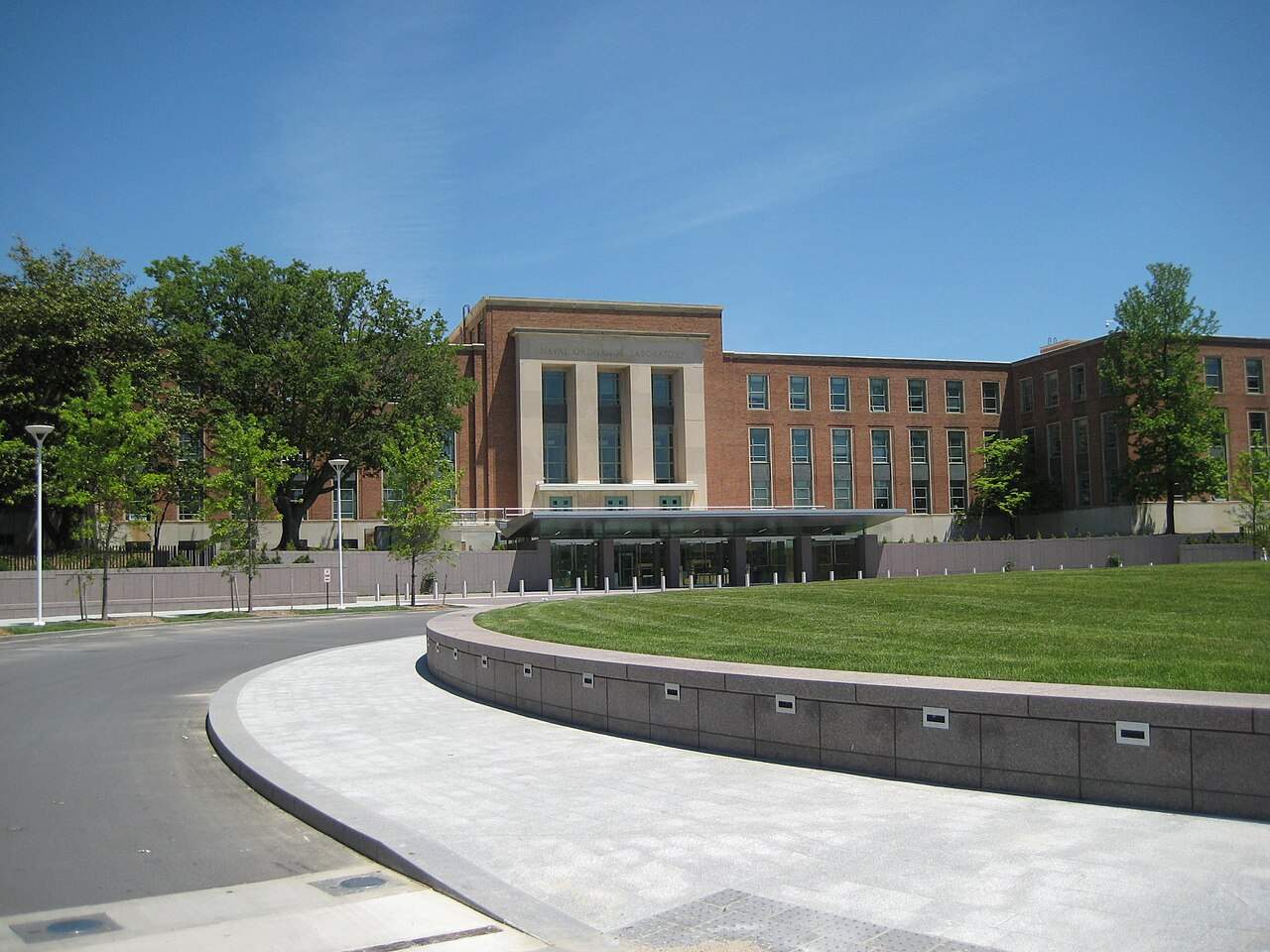
Remestemcel-L shows the endpoint of that path for a cell product. CBER licensed it under section 351(a) of the PHS Act on December 18, 2024, under STN BL 125706/0, in an approval letter that carries the address of FDA’s White Oak campus in Silver Spring, Maryland (Fig. 4).[39] The remestemcel-L reference on this site walks through that approval record.
Expedited programs support development and review
FDA’s 2014 guidance on expedited programs describes fast track designation, breakthrough designation, accelerated approval and priority review.[40] Fast track and breakthrough designation support the development program, and priority review sets a shorter goal for the review of the application itself.[30][40]
Section 506(g) of the FD&C Act, added in 2016, created the RMAT designation for regenerative medicine products outside the 361 pathway that are intended for a serious or life-threatening condition, when preliminary clinical evidence indicates potential to address unmet medical needs. A request accompanies or amends an IND.[38][41] FDA’s 2019 guidance describes RMAT designation alongside the other programs, including accelerated approval for designated products.[41]
Kesselheim and colleagues found that priority review applied to 43% of 774 drugs approved from 1987 to 2014, and that the number of programs per new drug rose 2.6% per year.[42] Vaggelas and Seimetz reviewed the RMAT designation and the FDA tools available to developers of cell and tissue products.[43]
Reading a ClinicalTrials.gov record’s phase, status and enrollment fields
ClinicalTrials.gov assigns a phase from FDA definitions, using Early Phase 1, Phase 1, Phase 2, Phase 3 and Phase 4, and labels studies without FDA-defined phases, such as device or behavioral trials, Not Applicable.[13] Phase 4 records include postmarketing requirement and commitment studies.[13]
Recruitment status runs from "Not yet recruiting" through "Recruiting" and "Active, not recruiting" to "Completed", with "Suspended", "Terminated" and "Withdrawn" marking studies that stopped.[13] Enrollment is the number of participants, and an estimated enrollment is the target number the researchers need.[13]
| Field | What it records | What to check |
|---|---|---|
| Phase | Early Phase 1, Phase 1 to 4, or Not Applicable | Whether the question matches the phase |
| Recruitment status | Not yet recruiting through Completed | Whether the study is planned, ongoing or finished |
| Enrollment | Number of participants, estimated or actual | Planned target against the number enrolled |
| Primary completion date | Final data collection for the primary outcome | Estimated or actual, and how recent |
| Results | Summary results posted to the database | Outcome measures and analysis populations |
Zarin and colleagues described the results database added in 2008 and found that 61% of a sample of registered outcome measures lacked specificity about the planned metric.[44] Tse, Fain and Zarin set out 10 issues to consider when using the database for research, from its built-in capabilities to the reporting policies that shape which studies appear.[45]
Where to go from here
The randomized controlled trials reference explains the design most phase 3 studies use, and the sham and placebo controls reference covers the comparators behind them. The hierarchy of evidence, risk of bias assessment and systematic reviews references show how trial results are graded and combined.
The reading the evidence guide applies these methods to clinic decisions, and the exosome clinical trials reference follows registered vesicle studies through their phases. The remestemcel-L reference, the extracellular vesicle potency assays reference and our quality references continue the thread, and our team is glad to discuss any of them.
Referencias comentadas
Numeradas en el orden en que se citan en el texto. Cada fuente lleva una nota sobre lo que respalda en esta página; los artículos revisados por pares se listan con revista, volumen, número y páginas, y las fuentes primarias son regulaciones, documentos de agencias y bases de datos de referencia.
- 1.Regulatory21 CFR 312.21, Phases of an investigation. Accessed 20 October 2026. https://www.ecfr.gov/current/title-21/chapter-I/subchapter-D/part-312/subpart-B/section-312.21
- 2.Regulatory21 CFR 312.20, Requirement for an IND. Accessed 20 October 2026. https://www.ecfr.gov/current/title-21/chapter-I/subchapter-D/part-312/subpart-B/section-312.20
- 3.RegulatoryFDA, The Drug Development Process, Step 3: Clinical Research. Accessed 20 October 2026. https://www.fda.gov/patients/drug-development-process/step-3-clinical-research
- 4.Peer-reviewedUmscheid CA, Margolis DJ, Grossman CE. Key concepts of clinical trials: a narrative review. Postgraduate Medicine. 2011. https://pubmed.ncbi.nlm.nih.gov/21904102/Annotation: Narrative review of trial design, oversight and the approval process from the preclinical phase to postmarketing surveillance. Cited for the overall sequence and its ethical foundations.
- 5.Peer-reviewedVan Norman GA. Drugs, Devices, and the FDA: Part 1: An Overview of Approval Processes for Drugs. JACC: Basic to Translational Science. 2016. https://pubmed.ncbi.nlm.nih.gov/30167510/Annotation: Overview of the FDA new drug approval process. Cited for the average of about 12 years from preclinical testing to approval for a new drug.
- 6.Peer-reviewedWong CH, Siah KW, Lo AW. Estimation of clinical trial success rates and related parameters. Biostatistics. 2019. https://pubmed.ncbi.nlm.nih.gov/29394327/Annotation: Analysis of 406,038 trial entries for more than 21,143 compounds, 2000 to 2015. Cited for phase-level success rate estimation and the higher success probability of trials using biomarkers in participant selection.
- 7.Peer-reviewedDiMasi JA, Grabowski HG, Hansen RW. Innovation in the pharmaceutical industry: New estimates of R&D costs. Journal of Health Economics. 2016. https://pubmed.ncbi.nlm.nih.gov/26928437/Annotation: Cost analysis of 106 randomly selected new drugs from 10 firms. Cited for linking the costs of discontinued compounds to approved ones and the capitalized pre-approval estimate of $2,558 million in 2013 dollars.
- 8.Peer-reviewedFogel DB. Factors associated with clinical trials that fail and opportunities for improving the likelihood of success: A review. Contemporary Clinical Trials Communications. 2018. https://pubmed.ncbi.nlm.nih.gov/30112460/Annotation: Review of 30 years of literature on trial execution. Cited for recurring patterns in successful trials tied to the study site, the coordinator and investigator, and participants.
- 9.Regulatory21 CFR 312.23, IND content and format. Accessed 20 October 2026. https://www.ecfr.gov/current/title-21/chapter-I/subchapter-D/part-312/subpart-B/section-312.23
- 10.Regulatory21 CFR 312.40, General requirements for use of an investigational new drug in a clinical investigation. Accessed 20 October 2026. https://www.ecfr.gov/current/title-21/chapter-I/subchapter-D/part-312/subpart-C/section-312.40
- 11.Regulatory21 CFR 312.42, Clinical holds and requests for modification. Accessed 20 October 2026. https://www.ecfr.gov/current/title-21/chapter-I/subchapter-D/part-312/subpart-C/section-312.42
- 12.Official sourceNIH, NIH Clinical Research Trials and You: The Basics. Accessed 20 October 2026. https://www.nih.gov/health-information/nih-clinical-research-trials-you/basics
- 13.Official sourceClinicalTrials.gov, Glossary Terms (National Library of Medicine). Accessed 20 October 2026. https://clinicaltrials.gov/study-basics/glossary
- 14.Peer-reviewedStorer BE. Design and analysis of phase I clinical trials. Biometrics. 1989. https://pubmed.ncbi.nlm.nih.gov/2790129/Annotation: Statistical comparison of phase 1 dose-escalation designs by Markov chain and Monte Carlo methods. Cited for two-stage designs that reduced bias in estimating the maximum tolerated dose.
- 15.Peer-reviewedSimon R. Optimal two-stage designs for phase II clinical trials. Controlled Clinical Trials. 1989. https://pubmed.ncbi.nlm.nih.gov/2702835/Annotation: Methods paper presenting optimal and minimax two-stage phase 2 designs. Cited for minimizing expected or maximum sample size within limits on type 1 and type 2 errors.
- 16.Peer-reviewedDowning NS, Aminawung JA, Shah ND, et al. Clinical trial evidence supporting FDA approval of novel therapeutic agents, 2005-2012. JAMA. 2014. https://pubmed.ncbi.nlm.nih.gov/24449315/Annotation: Cross-sectional analysis of 448 pivotal efficacy trials behind 188 approvals. Cited for the design features of pivotal trials, median enrollment of 760 per indication and the share of single-trial approvals.
- 17.Peer-reviewedHopewell S, Chan AW, Collins GS, et al. CONSORT 2025 statement: updated guideline for reporting randomised trials. BMJ. 2025. https://pubmed.ncbi.nlm.nih.gov/40228833/Annotation: Updated CONSORT reporting guideline. Cited for the 30-item checklist and the participant flow diagram used to read randomized trial reports.
- 18.Peer-reviewedChan AW, Boutron I, Hopewell S, et al. SPIRIT 2025 statement: updated guideline for protocols of randomised trials. BMJ. 2025. https://pubmed.ncbi.nlm.nih.gov/40294953/Annotation: Updated SPIRIT protocol guideline. Cited for the 34 minimum protocol items, the open science section and the item on public involvement.
- 19.RegulatoryFDA, Exploratory IND Studies, Guidance for Industry, Investigators, and Reviewers, January 2006. Accessed 20 October 2026. https://www.fda.gov/regulatory-information/search-fda-guidance-documents/exploratory-ind-studies
- 20.Peer-reviewedBurt T, Young G, Lee W, et al. Phase 0/microdosing approaches: time for mainstream application in drug development? Nature Reviews Drug Discovery. 2020. https://pubmed.ncbi.nlm.nih.gov/32901140/Annotation: Review of phase 0 and microdosing methods. Cited for their extension to mechanism of action and pharmacodynamics and the proposal to consider them in most development programs.
- 21.Peer-reviewedPallmann P, Bedding AW, Choodari-Oskooei B, et al. Adaptive designs in clinical trials: why use them, and how to run and report them. BMC Medicine. 2018. https://pubmed.ncbi.nlm.nih.gov/29490655/Annotation: Tutorial on adaptive designs. Cited for the definition of prespecified adaptation, use across all phases and the emphasis on interpretation and reporting.
- 22.Peer-reviewedStallard N, Todd S. Seamless phase II/III designs. Statistical Methods in Medical Research. 2011. https://pubmed.ncbi.nlm.nih.gov/20724313/Annotation: Methodological review of seamless phase 2/3 designs. Cited for interim selection with comparison against control in one study and the group-sequential, combination test and adaptive Dunnett approaches.
- 23.Peer-reviewedDimairo M, Pallmann P, Wason J, et al. The Adaptive designs CONSORT Extension (ACE) statement: a checklist with explanation and elaboration guideline for reporting randomised trials that use an adaptive design. BMJ. 2020. https://pubmed.ncbi.nlm.nih.gov/32554564/Annotation: CONSORT extension for adaptive designs developed by Delphi process and consensus meeting. Cited for its seven new and nine modified checklist items.
- 24.Peer-reviewedPark JJH, Siden E, Zoratti MJ, et al. Systematic review of basket trials, umbrella trials, and platform trials: a landscape analysis of master protocols. Trials. 2019. https://pubmed.ncbi.nlm.nih.gov/31533793/Annotation: Landscape analysis of 83 master protocols. Cited for the basket, umbrella and platform categories and the four platform trials with a seamless phase 2/3 design.
- 25.Regulatory21 CFR Part 56, Institutional Review Boards. Accessed 20 October 2026. https://www.ecfr.gov/current/title-21/chapter-I/subchapter-A/part-56
- 26.Regulatory21 CFR Part 50, Protection of Human Subjects. Accessed 20 October 2026. https://www.ecfr.gov/current/title-21/chapter-I/subchapter-A/part-50
- 27.Peer-reviewedEmanuel EJ, Wendler D, Grady C. What makes clinical research ethical? JAMA. 2000. https://pubmed.ncbi.nlm.nih.gov/10819955/Annotation: Framework of seven requirements for ethical clinical research. Cited for scientific validity, independent review and informed consent as requirements.
- 28.Regulatory21 CFR 314.50, Content and format of an NDA. Accessed 20 October 2026. https://www.ecfr.gov/current/title-21/chapter-I/subchapter-D/part-314/subpart-D/section-314.50
- 29.Regulatory21 CFR 601.2, Applications for biologics licenses; procedures for filing. Accessed 20 October 2026. https://www.ecfr.gov/current/title-21/chapter-I/subchapter-F/part-601/subpart-A/section-601.2
- 30.RegulatoryFDA, Priority Review. Accessed 20 October 2026. https://www.fda.gov/patients/fast-track-breakthrough-therapy-accelerated-approval-priority-review/priority-review
- 31.Peer-reviewedDarrow JJ, Avorn J, Kesselheim AS. FDA Approval and Regulation of Pharmaceuticals, 1983-2018. JAMA. 2020. https://pubmed.ncbi.nlm.nih.gov/31935033/Annotation: Review of FDA laws, programs and approval data from 1983 to 2018. Cited for review times, the stable total development time of about 8 years and the share of approvals with at least 2 pivotal trials.
- 32.Regulatory21 CFR 312.85, Phase 4 studies. Accessed 20 October 2026. https://www.ecfr.gov/current/title-21/chapter-I/subchapter-D/part-312/subpart-E/section-312.85
- 33.RegulatoryFDA, Postmarketing Requirements and Commitments: Introduction. Accessed 20 October 2026. https://www.fda.gov/drugs/guidance-compliance-regulatory-information/postmarket-requirements-and-commitments
- 34.Peer-reviewedWallach JD, Egilman AC, Dhruva SS, et al. Postmarket studies required by the US Food and Drug Administration for new drugs and biologics approved between 2009 and 2012: cross sectional analysis. BMJ. 2018. https://pubmed.ncbi.nlm.nih.gov/29794072/Annotation: Cross-sectional analysis of 437 postmarketing requirements. Cited for the share that were prospective studies, registries or trials and their registration on ClinicalTrials.gov.
- 35.Regulatory21 CFR 1271.10, HCT/Ps regulated solely under section 361 of the PHS Act. Accessed 20 October 2026. https://www.ecfr.gov/current/title-21/chapter-I/subchapter-L/part-1271/subpart-A/section-1271.10
- 36.Regulatory21 CFR 1271.20, HCT/Ps that do not meet the criteria in 1271.10. Accessed 20 October 2026. https://www.ecfr.gov/current/title-21/chapter-I/subchapter-L/part-1271/subpart-A/section-1271.20
- 37.Regulatory42 U.S.C. 262, Regulation of biological products (PHS Act section 351). Accessed 20 October 2026. https://www.govinfo.gov/content/pkg/USCODE-2024-title42/html/USCODE-2024-title42-chap6A-subchapII-partF-subpart1-sec262.htm
- 38.RegulatoryFDA, CBER, Regenerative Medicine Advanced Therapy Designation. Accessed 20 October 2026. https://www.fda.gov/vaccines-blood-biologics/cellular-gene-therapy-products/regenerative-medicine-advanced-therapy-designation
- 39.RegulatoryFDA, CBER, Approval letter for remestemcel-L-rknd, STN BL 125706/0, December 18, 2024. Accessed 20 October 2026. https://www.fda.gov/media/184605/download
- 40.RegulatoryFDA, Expedited Programs for Serious Conditions: Drugs and Biologics, Guidance for Industry, May 2014. Accessed 20 October 2026. https://www.fda.gov/regulatory-information/search-fda-guidance-documents/expedited-programs-serious-conditions-drugs-and-biologics
- 41.RegulatoryFDA, CBER, Expedited Programs for Regenerative Medicine Therapies for Serious Conditions, Guidance for Industry, February 2019. Accessed 20 October 2026. https://www.fda.gov/regulatory-information/search-fda-guidance-documents/expedited-programs-regenerative-medicine-therapies-serious-conditions
- 42.Peer-reviewedKesselheim AS, Wang B, Franklin JM, et al. Trends in utilization of FDA expedited drug development and approval programs, 1987-2014: cohort study. BMJ. 2015. https://pubmed.ncbi.nlm.nih.gov/26400751/Annotation: Cohort study of 774 FDA approvals and four expedited programs. Cited for priority review applying to 43% of approvals and the 2.6% annual rise in programs per drug.
- 43.Peer-reviewedVaggelas A, Seimetz D. Expediting Drug Development: FDA's New Regenerative Medicine Advanced Therapy Designation. Therapeutic Innovation & Regulatory Science. 2019. https://pubmed.ncbi.nlm.nih.gov/29895180/Annotation: Review of the RMAT designation introduced in March 2017 and other FDA expediting tools. Cited for the tools available to developers of cell and tissue products.
- 44.Peer-reviewedZarin DA, Tse T, Williams RJ, et al. The ClinicalTrials.gov results database--update and key issues. New England Journal of Medicine. 2011. https://pubmed.ncbi.nlm.nih.gov/21366476/Annotation: Analysis of ClinicalTrials.gov registry and results records, 2009 to 2010. Cited for the 2008 results database and the 61% of sampled outcome measures lacking metric specificity.
- 45.Peer-reviewedTse T, Fain KM, Zarin DA. How to avoid common problems when using ClinicalTrials.gov in research: 10 issues to consider. BMJ. 2018. https://pubmed.ncbi.nlm.nih.gov/29802130/Annotation: Guidance from ClinicalTrials.gov staff on research use of the database. Cited for the 10 issues spanning database capabilities and reporting policies.
Cite this page
ExaVeyra Sciences Editorial Team. Clinical Trial Phases: From IND to FDA Approval. ExaVeyra Sciences; 21 October 2026. Available from: https://exaveyra.com/science/research-methods/clinical-trial-phases. Accessed [date accessed].