DSIP: A Peptide Named for an Unconfirmed Effect
Animal and laboratory work only. A result in a rodent does not establish an effect in a person.
Delta sleep-inducing peptide carries its central claim in its name, which is unusual and worth pausing on. It was named for an effect seen in rabbits in the 1970s, and the intervening decades have not firmly established that it produces that effect in people.
This page separates the name from the evidence. It is an evidence summary, not a product page. ExaVeyra does not offer DSIP for sale.
Also known as: delta sleep-inducing peptide, emideltide.
Understanding the molecular properties
DSIP is a nine-residue peptide isolated in the mid-1970s from the cerebral venous blood of rabbits in induced sleep, and named for the delta-wave sleep its discoverers associated with it. It is a small, highly polar molecule of around 850 daltons.
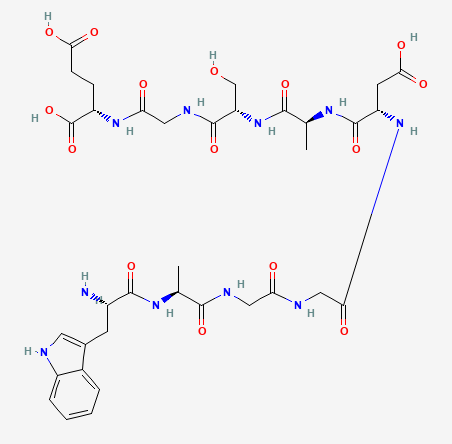
FDA lists it under a different name. On FDA’s bulk-substances page it appears as emideltide, with DSIP given in parentheses, so a reader searching that list for "DSIP" alone will conclude wrongly that it is absent. Substances in this market frequently carry several names, and the regulatory name is rarely the marketing one.
- Nine residues, roughly 850 daltons, highly polar.
- Isolated 1977 from rabbit cerebral venous blood during induced sleep.
- Listed by FDA as emideltide.
- A phosphorylated form appears in some published work and is a different molecule again.
What the literature covers
The published work is broader than the name suggests and, notably, much of it is not about sleep. Studies describe effects on oxidative modification of proteins during aging, on hepatocyte function under restraint stress, on motor recovery after focal stroke in rats, and on spatial memory at altitude using a phosphorylated form. Sleep is one strand among several rather than the dominant one.
That breadth is itself informative. A peptide reported to influence oxidative stress, hepatic function, motor recovery and memory is either extraordinarily pleiotropic or is being observed through a series of loosely specified assays. Either reading argues for caution about a specific claim.
The delivery question is unresolved and central. A polar nine-residue peptide does not obviously cross the blood-brain barrier, and a central effect requires that it reach the brain. Work on peptides and the barrier makes clear that transport is selective and molecule-specific rather than a general property of small peptides. Several recent studies address this by building fusion constructs designed to cross, which is an implicit acknowledgement that the unmodified peptide does not do so readily.
How far the evidence has got
There is no controlled human trial establishing that DSIP improves sleep. The animal work is real but scattered across models, much of it from a small number of groups, and a 2024 study of efficacy in a chemically induced insomnia mouse model used a fusion peptide engineered for brain penetration rather than DSIP itself.
Fifty years is a long time for a compound named after an effect to remain unconfirmed in humans for that effect. Absence of evidence over that span is not proof of absence, but it is a stronger signal than it would be for a molecule described last year.
- No controlled human trial supporting the effect the peptide is named for.
- Published work spans oxidative stress, hepatic function, stroke recovery and memory.
- Brain penetration is unresolved, and recent work engineers around it.
- Named 1977; still unestablished in humans.
Regulatory position
FDA placed emideltide, the name under which DSIP appears in category 2 of its interim policy on bulk drug substances for compounding under section 503A, meaning the agency identified significant safety risks, and the nomination was withdrawn by the nominator in April 2026. FDA now carries the substance under nominations withdrawn and still publishes the rationale it wrote, and a withdrawn nomination leaves the substance on no 503A list for any route. The Pharmacy Compounding Advisory Committee recommended against emideltide for the 503A bulks list on 24 July 2026. FDA’s rationale in full:
“Compounded drugs containing emideltide may pose risk for immunogenicity for certain routes of administration and may have complexities with regard to peptide-related impurities and API characterization. FDA has not identified safety-related information regarding emideltide for the proposed route of administration. Therefore, the agency lacks sufficient information to know whether the drug would cause harm if administered to humans.”
FDA source , checked 2026-09-16
FDA revises this list. The access date appears with the quotation.
Common questions
- Does DSIP induce sleep?
- There is no controlled human trial establishing that it improves sleep. The peptide was named in the 1970s for an effect associated with delta-wave sleep in rabbits, and the intervening decades have not firmly established that it produces that effect in people. The name records a hypothesis drawn from the original observation rather than a confirmed result.
- What does the published work on DSIP cover?
- More than the name suggests, and much of it is not about sleep at all. Studies describe effects on oxidative modification of proteins during aging, on hepatocyte function under restraint stress, and on motor recovery after focal stroke in animal models.
- Why does FDA list this substance as emideltide?
- Emideltide is the name under which it appears in FDA’s tables of bulk drug substances nominated for compounding, where it was placed in category 2 and now sits under nominations withdrawn. Searching that list by the marketed name alone will miss it, which is a practical problem when checking whether a substance has been evaluated.
- What did the 2024 mouse study test?
- A study of efficacy in a chemically induced insomnia mouse model used a fusion peptide engineered for brain penetration rather than the plain peptide. That distinction matters when the result is cited as evidence for the substance itself, because the article tested was not the article sold.
- Does ExaVeyra supply DSIP?
- No. ExaVeyra does not supply DSIP, and this page is not an offer to sell it. It is covered because the substance carries its central claim in its own name, which is an unusually direct example of how a hypothesis hardens into an assumption.
Sources
Every source is peer-reviewed and published within the last fifteen years. Each line states what that source is carrying, so nothing is here to pad a count.
- Mu X, Qu L, Yin L. Pichia pastoris secreted peptides crossing the blood-brain barrier and DSIP fusion peptide efficacy in PCPA-induced insomnia mouse models. Frontiers in Pharmacology. 2024.PMID 39444618
Preclinical
Source 1 supports: The most recent sleep work, and that it used an engineered fusion rather than DSIP itself.
- Tukhovskaya EA, Ismailova AM, Shaykhutdinova ER. Delta sleep-inducing peptide recovers motor function in SD rats after focal stroke. Molecules. 2021.PMID 34500605
Preclinical
Source 2 supports: A representative non-sleep strand of the literature.
- Roy K, Chauhan G, Kumari P. Phosphorylated delta sleep inducing peptide restores spatial memory and p-CREB expression by improving sleep architecture at high altitude. Life Sciences. 2018.PMID 30107169
Preclinical
Source 3 supports: Work using the phosphorylated form, which is a distinct molecule.
- Banks WA. Peptides and the blood-brain barrier. Peptides. 2015.PMID 25805003
Narrative review
Source 4 supports: That peptide transport across the barrier is selective, not a general property.
- Bobyntsev II, Kryukov AA, Belykh AE. Effect of delta sleep-inducing peptide on functional state of hepatocytes in rats during restraint stress. Bulletin of Experimental Biology and Medicine. 2016.PMID 26902351
Preclinical
Source 5 supports: The breadth of unrelated systems the peptide is reported to affect.
- Bondarenko TI, Sorokina IA, Mayboroda EA. Effect of delta sleep-inducing peptide on oxidative modification of proteins in rat tissues and blood during physiological aging. Bulletin of Experimental Biology and Medicine. 2012.PMID 22866315
Preclinical
Source 6 supports: The oxidative stress strand, a further example of that breadth.
- Zhang XG, Wang WN, Zhang CS. Expression and purification of delta sleep-inducing peptide fused with protein transduction domain and human serum albumin in Pichia pastoris. Protein and Peptide Letters. 2017.PMID 28462721
Preclinical
Source 7 supports: Further evidence that delivery is treated as a problem requiring engineering.
Figure sources
- [1]PubChem CID 68816, DSIP. National Center for Biotechnology Information, PubChem. Public domain.
Related
Reviewed 2026-08-16 by Benn Bluestein-Veyra, M.Sc. Organic Chemistry. This page is an evidence summary, not medical advice, and not an offer to sell. ExaVeyra does not supply DSIP. Compounded medications are not FDA-approved finished drug products.