Dihexa: A Compound With No Human Exposure Data
FDA has stated it identified no human exposure data for this substance by any route.
FDA’s stated reason for placing dihexa in category 2 was not a risk it found but an absence: no human exposure data by any route. The nomination has since been withdrawn.
This page sets out the preclinical program, the mechanism, and why that absence is the governing fact. It is an evidence summary, not a product page. ExaVeyra does not offer dihexa for sale.
Also known as: dihexa acetate, angiotensin IV analog.
Understanding the molecular properties
Dihexa is a small synthetic molecule derived from angiotensin IV, developed at Washington State University as part of a program on angiotensin IV analogs for cognitive impairment. Its formal name, N-hexanoic-Tyr-Ile-(6) aminohexanoic amide, describes what was done to a short peptide backbone to make it survive in the body and reach the brain: hexanoic acid groups were added at both ends to raise lipophilicity and block the peptidases that would otherwise clear it in minutes.
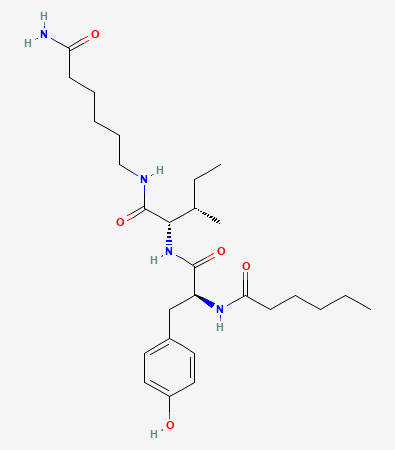
It is therefore a peptidomimetic rather than a peptide, and it is sold as an oral capsule rather than injected, both consequences of that design.
- A modified angiotensin IV analog, not a natural peptide fragment.
- Chemically capped at both ends for metabolic stability and lipophilicity.
- Developed in an academic program aimed at cognitive impairment.
- Supplied as an oral capsule.
The proposed mechanism
The program’s account is that angiotensin IV analogs act through the hepatocyte growth factor and c-Met receptor system, and that this drives synapse formation. Work published in the Journal of Pharmacology and Experimental Therapeutics reported that the procognitive and synaptogenic effects of these compounds depend on activation of that system, which is a specific and falsifiable mechanistic claim rather than a general assertion about brain health.
Animal work has followed in several models: cognitive rescue in an Alzheimer’s mouse model through PI3K/AKT signaling, a Huntington’s model in rats, and a sciatic nerve repair model. A systematic review of experimental studies on the cognitive effects of angiotensin IV and angiotensin-(1-7) collects the broader class evidence.
This is a coherent research program. It is entirely preclinical.
How far the evidence has got
To the edge of animal work and no further. There is no published clinical trial of dihexa. There is, on FDA’s account, no human exposure data at all by any route, which is a stronger statement than the absence of trials: it means the agency could not identify even uncontrolled human use in the literature to reason from.
That places dihexa in a different position from most compounds in this cluster. For BPC-157 or MOTS-c the criticism is that human evidence is thin. Here the starting point is that the safety questions a first-in-human study exists to answer have not been asked. Dose, exposure, metabolism in people, interactions, and what a synaptogenic agent does over months are all unaddressed.
Worth naming directly: a compound designed to promote synapse formation through a growth factor receptor system is not one where absent human data is a formality. HGF/c-Met signaling is implicated in cell proliferation and migration well beyond the nervous system, and long-term consequences of activating it systemically are precisely what a development program would be built to characterize.
The standing of the mechanistic papers
One further fact belongs here, and it is not one a vendor page will carry. Two of the foundational angiotensin IV analog papers from the originating research group no longer stand as published. The 2014 paper proposing that the procognitive effect depends on activation of the HGF/c-Met system was retracted in April 2025. The 2013 paper evaluating the metabolically stabilized analogs is subject to an expression of concern published in 2021. Both are cited on this page, both are labeled, and the notices are linked in the source list.
This does not establish that the mechanism is wrong. A retraction speaks to the reliability of a particular report rather than to the underlying biology, and independent work on angiotensin IV analogs continues. What it does mean is that the specific evidence most often pointed to for how dihexa is supposed to work is weaker than a citation count suggests, and anyone weighing this compound should know that before they weigh anything else.
- No clinical trial.
- FDA states it identified no human exposure data by any route.
- Preclinical evidence spans several disease models and is genuine academic work.
- Two foundational mechanistic papers are respectively retracted and subject to an expression of concern.
- The mechanism is specific enough to be testable, and has not been tested in people.
Regulatory position
FDA placed dihexa in category 2 of its interim policy on bulk drug substances for compounding under section 503A, meaning the agency identified significant safety risks, and the nomination was withdrawn by the nominator in April 2026. FDA now carries the substance under nominations withdrawn and still publishes the rationale it wrote, and a withdrawn nomination leaves the substance on no 503A list for any route. Its rationale is reproduced in full, and is short:
“FDA has not identified any human exposure data on drug products containing dihexa acetate administered via any route of administration. FDA lacks important information regarding any safety issues raised by dihexa acetate, including whether it would cause harm if administered to humans.”
FDA source , checked 2026-09-16
Five substances on that list carry this particular wording about a complete absence of human exposure data: dihexa, KPV, MOTS-c, PEG-MGF and the thymosin beta-4 fragment. It is a narrower and more specific statement than the immunogenicity language applied to most of the peptides, and it is worth reading as such rather than as boilerplate.
Dihexa is distinguished within that group by having no human data of any other kind either. MOTS-c is endogenous, so its concentrations have been measured in people in observational work even though no drug product exposure has been identified. Dihexa is a synthetic molecule with no natural counterpart to measure, so there is not even an observational literature to fall back on.
FDA revises this list. The access date appears with the quotation.
Common questions
- Why did FDA place dihexa in category 2?
- Because of an absence rather than a finding, and the nomination has since been withdrawn, which leaves the substance on no 503A list. FDA’s stated reason is that it identified no human exposure data for the compound by any route of administration. That is a stronger statement than the absence of trials, because it means the agency could not identify even uncontrolled human use in the literature.
- Is dihexa a peptide?
- It is a small synthetic molecule derived from angiotensin IV, developed at Washington State University within a program on angiotensin IV analogs for cognitive impairment. Its formal name describes its construction, and it is better understood as a peptidomimetic than as a clean peptide sequence.
- What mechanism does the originating program propose?
- That angiotensin IV analogs act through the hepatocyte growth factor and c-Met receptor system, and that this drives synapse formation. Two of the papers underpinning that account carry integrity flags, which this page labels rather than removes.
- Why does this page cite a retracted paper?
- Because removing it would hide the state of the evidence rather than represent it. One cited paper has been retracted and one carries an expression of concern, both from the originating research group, and both are labeled here with a link to the notice. A reader assessing a mechanism is better served by seeing which support has been withdrawn than by a tidier list.
- Does ExaVeyra supply dihexa?
- No. ExaVeyra does not supply dihexa, and nothing on this page is an offer to sell it. It is covered because FDA’s stated reason for restricting it is an absence of human exposure data rather than a finding of harm, and that distinction is easy to misread in either direction.
Sources
Every source is peer-reviewed and published within the last fifteen years. Each line states what that source is carrying, so nothing is here to pad a count.
- Benoist CC, Kawas LH, Zhu M. The procognitive and synaptogenic effects of angiotensin IV-derived peptides are dependent on activation of the hepatocyte growth factor/c-met system. The Journal of Pharmacology and Experimental Therapeutics. 2014.PMID 25187433
PreclinicalRetracted
The journal has withdrawn this paper. It is cited here so the record is visible, not as support for any claim. Notice: J Pharmacol Exp Ther. 2025 Apr;392(4):103567.
Source 1 supports: The paper that proposed the HGF/c-Met mechanism. Retained and labeled rather than deleted, because its withdrawal is the single most informative fact available about this literature.
- McCoy AT, Benoist CC, Wright JW. Evaluation of metabolically stabilized angiotensin IV analogs as procognitive/antidementia agents. The Journal of Pharmacology and Experimental Therapeutics. 2013.PMID 23055539
PreclinicalExpression of concern
The journal has published a formal notice that questions have been raised about this paper. It has not been withdrawn. Notice: J Pharmacol Exp Ther. 2021 Sep;378(3):313.
Source 2 supports: Why the molecule is chemically capped, and what stabilization was for. Subject to a published expression of concern, noted here rather than left for a reader to discover.
- Wright JW, Kawas LH, Harding JW. The development of small molecule angiotensin IV analogs to treat Alzheimer’s and Parkinson’s diseases. Progress in Neurobiology. 2015.PMID 25455861
Narrative review
Source 3 supports: The program’s own account of its development rationale.
- Ho JK, Nation DA. Cognitive benefits of angiotensin IV and angiotensin-(1-7): a systematic review of experimental studies. Neuroscience and Biobehavioral Reviews. 2018.PMID 29733881
Systematic review
Source 4 supports: An independent systematic review of the class, and that it covers experimental studies only.
- Sun X, Deng Y, Fu X. AngIV-analog dihexa rescues cognitive impairment and recovers memory in the APP/PS1 mouse via the PI3K/AKT signaling pathway. Brain Sciences. 2021.PMID 34827486
Preclinical
Source 5 supports: Dihexa specifically in an Alzheimer’s animal model.
- Wells RG, Azzam AF, Hiller AL. Effects of an angiotensin IV analog on 3-nitropropionic acid-induced Huntington’s disease-like symptoms in rats. Journal of Huntington’s Disease. 2024.PMID 38489193
Preclinical
Source 6 supports: Recent animal work extending the class into another model.
- Weiss JB, Phillips CJ, Malin EW. Stem cell, granulocyte-colony stimulating factor and/or dihexa to promote limb function recovery in a rat sciatic nerve damage-repair model. Annals of Medicine and Surgery. 2021.PMID 34703584
Preclinical
Source 7 supports: Dihexa outside the cognitive setting, still in animals.
- Wright JW, Harding JW. The brain hepatocyte growth factor/c-Met receptor system: a new target for the treatment of Alzheimer’s disease. Journal of Alzheimer’s Disease. 2015.PMID 25649658
Narrative review
Source 8 supports: The receptor system, and its reach beyond the nervous system.
- Uribe PM, Kawas LH, Harding JW. Hepatocyte growth factor mimetic protects lateral line hair cells from aminoglycoside exposure. Frontiers in Cellular Neuroscience. 2015.PMID 25674052
Preclinical
Source 9 supports: The mimetic approach applied in a non-cognitive model.
Figure sources
- [1]PubChem CID 129010512, Dihexa. National Center for Biotechnology Information, PubChem. Public domain.
Related
Reviewed 2026-08-16 by Benn Bluestein-Veyra, M.Sc. Organic Chemistry. This page is an evidence summary, not medical advice, and not an offer to sell. ExaVeyra does not supply Dihexa. Compounded medications are not FDA-approved finished drug products.