Epitalon: Telomerase Claims and Their Evidence
Animal and laboratory work only. A result in a rodent does not establish an effect in a person.
Epitalon is a four-residue peptide marketed almost entirely on a single claim: that it lengthens telomeres by activating telomerase. Unusually for this category, that claim is specific enough to test, and it has been tested.
This page covers what the testing shows, and the structure of the literature around it. It is an evidence summary, not a product page. ExaVeyra does not offer epitalon for sale.
Also known as: epithalon, AEDG peptide, epithalamin.
Understanding the molecular properties
Epitalon is a tetrapeptide, sequence alanine-glutamate-aspartate-glycine, usually written AEDG. Four residues makes it one of the smallest molecules in this cluster, around 390 daltons, which puts it in an unusual position: small enough that some of the absorption objections applying to larger peptides carry less force, and small enough that a four-residue sequence conveying specific biological instruction is a strong claim on its face.
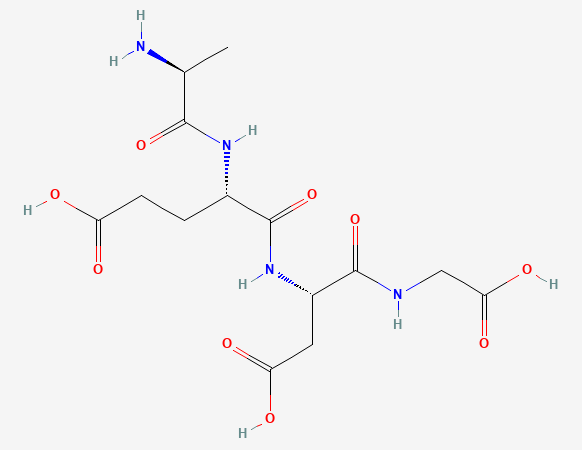
It emerged from a Russian research program on pineal extracts. An earlier preparation, epithalamin, was a peptide extract of pineal tissue; epitalon was presented as a defined synthetic peptide reproducing its activity. Some literature uses the names loosely, and results obtained with a tissue extract are not results about a defined tetrapeptide.
- Four residues, AEDG, roughly 390 daltons.
- Derived from work on pineal extracts, with epithalamin as the earlier extract preparation.
- Described in its own literature as a peptide bioregulator acting on gene expression.
- Marketed overwhelmingly on telomerase and longevity claims.
The proposed mechanism
The claim is that epitalon upregulates telomerase, the enzyme that extends telomeres, and that this slows or partially reverses cellular aging. Telomerase is genuinely central to replicative senescence, so the hypothesis is coherent rather than arbitrary. It is also a claim with an obvious experiment attached: measure telomere length in cells exposed to the peptide.
A 2025 study in Biogerontology did that in human cell lines and reported increased telomere length, attributing it to telomerase upregulation or to alternative lengthening of telomeres. That is a direct test of the central claim in human cells, and it is the most relevant single result on this page.
A second strand describes effects on gene expression and protein synthesis during neurogenesis, framed as an epigenetic mechanism, alongside work in mesenchymal stem cell aging cultures. Recent work extends into oocyte maturation and an in vitro model of diabetic retinopathy.
How far the evidence has got
The 2025 cell line result is meaningful and it is not the same as a clinical finding. Telomere lengthening in cultured cells does not establish that a person taking the peptide ages more slowly, lives longer, or experiences any outcome they would notice. The distance between those propositions is the whole of clinical development.
The structure of the wider literature is worth stating plainly. A substantial share of it, particularly the earlier work and the gene expression strand, traces to Khavinson and colleagues, who originated the peptide bioregulator program. Concentrated authorship is not evidence of error, but a finding replicated only within the group that produced it carries less weight than one reproduced independently, and readers weighing this literature should know which situation they are in. The 2025 Biogerontology work is notable partly because it comes from outside that lineage.
There is no controlled human trial of epitalon supporting a longevity or healthspan outcome.
- Direct human cell line evidence for telomere lengthening, published 2025.
- No controlled human trial of any clinical outcome.
- Much of the older literature originates from a single research program.
- Results obtained with the pineal extract epithalamin are not results about the tetrapeptide.
Regulatory position
FDA placed epitalon in category 2 of its interim policy on bulk drug substances for compounding under section 503A, meaning the agency identified significant safety risks, and the nomination was withdrawn by the nominator in April 2026. FDA now carries the substance under nominations withdrawn and still publishes the rationale it wrote, and a withdrawn nomination leaves the substance on no 503A list for any route. The Pharmacy Compounding Advisory Committee recommended it for the 503A bulks list on 24 July 2026; that recommendation is advice to the agency, and inclusion requires rulemaking. FDA’s rationale in full:
“Compounded drugs containing epitalon may pose risk for immunogenicity for certain routes of administration due to the potential for aggregation and peptide-related impurities. FDA has not identified safety-related information regarding epitalon for the proposed route of administration. Therefore, the agency lacks sufficient information to know whether the drug would cause harm if administered to humans.”
FDA source , checked 2026-09-16
One point deserves drawing out, because it runs against the direction of the marketing. If the mechanism is real, it is a mechanism for extending replicative lifespan in cells, and the relationship between telomerase activity and cancer is not a simple or reassuring one. A claim to upregulate telomerase is not automatically a claim to a benefit, and the absence of long-term human safety data is more consequential for a mechanism of that kind, not less.
FDA revises this list. The access date appears with the quotation.
Common questions
- What is the central claim made for epitalon?
- That it upregulates telomerase, the enzyme that extends telomeres, and that this slows cellular aging. The claim is unusually specific for this category, which is what makes it testable, and it has been tested.
- What did that testing actually show?
- A 2025 cell line result reported telomere lengthening in culture. That finding is meaningful and it is not a clinical result. Telomere lengthening in cultured cells does not establish that a person taking the peptide ages more slowly, lives longer, or experiences any outcome they would notice.
- Does the proposed mechanism carry a risk?
- The mechanism cuts both ways, and this page says so. Telomerase extends replicative lifespan in cells, and unlimited replicative capacity is a defining feature of malignant cell populations. That relationship is why this page links to a prescriber framework on oncological risk rather than treating the mechanism as straightforwardly desirable.
- Why did FDA place epitalon in category 2, and where does it stand now?
- FDA evaluated it for compounding use under section 503A and identified significant safety risks. The nomination was withdrawn in April 2026, so the substance now sits under nominations withdrawn and on no 503A list, and a July 2026 advisory committee recommendation does not change that until rulemaking does. The agency rationale is reproduced in full on this page with the date it was accessed, because FDA revises the page and a summary would go stale without showing when it was true.
- Does ExaVeyra supply epitalon?
- No. ExaVeyra does not supply epitalon, and nothing on this page is an offer to sell it. It is covered because its central claim is specific enough to test, which makes it a useful case study in the distance between a cell culture result and a clinical one.
Sources
Every source is peer-reviewed and published within the last fifteen years. Each line states what that source is carrying, so nothing is here to pad a count.
- Al-Dulaimi S, Thomas R, Matta S. Epitalon increases telomere length in human cell lines through telomerase upregulation or ALT activity. Biogerontology. 2025.PMID 40908429
Clinical study
Source 1 supports: A direct test of the central telomerase claim in human cells, from outside the originating group.
- Araj SK, Brzezik J, Mądra-Gackowska K. Overview of epitalon: highly bioactive pineal tetrapeptide with promising properties. International Journal of Molecular Sciences. 2025.PMID 40141333
Narrative review
Source 2 supports: A recent survey of the claims made for the peptide.
- Gatta M, Dovizio M, Milillo C. The antioxidant tetrapeptide epitalon enhances delayed wound healing in an in vitro model of diabetic retinopathy. Stem Cell Reviews and Reports. 2025.PMID 40493162
Clinical study
Source 3 supports: Current in vitro work outside the telomere strand.
- Ullah S, Haider Z, Perera CD. Epitalon-activated telomerase enhance bovine oocyte maturation rate and post-thawed embryo development. Life Sciences. 2025.PMID 39788414
Preclinical
Source 4 supports: The telomerase mechanism examined in a non-human system.
- Yue X, Liu SL, Guo JN. Epitalon protects against post-ovulatory aging-related damage of mouse oocytes in vitro. Aging. 2022.PMID 35413689
Preclinical
Source 5 supports: Animal cell work on the aging claim.
- Khavinson V, Diomede F, Mironova E. AEDG peptide (epitalon) stimulates gene expression and protein synthesis during neurogenesis: possible epigenetic mechanism. Molecules. 2020.PMID 32019204
Clinical study
Source 6 supports: The gene expression strand, and the authorship pattern described above.
- Ashapkin V, Khavinson V, Shilovsky G. Gene expression in human mesenchymal stem cell aging cultures: modulation by short peptides. Molecular Biology Reports. 2020.PMID 32399807
Clinical study
Source 7 supports: Human cell work from the originating program, for comparison with the 2025 result.
- Mavrych V, Shypilova I, Bolgova O. Therapeutic peptides in gerontology: mechanisms and applications for healthy aging. Frontiers in Aging. 2026.PMID 42021992
Narrative review
Source 8 supports: Where epitalon sits among peptides marketed for aging.
Figure sources
- [1]PubChem CID 219042, Epitalon. National Center for Biotechnology Information, PubChem. Public domain.
Related
Reviewed 2026-08-16 by Benn Bluestein-Veyra, M.Sc. Organic Chemistry. This page is an evidence summary, not medical advice, and not an offer to sell. ExaVeyra does not supply Epitalon. Compounded medications are not FDA-approved finished drug products.