The FDA states that there are no FDA-approved exosome products and regulates exosomes marketed to treat disease as drugs and biological products that need an approved biologics license or an investigational new drug application. Its 2026 letters cited website claims as evidence of intended use, rejected the argument that the products qualified as minimally regulated tissue products, and in one case found manufacturing failures, including a process that did not appear to isolate exosomes.
Regulatory Status
The FDA states that there are currently no FDA-approved exosome products, and it regulates exosomes used to treat diseases and conditions as drugs and biological products subject to premarket review. This article describes enforcement actions against other companies for education and makes no claim about any product supplied by ExaVeyra Sciences. ExaVeyra sells only to verified licensed providers, does not provide care, and makes no efficacy claim for any product.
Practices that use or are considering cell-derived products usually ask what FDA actually objected to, whether the same reasoning reaches topical aesthetic use, and how to vet a supplier. The sections below take those questions in order.
The FDA Treats Exosomes Marketed to Treat Disease as Drugs and Biological Products
FDA’s Public Safety Notification on Exosome Products, issued on 6 December 2019, states that there are currently no FDA-approved exosome products and that certain clinics, including some marketing violative stem cell products, had begun offering exosome products to patients [1]. The FDA issued it after multiple reports of serious adverse events in patients in Nebraska treated with unapproved products marketed as containing exosomes [2]. The notification advises patients considering an exosome product in the United States to ask whether FDA has reviewed it and to ask for the investigational new drug (IND) number [2].
The framework FDA applies follows from that position. Under the FDA’s framework, exosomes used to treat diseases and conditions in humans are regulated as drugs under the Federal Food, Drug, and Cosmetic Act and biological products under section 351 of the Public Health Service Act, and are subject to premarket review and approval [3, 6]. To be marketed lawfully, such a product needs an approved biologics license application, and while in development it may be used in people only under an IND [6, 7]. Every 2026 letter reviewed here cites one or both of those requirements [3, 4, 5].
Three 2026 Letters Addressed Exosome Products
Dynamic Stem Cell Therapy, 11 February 2026
CBER’s letter, posted on 24 February, concerned an umbilical cord-derived stem cell product marketed on the company’s website, with its exosome products raised as an additional concern [3]. FDA found that the cord product failed the minimal manipulation and homologous use criteria of 21 CFR 1271.10(a), so it could not be regulated solely as a tissue product under section 361 of the Public Health Service Act, and the agency stated that exosomes used to diagnose, treat or prevent disease, or to affect the structure or function of the body, are subject to drug and biological product requirements, including premarket review and approval [3]. The letter directed the company to the 2019 safety notification [3].
Blue Horizon International, 26 May 2026
CBER’s letter, posted on 2 June, concerned an umbilical cord blood product marketed under a stem cell “therapy” name and an exosome product derived from Wharton’s jelly mesenchymal stem cells, also marketed under a “therapy” name, for allogeneic use [4]. FDA found both to be drugs and biological products with no approved biologics license or IND in effect, found the cord blood product outside the section 361 tissue framework, and cited misbranding for lack of adequate directions for use [4]. The website claims the agency quoted in the letter included treating chronic conditions, injuries and degenerative diseases, and describing the exosomes as having strong regenerative and anti-inflammatory properties [4].
R3 Medical Companies, 14 August 2026
CBER’s letter followed an inspection of the contract manufacturer Bello Bio and the distributor Regen Suppliers from 17 November to 16 December 2025, and covered umbilical cord-derived products sold under the ReBella and Bello names, including products labeled as exosome products [5]. FDA found the products to be unapproved new drugs and unlicensed biological products, found that they failed the homologous use criterion, and recorded current good manufacturing practice violations: no validated aseptic process, no validated manufacturing process for identity, strength, quality and purity, sterility testing on samples that had been frozen and thawed first, no validated cleaning of the biological safety cabinet, and a 24-month expiration date with no supporting stability data [5]. FDA also noted that the products were labeled as exosome products although the manufacturing process did not appear to isolate exosomes, and that donor eligibility records lacked required screening qualifiers [5].
Letters in 2025 Set the Same Pattern
The 2026 letters continued a series. FDA’s May 2025 letter to Supreme Rejuvenation concerned umbilical cord mesenchymal stem cell-derived exosome products and quoted social media claims about diabetes and fibromyalgia; it noted that the company’s statement that its products were for research and investigational purposes did not change the analysis, because no IND was in effect [6]. In August 2025 FDA wrote to Platinum Biologics about two exosome products, finding them unapproved new drugs and unlicensed biological products, and in September 2025 it wrote to New Life Medical Services about an exosome product found during an inspection [7, 8]. In December 2024 FDA wrote to Evolutionary Biologics about EXO RNA, an exosome product its website promoted with claims about neurodegenerative disease, found it to be a drug and biological product subject to premarket approval, and pointed the company to the 2019 safety notification [9].
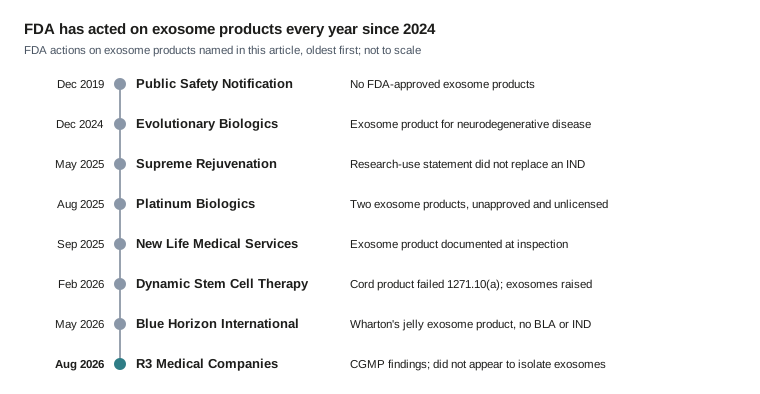
The letters run from December 2024 to August 2026 (Fig. 1) and reach clinics, distributors and manufacturers. The newest, to R3 Medical Companies, pairs the intended-use analysis with detailed manufacturing findings.
What the Letters Have in Common
Four points recur across the letters reviewed here, and each maps to something a practice can check.
- Claims establish intended use. Every letter reviewed here quoted website or social media language describing disease treatment or tissue repair as evidence that the product was a drug [3, 4, 5, 6].
- The tissue exemption did not apply. Each cell or cord product failed at least one criterion in 21 CFR 1271.10(a), most often homologous use, which removed it from the section 361 framework [3, 4, 5, 10].
- Research-use statements did not replace an IND. A statement that a product is for research or investigational use did not substitute for an IND [6].
- Manufacturing quality matters on its own. The R3 letter shows that FDA examines sterility testing, process validation, stability data and whether the product contains what its label says [5].
None of the 2026 letters reviewed here concerned a product sold as a topical cosmetic. The FDA’s notification addresses exosomes used to treat diseases and conditions, so the claims made for a product, and the route by which it is used, decide which framework applies [1, 3].
The 2026 Letters at a Glance
| Date | Recipient | Products named | Main findings | Source |
|---|---|---|---|---|
| 11 February 2026 | Dynamic Stem Cell Therapy | Umbilical cord-derived product; exosome products as an additional concern | Unapproved drug and unlicensed biologic; failed 1271.10(a) minimal manipulation and homologous use | [3] |
| 26 May 2026 | Blue Horizon International | Cord blood product and Wharton’s jelly MSC-derived exosome product, each marketed under a “therapy” name | Unapproved drug and unlicensed biologic; outside section 361; misbranding | [4] |
| 14 August 2026 | R3 Medical Companies, Bello Bio, Regen Suppliers | ReBella and Bello cord-derived products, some labeled as exosomes | Unapproved drug and unlicensed biologic; CGMP violations; process did not appear to isolate exosomes | [5] |
ExaVeyra sells cell-derived products only to verified licensed providers and supplies its documentation to any account that asks. Clinical decisions remain with the licensed practitioner.
Educational Disclaimer: This article is for educational purposes only and does not constitute medical or legal advice. It does not identify any material, compound, device setting or protocol as safe, effective or appropriate for any patient, and it is not intended to diagnose, treat, cure, or prevent any disease. Questions about a treatment belong with the reader’s own licensed provider. Exosome material is supplied for topical aesthetic use by licensed practitioners. No exosome product is FDA-approved for any use, and ExaVeyra Sciences makes no statement about administration, route, or outcome. Compounded medications are not FDA-approved. They are prepared by a 503A compounding pharmacy licensed by the Texas State Board of Pharmacy for an individual patient against that patient’s prescription, and are available to NPI-verified licensed practitioners only, in the states where the pharmacy is licensed. Product, device and brand names mentioned are trademarks of their respective owners and are used only to identify the products discussed. Their mention is not an endorsement, and those owners have not reviewed or endorsed this article. ExaVeyra Sciences is a supplier and takes no part in any diagnosis, treatment decision, or plan of care. Findings described are attributed to the peer-reviewed literature, trial registries and agencies cited. The content of these guides is provided for general informational purposes only. It does not constitute legal, medical, or regulatory advice, and does not establish that any particular product or practice is compliant. Regulatory requirements vary by state and depend on the circumstances of each practice. Each practitioner should consult their own legal counsel and the applicable state licensing boards before acting on anything stated here.
References
- 1.US Food and Drug Administration. Public Safety Notification on Exosome Products. 6 December 2019. https://www.fda.gov/vaccines-blood-biologics/safety-availability-biologics/public-safety-notification-exosome-productsPrimary source. Carries in this article: no FDA-approved exosome products, and the clinics offering them.
- 2.US Food and Drug Administration. Public Safety Alert Due to Marketing of Unapproved Stem Cell and Exosome Products. Posted 9 December 2019. https://www.fda.gov/safety/medical-product-safety-information/public-safety-alert-due-marketing-unapproved-stem-cell-and-exosome-productsPrimary source. Carries in this article: the Nebraska adverse events and the advice to ask for an IND number.
- 3.US Food and Drug Administration, CBER. Warning letter to Dynamic Stem Cell Therapy, CBER 25-712579. 11 February 2026, posted 24 February 2026. https://www.fda.gov/inspections-compliance-enforcement-and-criminal-investigations/warning-letters/dynamic-stem-cell-therapy-712579-02112026Primary source. Carries in this article: the 1271.10(a) findings, the exosome concern and the statement on exosome regulation.
- 4.US Food and Drug Administration, CBER. Warning letter to Blue Horizon International, LLC, CBER 26-728085. 26 May 2026, posted 2 June 2026. https://www.fda.gov/inspections-compliance-enforcement-and-criminal-investigations/warning-letters/blue-horizon-international-llc-728085-05262026Primary source. Carries in this article: the Wharton’s jelly MSC-derived exosome product, the claims quoted and the findings.
- 5.US Food and Drug Administration, CBER. Warning letter to R3 Medical Companies, CBER 26-726330. 14 August 2026. https://www.fda.gov/inspections-compliance-enforcement-and-criminal-investigations/warning-letters/r3-medical-companies-726330-08142026Primary source. Carries in this article: the inspection dates, the CGMP and donor eligibility findings, and the finding that the process did not appear to isolate exosomes.
- 6.US Food and Drug Administration, CBER. Warning letter to Supreme Rejuvenation, LLC, 700749. 5 May 2025. https://www.fda.gov/inspections-compliance-enforcement-and-criminal-investigations/warning-letters/supreme-rejuvenation-llc-700749-05052025Primary source. Carries in this article: the exosome products, the claims quoted, the BLA and IND requirements, and the research-use statement.
- 7.US Food and Drug Administration, CBER. Warning letter to Platinum Biologics LLC, CBER 25-705090. 15 August 2025. https://www.fda.gov/inspections-compliance-enforcement-and-criminal-investigations/warning-letters/platinum-biologics-llc-705090-08152025Primary source. Carries in this article: the two exosome products found to be unapproved new drugs and unlicensed biological products.
- 8.US Food and Drug Administration, CBER. Warning letter to New Life Medical Services, LLC, CBER 25-711102. 24 September 2025. https://www.fda.gov/inspections-compliance-enforcement-and-criminal-investigations/warning-letters/new-life-medical-services-llc-711102-09242025Primary source. Carries in this article: an exosome product documented during an inspection.
- 9.US Food and Drug Administration, CBER. Warning letter to Evolutionary Biologics Inc., CBER-24-681586. 30 December 2024, posted 28 January 2025, in FDA’s warning letter database. https://www.fda.gov/inspections-compliance-enforcement-and-criminal-investigations/compliance-actions-and-activities/warning-lettersPrimary source. Carries in this article: the exosome product EXO RNA, the website claims about neurodegenerative disease, and the direction to the 2019 safety notification.
- 10.21 CFR 1271.10, Criteria for regulation solely under section 361 of the PHS Act. Electronic Code of Federal Regulations. https://www.ecfr.gov/current/title-21/chapter-I/subchapter-L/part-1271/subpart-A/section-1271.10Primary source, regulation text. Carries in this article: the minimal manipulation and homologous use criteria.
- 11.21 CFR part 1271, subpart B, Procedures for Registration and Listing. Electronic Code of Federal Regulations. https://www.ecfr.gov/current/title-21/chapter-I/subchapter-L/part-1271/subpart-BPrimary source, regulation text. Carries in this article: the establishment registration item on the supplier checklist.
- 12.21 CFR part 1271, subpart C, Donor Eligibility. Electronic Code of Federal Regulations. https://www.ecfr.gov/current/title-21/chapter-I/subchapter-L/part-1271/subpart-CPrimary source, regulation text. Carries in this article: the donor screening and testing requirements behind the donor eligibility item on the supplier checklist.
Image credits
- Fig. 1ExaVeyra Sciences, original figure. ↩