Retail exosome serums are sold as cosmetics and often use plant-derived or exosome-like vesicles, while professional exosome products are typically derived from human stem cells and sold to licensed practitioners. FDA states that there are no FDA-approved exosome products, and whether any product is a cosmetic or a drug depends on its intended use and the claims made for it. The controlled studies published so far tested professional formulations applied with microneedling or energy devices.
Regulatory Status
FDA states that there are currently no FDA-approved exosome products. Cosmetics do not need FDA approval before sale, but under the FDA’s intended-use test a product marketed with claims to treat disease or affect the structure or function of the body is regulated as a drug. ExaVeyra Sciences sells only to verified licensed providers, does not provide care, and makes no efficacy claim for any product it supplies.
Patients often arrive at a clinic having already used an exosome serum, and practitioners are asked whether a professional procedure differs. The sections below set out the differences in source, regulation, documentation and evidence.
Retail Exosome Serums Often Contain Plant-Derived or Exosome-Like Vesicles
Exosomes are small extracellular vesicles that cells release, and the reviews of their use in cosmetics describe several sources: platelets, mesenchymal stem cells, immune and epithelial cells, and plant cells, whose vesicles are often called plant-derived extracellular nanoparticles (Dal Col et al., 2025; Haykal et al., 2025). Human-derived vesicles have attracted the most research interest, but a 2026 review in Cosmetics describes strict prohibitions on human-derived biological material in the European cosmetic market and a resulting shift toward plant-derived, microbiome-derived and other alternative vesicles (Costa et al., 2026). A 2025 review in the same journal states that human mesenchymal stem cell-derived vesicles are prohibited in cosmetics by regulatory agencies, and that plant and bacterial vesicles are being explored to meet demand (Dal Col et al., 2025).
The practical result is that a serum labeled with the word exosome may contain vesicles from roses, other botanicals or fermentation, sometimes described as exosome-like. The label rarely states the source, the vesicle concentration or how the vesicles were measured, and the reviews identify standardization of isolation and characterization as an open problem across the field (Dal Col et al., 2025; Costa et al., 2026).
Intended Use Decides Whether a Product Is a Cosmetic or a Drug
Under US law, the same ingredient can be regulated as a cosmetic or as a drug depending on what the product is intended to do. FDA explains that a product’s intended use can be established by claims on its labeling, in advertising, on the internet or in other promotional materials, and that certain claims make a product a drug even when it is marketed as a cosmetic (FDA, Is It a Cosmetic, a Drug, or Both?). FDA’s examples of such claims include restoring hair growth, increasing or decreasing melanin production, and regenerating cells (FDA, Is It a Cosmetic, a Drug, or Both?).
Cosmetics and their ingredients, other than color additives, do not need FDA approval before they are sold, but the Modernization of Cosmetics Regulation Act of 2022 gave FDA new authority over them, including mandatory recall authority, access to records, and a requirement that each marketed cosmetic product be listed with FDA along with its ingredients (FDA, Cosmetics and US Law; FDA, MoCRA; FDA, Registration and Listing of Cosmetic Product Facilities and Products). A retail serum that stays within appearance claims is therefore a listed cosmetic, and the same serum sold with claims to repair or regenerate skin cells moves toward drug status.
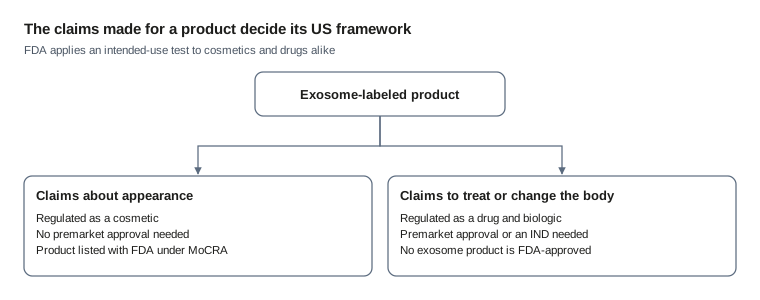
The same exosome ingredient can sit on either side of that line depending on the claims (Fig. 1). Practices can review their supplier’s claims and their own marketing with counsel.
Professional Exosome Products Face a Stricter Framework
Professional exosome products are usually derived from human cells, such as adipose or umbilical cord mesenchymal stem cells, and are supplied to clinics as lyophilized powder or solution. FDA’s 2019 Public Safety Notification states that there are currently no FDA-approved exosome products (FDA, 2019). The FDA’s warning letters describe exosomes used to diagnose, treat or prevent disease, or to affect the structure or function of the body, as drugs and biological products subject to premarket review and approval (FDA, Dynamic Stem Cell Therapy letter, 2026).
In aesthetic practice, these products are commonly applied to the skin after microneedling or an energy-based device, and the clinical studies published so far used them that way (Park et al., 2023; Estupiñan et al., 2025). How a particular product and procedure are classified depends on the product’s source, its intended use and the claims made for it, and that is a question for each practice’s counsel rather than one this article can answer.
What a Supplier Should Be Able to Document
The testing that matters follows from what can go wrong. In its August 2026 warning letter to R3 Medical Companies, FDA found that umbilical cord products labeled as exosome products came from a manufacturing process that did not appear to isolate exosomes, and also cited sterility testing on frozen and thawed samples and an expiration date without stability data (FDA, R3 Medical Companies letter, 2026). A practice can ask any exosome supplier, retail or professional, for the following.
- Source. The cell or plant source, and for human-derived material, how donors were screened.
- Characterization. Vesicle concentration and size distribution, the method used to measure them, and the markers used to confirm the vesicles’ identity.
- Safety testing. Sterility, endotoxin and, for human-derived material, donor infectious disease testing, each on the lot supplied.
- Stability. Data supporting the expiration date and the storage conditions.
- Regulatory position. How the supplier characterizes the product’s status, in writing.
What the Published Studies Tested
The controlled clinical studies identified for this review tested professional, human-derived formulations combined with a procedure, not retail serums used alone. The two summarized here describe their formulation and procedure in enough detail to compare.
Park and Colleagues, 2023
In a 12-week prospective, randomized, split-face study published in the Journal of Cosmetic Dermatology, 28 participants received three sessions three weeks apart, with a human adipose tissue stem cell-derived exosome-containing solution plus microneedling on one side of the face and saline plus microneedling on the other (Park et al., 2023). The authors reported a significantly higher Global Aesthetic Improvement Scale score on the exosome-treated side at the final visit, greater improvement on that side in device measurements of wrinkles, elasticity, hydration and pigmentation, and no serious adverse events (Park et al., 2023).
Estupiñan, Ly and Goldberg, 2025
In an investigator-blinded, non-randomized split-face trial, participants with mild to moderate photoaging underwent three radiofrequency microneedling sessions, with platelet-rich plasma applied to one half of the face and a topical adipose stem cell exosome product to the other (Estupiñan et al., 2025). The exosome product was reconstituted from lyophilized powder and, in the study’s description, also contained rose plant stem cell exosomes, growth factors and peptides, so the comparison is between two procedures with complex formulations (Estupiñan et al., 2025). A conference abstract describing the same design disclosed sponsorship by the product’s manufacturer (IMCAS World Congress, 2025; see Estupiñan et al., 2025).
Both studies are small, both pair the product with a procedure that itself affects the skin, and neither tested a retail serum. The cosmetics reviews describe the overall clinical evidence as limited and call for standardized, controlled studies (Dal Col et al., 2025; Costa et al., 2026).
Retail Serum and Professional Product, Side by Side
| Feature | Retail exosome serum | Professional exosome product |
|---|---|---|
| Typical source | Plant-derived, fermentation-derived or exosome-like vesicles; source often not stated | Human mesenchymal or adipose stem cells |
| Who buys it | Consumers | Licensed practitioners |
| US framework | Cosmetic if limited to appearance claims; listing required under MoCRA | No FDA-approved exosome products; the FDA regulates treatment use as drug and biological product |
| Typical use | Applied at home on intact skin | Applied in clinic, often after microneedling or an energy device |
| Published controlled studies | None identified for retail serums used alone | Small split-face studies combined with procedures |
| Documentation to request | Ingredient listing, source, characterization | Donor screening, characterization, sterility, endotoxin, stability, lot certificate |
ExaVeyra supplies professional products only to verified licensed providers and provides its supplier documentation on request. Clinical decisions remain with the practitioner.
Educational Disclaimer: This article is for educational purposes only and does not constitute medical or legal advice. It does not identify any material, compound, device setting or protocol as safe, effective or appropriate for any patient, and it is not intended to diagnose, treat, cure, or prevent any disease. Questions about a treatment belong with the reader’s own licensed provider. Exosome material is supplied for topical aesthetic use by licensed practitioners. No exosome product is FDA-approved for any use, and ExaVeyra Sciences makes no statement about administration, route, or outcome. Compounded medications are not FDA-approved. They are prepared by a 503A compounding pharmacy licensed by the Texas State Board of Pharmacy for an individual patient against that patient’s prescription, and are available to NPI-verified licensed practitioners only, in the states where the pharmacy is licensed. Product, device and brand names mentioned are trademarks of their respective owners and are used only to identify the products discussed. Their mention is not an endorsement, and those owners have not reviewed or endorsed this article. ExaVeyra Sciences is a supplier and takes no part in any diagnosis, treatment decision, or plan of care. Findings described are attributed to the peer-reviewed literature, trial registries and agencies cited. The content of these guides is provided for general informational purposes only. It does not constitute legal, medical, or regulatory advice, and does not establish that any particular product or practice is compliant. Regulatory requirements vary by state and depend on the circumstances of each practice. Each practitioner should consult their own legal counsel and the applicable state licensing boards before acting on anything stated here.
References
- 1.Costa G, Silva E, Silva F, Casas A, Bastos B, Nóbrega C, Oliveira MBPP, Almeida H. The Benefits of Using Exosomes in Professional Cosmetic Products: From Theory to Practice. Cosmetics. 2026;13(3):131. Published 24 May 2026. doi:10.3390/cosmetics13030131Review. Carries in this article: the restriction on human-derived biological material in the European cosmetic market and the shift to plant-derived and microbiome-derived vesicles. Disclosure: several authors list an affiliation with a private investment company, and the review evaluates a commercial cosmetics portfolio.
- 2.Dal Col V, Ribas FF, Araldi RP. The Transformative Impact of Extracellular Vesicles on the Cosmetics Industry: A Comprehensive Review. Cosmetics. 2025;12(5):191. doi:10.3390/cosmetics12050191Comprehensive review. Carries in this article: the sources of vesicles, the statement that human MSC-derived vesicles are prohibited in cosmetics by regulators, and the limits of the evidence. Disclosure: two authors list a cosmetics company affiliation.
- 3.Estupiñan B, Ly K, Goldberg DJ. Adipose Mesenchymal Stem Cell-Derived Exosomes Versus Platelet-Rich Plasma Treatment for Photoaged Facial Skin: An Investigator-Blinded, Split-Face, Non-Inferiority Trial. Journal of Cosmetic Dermatology. 2025;24(5):e70208. PMID 40414798. PMC12104007. doi:10.1111/jocd.70208Investigator-blinded, split-face, non-randomized trial. Carries in this article: the design, the radiofrequency microneedling procedure and the formulation’s contents. The product studied was a commercial exosome complex, and the IMCAS World Congress 2025 abstract of the same design (https://www.imcas.com/pt/attend/imcas-world-congress-2025/program/session/55849) names its manufacturer as the funder.
- 4.FDA (2019). Public Safety Notification on Exosome Products. 6 December 2019. https://www.fda.gov/vaccines-blood-biologics/safety-availability-biologics/public-safety-notification-exosome-productsPrimary source. Carries in this article: no FDA-approved exosome products.
- 5.FDA, Cosmetics and US Law. Agency page. https://www.fda.gov/cosmetics/laws-regulations/cosmetics-us-lawPrimary source. Carries in this article: MoCRA’s new authorities, product listing and the absence of premarket approval for cosmetics.
- 6.FDA, Dynamic Stem Cell Therapy letter (2026). Warning letter, CBER 25-712579. 11 February 2026. https://www.fda.gov/inspections-compliance-enforcement-and-criminal-investigations/warning-letters/dynamic-stem-cell-therapy-712579-02112026Primary source. Carries in this article: the agency’s statement that exosomes used to diagnose, treat or prevent disease, or to affect body structure or function, are subject to drug and biological product requirements.
- 7.FDA, Is It a Cosmetic, a Drug, or Both? (Or Is It Soap?). Agency page. https://www.fda.gov/cosmetics/laws-regulations/it-cosmetic-drug-or-both-or-it-soapPrimary source. Carries in this article: intended use as the test, how it is established, and the agency’s examples of drug claims.
- 8.FDA, MoCRA. Modernization of Cosmetics Regulation Act of 2022 (MoCRA). Agency page. https://www.fda.gov/cosmetics/cosmetics-laws-regulations/modernization-cosmetics-regulation-act-2022-mocraPrimary source, added at conversion. Carries in this article: the statute that added mandatory recall authority, records access and product listing for cosmetics.
- 9.FDA, R3 Medical Companies letter (2026). Warning letter, CBER 26-726330. 14 August 2026. https://www.fda.gov/inspections-compliance-enforcement-and-criminal-investigations/warning-letters/r3-medical-companies-726330-08142026Primary source. Carries in this article: the finding that a process did not appear to isolate exosomes, and the sterility and stability findings.
- 10.FDA, Registration and Listing of Cosmetic Product Facilities and Products. Agency page. https://www.fda.gov/cosmetics/registration-listing-cosmetic-product-facilities-and-productsPrimary source, added at conversion. Carries in this article: the requirement that each marketed cosmetic product be listed with the agency along with its ingredients.
- 11.Haykal D, Wyles S, Garibyan L, Cartier H, Gold M. Exosomes in Cosmetic Dermatology: A Review of Benefits and Challenges. Journal of Drugs in Dermatology. 2025;24(1):12-18. doi:10.36849/JDD.8872Review. Carries in this article: the range of vesicle sources, including plant-derived nanoparticles.
- 12.Park GH, Kwon HH, Seok J, Yang SH, Lee J, Park BC, Shin E, Park KY. Efficacy of combined treatment with human adipose tissue stem cell-derived exosome-containing solution and microneedling for facial skin aging: A 12-week prospective, randomized, split-face study. Journal of Cosmetic Dermatology. 2023;22(12):3418-3426. PMID 37377400. doi:10.1111/jocd.15872Prospective, randomized, split-face study. Carries in this article: the 28-participant design, the comparison with saline plus microneedling, the outcomes and the safety finding.
Image credits
- Fig. 1ExaVeyra Sciences, original figure. ↩