GHK-Cu Copper Peptide: Evidence and FDA Status
Case reports or small series only. No controlled trial of meaningful size.
GHK-Cu is the tripeptide glycyl-histidyl-lysine complexed with copper, one of the most written-about peptides in skin science and one of the most loosely cited. Its literature is large and mostly concerns skin, wounds and gene expression; its hair literature is small and concerns a related molecule; and its regulatory position depends on the route, because FDA’s category 2 entry covered the injectable form, and that injectable nomination was withdrawn in April 2026, while GHK-Cu for non-injectable routes, which covers the topical preparations a licensed 503A pharmacy compounds to prescription, is in category 1 of FDA’s 503A list as of 14 May 2026.
This page separates those three things. It is an evidence summary of the published literature. ExaVeyra does not supply GHK-Cu as an injectable or as a bulk research substance; the topical scalp solution and the creams a 503A pharmacy prepares to prescription are listed on the product pages linked below by composition and dating only.
Also known as: copper tripeptide, glycyl-histidyl-lysine copper, GHK copper complex, copper peptide.
A tripeptide with a copper-binding motif
GHK is a naturally occurring tripeptide, glycine, histidine and lysine in that order, first isolated from human plasma in the 1970s and found since in saliva and urine.[1] The free peptide has a mass of roughly 340 daltons,[2] and its histidine and the terminal amine give it a high affinity for copper(II), so that in tissue it exists largely as the copper complex written GHK-Cu (Fig. 1).[1][3]
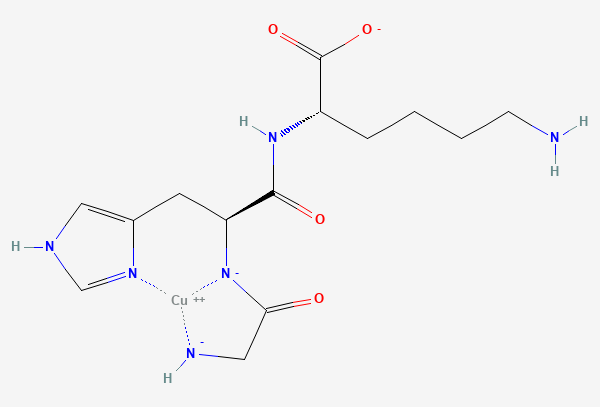
Plasma concentrations of the peptide have been reported to fall with age, an observation the 2015 review by Pickart and colleagues in BioMed Research International uses to frame the peptide as a natural modulator of skin repair.[4] Whether that decline is cause or correlate remains open, and the review is careful to present it as the motivation for the research.[4]
- Sequence: glycyl-histidyl-lysine, three residues, roughly 340 daltons as the free peptide.[2]
- Copper complex: GHK binds copper(II) with high affinity and is studied almost entirely as the complex.
- Origin: isolated from human plasma; also present in saliva and urine.[1]
- Related molecule: AHK-Cu, alanyl-histidyl-lysine with copper, shares the binding motif and is the peptide in the most-cited follicle study.
What the literature describes it doing
The 2018 review by Pickart and Margolina in the International Journal of Molecular Sciences is the standard entry point. It summarizes gene-expression work in which GHK was reported to change the expression of a large fraction of human genes in cultured cells, and it collects the in vitro and animal literature described in the context of collagen and glycosaminoglycan synthesis, angiogenesis, anti-inflammatory signaling and wound models.[1][5][6] The review is a synthesis by the peptide’s principal investigator, which is a reason to read it and a reason to read the primary studies it cites.[1]
The animal work is where mechanism meets a measurable outcome, and the outcomes are mixed. A 2013 study in Otolaryngology, Head and Neck Surgery found no difference with topical GHK-Cu gel in flap ischemia, vessel number or VEGF expression in an irradiated rat wound model, and a 2015 study in the Journal of Orthopaedic Research found that intra-articular GHK-Cu reduced knee laxity at 6 weeks after ACL reconstruction in rats, with no difference at 12 weeks.[7][8] Both are preclinical, both are cited below with that design labeled, and neither concerns hair.
Delivery is its own research question, because a hydrophilic tripeptide-copper complex does not cross intact stratum corneum readily.[9] A 2015 study in Pharmaceutical Research examined microneedle-mediated delivery of copper peptide through skin, which is the mechanistic background to the pairing of copper peptide formulations with microneedling in aesthetic practice.[10]
Evaluating the current clinical evidence
For skin, the human evidence consists of cosmetic-formulation studies summarized in the reviews, most of them older than this page’s source window and several of them unpublished in indexed journals.[3][4] For wounds, there are animal models and older human wound series described in the same reviews.[1][4] For hair, there is no randomized controlled trial of GHK-Cu in human pattern hair loss, and the follicle organ-culture study most often cited used AHK-Cu rather than GHK-Cu; the hair cluster page linked below takes that literature at its own level of detail.
The evidence state on this page is therefore recorded as limited human data. That is a description of the literature, stated once here so the rest of the page can read plainly.
- Gene-expression and in vitro work: substantial, synthesized in the 2015 and 2018 reviews.[1][4][5]
- Animal models: wound and ligament studies from 2013 and 2015, preclinical.[7][8]
- Human skin studies: cosmetic-formulation work summarized in the reviews.[4]
- Human hair trials: none published for GHK-Cu.
Regulatory position: the route decides
FDA placed GHK-Cu for injectable routes of administration in category 2 of its interim policy on bulk drug substances for compounding under section 503A, meaning the agency identified significant safety risks, and that nomination was withdrawn by the nominator in April 2026. FDA now carries the entry under nominations withdrawn and still publishes the rationale it wrote, so the withdrawn route sits in no interim category. GHK-Cu for non-injectable routes, which covers topical preparations, is in category 1 (bulk drug substances under evaluation) on FDA’s 503A list updated 14 May 2026, after a nominator clarified on 5 May 2026 that it had withdrawn only its injectable nomination. Under the interim policy, FDA does not intend to take action against a licensed 503A pharmacy that compounds with a category 1 substance when the policy’s conditions are met, and FDA plans to consult its Pharmacy Compounding Advisory Committee on GHK-Cu before the end of February 2027. The withdrawn entry is written for injectable routes, and FDA’s rationale for it is reproduced in full:
“Compounded injectable drugs containing GHK-Cu may pose risk for immunogenicity due to the potential for aggregation and peptide-related impurities. There are limited data in humans to inform safety-related considerations.”
FDA source , checked 2026-09-16
Aggregation and peptide-related impurities are properties of a preparation, which is why the agency’s concern attaches to characterization of an injectable product. No GHK-Cu product is FDA-approved for any indication, and the FDA has not approved GHK-Cu for hair loss or any form of alopecia. Topical preparations prepared under section 503A are compounded prescription products that have not been evaluated by the FDA for safety, effectiveness or quality. FDA revises its lists; the category 1 status is taken from FDA’s 503A Categories Update of 14 May 2026 (fda.gov/media/94155/download), and the access date for the rationale is shown with the quotation above.
Common questions
- Is GHK-Cu FDA-approved?
- No. No GHK-Cu product is FDA-approved for any indication, and the FDA has not approved GHK-Cu for hair loss or any form of alopecia. FDA placed GHK-Cu for injectable routes of administration in category 2 of its 503A bulk substances policy, meaning the agency identified significant safety risks for the injectable form, and that injectable nomination was withdrawn in April 2026. GHK-Cu for non-injectable routes is in category 1 (under evaluation) on FDA’s 503A list updated 14 May 2026, so a licensed 503A pharmacy may compound topical GHK-Cu to prescription under FDA’s interim policy, and FDA plans to consult its Pharmacy Compounding Advisory Committee before the end of February 2027. Topical preparations a compounding pharmacy prepares to prescription are compounded products that have not been evaluated by the FDA.
- Does the FDA entry for injectable GHK-Cu apply to the topical scalp solution?
- No. The entry reads GHK-Cu for injectable routes of administration; FDA placed it in category 2, the injectable nomination was withdrawn in April 2026, and the rationale concerns immunogenicity risk from aggregation and peptide-related impurities in an injectable preparation. GHK-Cu for non-injectable routes is in category 1 on FDA’s 503A list updated 14 May 2026, so a topical scalp solution or cream can be compounded to prescription by a licensed 503A pharmacy under FDA’s interim policy and its state board’s oversight. It is a compounded product prepared to prescription by a 503A pharmacy. ExaVeyra does not supply GHK-Cu as an injectable or as a bulk research substance.
- What does the GHK-Cu literature actually cover?
- Mostly skin, wounds and gene expression. The 2015 and 2018 reviews by Pickart and colleagues summarize in vitro gene-expression work, animal wound models and cosmetic-formulation studies in human skin. The animal studies cited on this page examined an irradiated rat wound model in 2013 and a rat ligament model in 2015. The hair literature is small and concerns a related peptide, AHK-Cu, in follicle organ culture.
- Is there a human trial of GHK-Cu for hair?
- No randomized controlled trial of GHK-Cu in human pattern hair loss has been published as of this review. The follicle organ-culture study most often cited for copper peptides used AHK-Cu, a structural relative, and the only animal hair report is a 1993 paper by Uno and Kurata in which a different copper-binding peptide, PC1031, enlarged follicles on the back skin of fuzzy rats; the macaque work in that paper concerned minoxidil and a 5-alpha-reductase inhibitor. The hair cluster page on GHK-Cu takes that literature in detail and cites it.
- Why does a copper peptide get paired with microneedling?
- Because a hydrophilic tripeptide-copper complex does not cross intact stratum corneum readily, and a 2015 study in Pharmaceutical Research examined microneedle-mediated delivery of copper peptide through skin. That is a delivery study, and the clinic-launch guide on topical application and microneedling on this site explains the scope of a cleared microneedling device’s clearance.
Annotated References
Every source is peer-reviewed and published within the last fifteen years, numbered in the order it is cited. Each line states what that source is carrying, so every entry earns its place in the list.
- 1.Peer-reviewedPickart L, Margolina A. Regenerative and protective actions of the GHK-Cu peptide in the light of the new gene data. International Journal of Molecular Sciences. 2018;19(7):1987. https://pubmed.ncbi.nlm.nih.gov/29986520/Annotation: The standard review of the GHK-Cu literature, cited for the gene-expression synthesis and the scope of the wound and skin work.
- 2.Official sourceNational Center for Biotechnology Information. PubChem Compound Summary for CID 73587, glycyl-L-histidyl-L-lysine. PubChem, National Library of Medicine. 2026. https://pubchem.ncbi.nlm.nih.gov/compound/73587Annotation: The molecular formula C14H24N6O4 and molecular weight of 340.38 for the free tripeptide.
- 3.Peer-reviewedMokhtar J, Mohamad B, Haddad J, et al. The regenerative potential of GHK-Cu in aesthetic medicine. Aesthetic Surgery Journal. 2026:sjag169. https://pubmed.ncbi.nlm.nih.gov/42619529/Annotation: The most recent review of GHK-Cu in aesthetic practice, cited for the current framing of the peptide and its account of the evidence.
- 4.Peer-reviewedPickart L, Vasquez-Soltero JM, Margolina A. GHK peptide as a natural modulator of multiple cellular pathways in skin regeneration. BioMed Research International. 2015;2015:648108. https://pubmed.ncbi.nlm.nih.gov/26236730/Annotation: The earlier review, cited for the plasma-decline observation and for its summary of the cosmetic-formulation studies in human skin.
- 5.Peer-reviewedCampbell JD, McDonough JE, Zeskind JE, et al. A gene expression signature of emphysema-related lung destruction and its reversal by the tripeptide GHK. Genome Medicine. 2012;4(8):67. https://pubmed.ncbi.nlm.nih.gov/22937864/Annotation: The gene-expression signature study behind the claim of broad transcriptional effects, cited so a reader can see it was a lung-tissue study.
- 6.Peer-reviewedHu J, Zhang C, Wang F, et al. Glycyl-L-histidyl-L-lysine-Cu2+ (GHK-Cu) attenuates CuSO4 or LPS induced-inflammation in zebrafish larvae model. European Journal of Pharmacology. 2026;1023:178880. https://pubmed.ncbi.nlm.nih.gov/41997403/Annotation: The most recent preclinical work on the anti-inflammatory signaling the reviews describe, in a zebrafish model.
- 7.Peer-reviewedParker NP, Ardeshirpour F, Schmechel SC, Lassig AA. Effects of topical copper tripeptide complex on wound healing in an irradiated rat model. Otolaryngology, Head and Neck Surgery. 2013;149(3):384-389. https://pubmed.ncbi.nlm.nih.gov/23744835/Annotation: The irradiated-wound animal model, cited for the topical route and for its null result: no difference from controls in flap ischemia, vessel number or VEGF expression.
- 8.Peer-reviewedFu SC, Cheuk YC, Chiu WY, et al. Tripeptide-copper complex GHK-Cu (II) transiently improved healing outcome in a rat model of ACL reconstruction. Journal of Orthopaedic Research. 2015;33(7):1024-1033. https://pubmed.ncbi.nlm.nih.gov/25731775/Annotation: An animal model in which GHK-Cu itself was studied and a measurable, transient outcome was reported; cited as representative preclinical evidence.
- 9.Peer-reviewedOgorek K, Nowak K, Wadych E, et al. Are we ready to measure skin permeation of modern antiaging GHK-Cu tripeptide encapsulated in liposomes? Molecules. 2025;30(1):136. https://pubmed.ncbi.nlm.nih.gov/39795193/Annotation: A review of permeation methods for liposomal GHK-Cu, cited for the delivery question any topical formulation has to answer.
- 10.Peer-reviewedLi H, Low YS, Chong HP, et al. Microneedle-mediated delivery of copper peptide through skin. Pharmaceutical Research. 2015;32(8):2678-2689. https://pubmed.ncbi.nlm.nih.gov/25690343/Annotation: The delivery study, cited for why a hydrophilic copper peptide is paired with microneedling in practice.
Figure sources
- 11.PubChem CID 139035031, GHK-Cu. National Center for Biotechnology Information, PubChem. Public domain.
Related
- GHK-Cu in follicle and dermal papilla research
- Compounded hair and scalp formulations
- Skin and aesthetics formulations
- TB-500 and thymosin beta-4: two distinct molecules
- Topical application and microneedling
Reviewed 2026-09-15 by Benn Bluestein-Veyra, M.Sc. Organic Chemistry. This page is an evidence summary for professional education and carries no medical advice. ExaVeyra offers GHK-Cu for IND-authorized clinical research through its pharmacy partner; the IND number, sponsor details and protocol are required before any supply. Compounded medications are not FDA-approved finished drug products.