GHK-Cu 1%
Solo para consultorios con licencia
Complejo de glicil-L-histidil-L-lisina y cobre(II)
- Presentación
- Solución para el cuero cabelludo
- Especificación
- 30 mL
- Origen
- Una farmacia 503A con licencia de su Junta Estatal de Farmacia
Formulaciones disponibles
Preparadas a pedido por nuestra farmacia asociada 503A; no es una recomendación de dosis. Las fechas límite de uso se asignan al momento de la preparación y se imprimen en cada etiqueta, y rige el límite aplicable más corto.
| Concentración y tamaño | Fecha límite de uso | Cantidad por despacho |
|---|---|---|
| Solution 30 mL | 35 días | Máx. 1 unidad |
- Norma de preparación
- USP <795>, no estéril
- Precios
- Disponibles al aprobarse la cuenta verificada
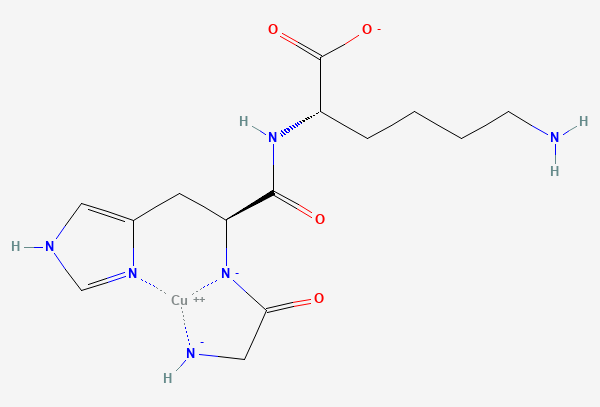
Estructura molecular
Mecanismo y función fisiológica
Complejo endógeno de tripéptido y cobre estudiado en la remodelación cutánea, la angiogénesis, la biología del folículo piloso y la modulación de las metaloproteinasas de matriz.
Aplicaciones clínicas y de investigación
Las formulaciones tópicas se analizan en la investigación dermatológica sobre la biología del folículo piloso y la reparación dérmica. La literatura preclínica informa actividad en el nicho de células madre del folículo piloso y en el depósito de colágeno dérmico.
Biosíntesis, manejo y origen
El GHK es un tripéptido, glicil-L-histidil-L-lisina, y casi nada de lo estudiado sobre él se refiere al péptido libre. Su amina N-terminal, el nitrógeno peptídico adyacente y la cadena lateral imidazólica de la histidina forman juntos un sitio de coordinación plano cuadrado con alta afinidad por el cobre(II), y es ese complejo, escrito GHK-Cu, el que describe la literatura. Formular el péptido sin tener en cuenta el metal produce una sustancia distinta de la que estudiaron los trabajos publicados.
La literatura mecanística se ocupa en gran parte del recambio de la matriz y no del crecimiento. Los trabajos que informan la modulación de la expresión de metaloproteinasas de matriz en modelos de heridas tienen ya varias décadas y no se han revisado de forma sustancial, mientras que el cobre se describe por separado como cofactor necesario de la lisil oxidasa, la enzima que entrecruza el colágeno y la elastina. Leídos en conjunto, describen una molécula investigada en el contexto de la remodelación de la matriz existente, una afirmación más acotada y mejor respaldada que la que hace la mayoría de los textos publicitarios sobre péptidos de cobre. Los trabajos más recientes se han orientado hacia la química de coordinación y los sistemas de liberación, más que hacia nuevos mecanismos.
La formulación es donde un péptido de cobre se puede elaborar mal con más facilidad, y es la parte que un consultorio realmente puede inspeccionar. El complejo es sensible al pH y se disocia fuera de un intervalo bastante estrecho; los agentes quelantes habituales en las bases cosméticas compiten por el cobre; y los agentes reductores, entre ellos el ácido ascórbico, reducen el cobre(II) a cobre(I) y cambian por completo la especie. Un tono azulado de la solución es la señal visible de que el complejo está intacto, de modo que una preparación para el cuero cabelludo que ha perdido su color ya le está indicando algo. Son preparaciones no estériles elaboradas conforme al Capítulo General 795 de la USP, con una fecha límite de uso asignada en el momento de la preparación.
La mayor parte de lo publicado son trabajos in vitro y en animales; los datos en humanos se concentran en estudios dermatológicos pequeños y no en ensayos controlados en el cuero cabelludo, y la literatura sobre el nicho del folículo piloso en particular sigue siendo preclínica. Nada en esta página afirma que alguna preparación sea adecuada para un paciente determinado. Los medicamentos magistrales no son productos farmacéuticos terminados aprobados por la FDA.
Referencias revisadas por pares
Bossak-Ahmad K, Wiśniewska MD, Bal W
International Journal of Molecular Sciences · 2020 · PMID: 32867146
Liposomes as carriers of GHK-Cu tripeptide for cosmetic application
Dymek M, Olechowska K, Hąc-Wydro K
Pharmaceutics · 2023 · PMID: 37896245
The human tri-peptide GHK and tissue remodeling
Pickart L
Journal of Biomaterials Science, Polymer Edition · 2008 · PMID: 18644225
Fuentes de las figuras
- [1]PubChem CID 139035031, GHK-Cu. National Center for Biotechnology Information, PubChem. Public domain.
¿Desea incorporar GHK-Cu 1% a su protocolo?
Las formulaciones magistrales son dispensadas por nuestra farmacia asociada 503A, con licencia de la Junta Estatal de Farmacia de Texas, con una receta específica para cada paciente. ¿Prefiere una cotización formal? Solicite precios para una formulación específica.