GHK-Cu 1%
Licensed practices only
Glycyl-L-histidyl-L-lysine copper(II) complex
- Format
- Scalp Solution
- Spec
- 30 mL
- Sourcing
- A 503A pharmacy licensed by its state Board of Pharmacy
Available Formulations
Compounded to order by our 503A pharmacy partner; not a dosing recommendation. Beyond-use dates are assigned at compounding and printed on each label, and the shortest applicable limit governs.
| Strength & size | Beyond-use date | Quantity per fill |
|---|---|---|
| Solution 30 mL | 35 days | Max 1 unit |
- Compounding standard
- USP <795>, non-sterile
- Pricing
- Available on verified account approval
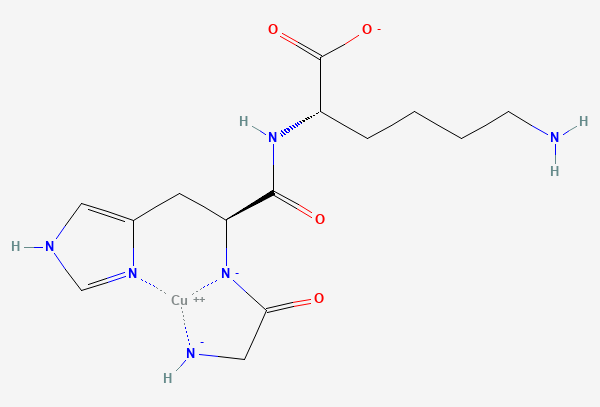
Molecular structure
Mechanism & Physiological Role
Endogenous tripeptide-copper complex studied in skin remodeling, angiogenesis, hair-follicle biology and matrix metalloproteinase modulation.
Clinical & Research Applications
Topical formulations discussed in dermatologic research on hair-follicle biology and dermal repair. Preclinical literature reports activity in the hair-follicle stem-cell niche and dermal collagen deposition.
Biosynthesis, Handling & Sourcing
GHK is a tripeptide, glycyl-L-histidyl-L-lysine, and almost nothing studied about it concerns the free peptide. Its N-terminal amine, the adjacent peptide nitrogen and the imidazole side chain of the histidine together form a square-planar coordination site with high affinity for copper(II), and it is that complex, written GHK-Cu, which the literature describes. Formulating the peptide without accounting for the metal produces a different substance from the one the published work studied.
The mechanistic literature is largely about matrix turnover rather than about growth. Work reporting modulation of matrix metalloproteinase expression in wound models is now several decades old and has not been substantially revisited, while copper is separately described as a required cofactor for lysyl oxidase, the enzyme that cross-links collagen and elastin. Read together those describe a molecule investigated in the context of remodelling existing matrix, which is a narrower and better supported statement than most marketing copy about copper peptides makes. More recent work has moved toward coordination chemistry and delivery rather than toward new mechanism.
Formulation is where a copper peptide is most easily got wrong, and it is the part a practice can actually inspect. The complex is pH-sensitive and dissociates outside a fairly narrow window; chelating agents common in cosmetic bases will compete for the copper; and reducing agents, ascorbic acid among them, will reduce copper(II) to copper(I) and change the species entirely. A blue-tinted solution is the visible sign that the complex is intact, so a scalp preparation that has lost its color has told you something. These are non-sterile preparations compounded under USP General Chapter 795 with a beyond-use date assigned at preparation.
Most of what is published is in vitro and animal work, with human data concentrated in small dermatologic studies rather than in controlled scalp trials, and the literature on the hair-follicle niche specifically remains preclinical. Nothing on this page is a statement that any preparation is suitable for a given patient. Compounded medications are not FDA-approved finished drug products.
Peer-Reviewed References
Bossak-Ahmad K, Wiśniewska MD, Bal W
International Journal of Molecular Sciences · 2020 · PMID: 32867146
Liposomes as carriers of GHK-Cu tripeptide for cosmetic application
Dymek M, Olechowska K, Hąc-Wydro K
Pharmaceutics · 2023 · PMID: 37896245
The human tri-peptide GHK and tissue remodeling
Pickart L
Journal of Biomaterials Science, Polymer Edition · 2008 · PMID: 18644225
Figure sources
- [1]PubChem CID 139035031, GHK-Cu. National Center for Biotechnology Information, PubChem. Public domain.
Ready to add GHK-Cu 1% to your protocol?
Compounded formulations are dispensed by our 503A pharmacy partner, licensed by the Texas State Board of Pharmacy, under a valid patient-specific prescription. Prefer a formal quote? Request formulation-specific pricing instead.