NAD+ (Nicotinamide Adenine Dinucleotide)
Licensed practices only
Nicotinamide Adenine Dinucleotide
- Format
- Injectable and Nasal Spray
- Spec
- 100 mg/mL (10 mL); 10 mg/0.1 mL (15 mL)
- Sourcing
- A 503A pharmacy licensed by its state Board of Pharmacy
Available Formulations
Compounded to order by our 503A pharmacy partner; not a dosing recommendation. Beyond-use dates are assigned at compounding and printed on each label, and the shortest applicable limit governs.
| Strength & size | Beyond-use date | Quantity per fill |
|---|---|---|
| 100 mg/mL (10 mL) | 90 days | Max 2 vials |
| 10 mg/0.1 mL (15 mL) Nasal Spray | 30 days | Max 1 unit |
- Sterility
- Endotoxin and sterility tested per sterile batch
- Compounding standard
- USP <797>, sterile
- Pricing
- Available on verified account approval
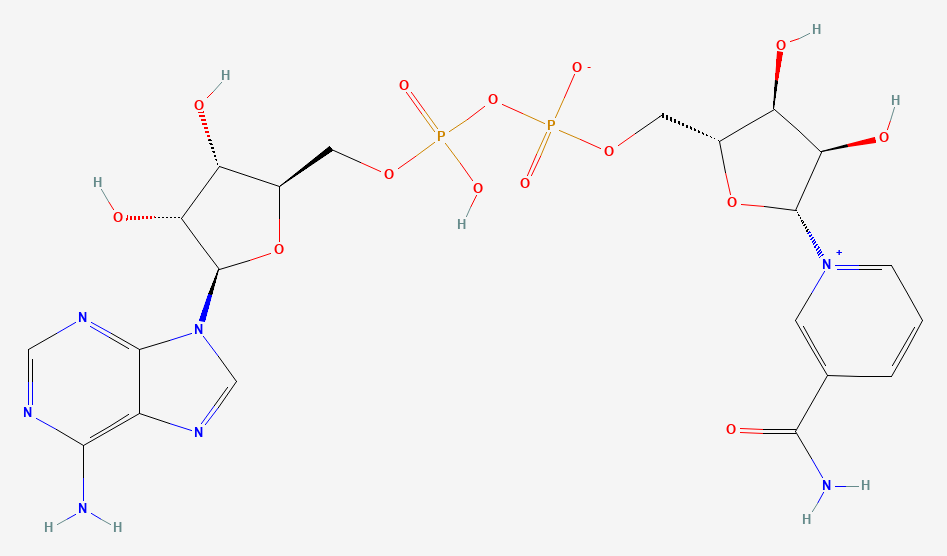
Molecular structure
Mechanism & Physiological Role
Coenzyme in the mitochondrial electron transport chain and an obligate substrate for sirtuins (SIRT1-7) and PARP enzymes involved in DNA repair, genomic stability, and metabolic signaling.
Clinical & Research Applications
Discussed in the peer-reviewed literature on cellular energy metabolism and on sirtuin and PARP enzyme biology.
Biosynthesis, Handling & Sourcing
NAD+ is maintained by three biosynthetic routes rather than one: de novo synthesis from tryptophan by way of quinolinic acid, the Preiss-Handler pathway from nicotinic acid, and a salvage pathway that recycles nicotinamide through nicotinamide phosphoribosyltransferase. The salvage route carries most of the flux in mammalian tissue, which is why the intracellular pool turns over on a timescale of hours rather than days, and why precursor availability rather than total body content is what the literature tends to measure.
The molecule occupies two distinct roles that are easy to conflate. As a redox cofactor it cycles between NAD+ and NADH without net consumption, shuttling electrons through glycolysis, the tricarboxylic acid cycle and oxidative phosphorylation. As a substrate it is cleaved and consumed, releasing nicotinamide, by three enzyme families: the sirtuins, the poly(ADP-ribose) polymerases recruited to DNA strand breaks, and the ectoenzyme CD38. Because all three draw on the same pool, their activities are coupled, and that coupling is the subject of an extensive peer-reviewed literature on cellular aging.
For a compounding pharmacy the governing constraints are chemical rather than pharmacological. NAD+ in aqueous solution is sensitive to light and to alkaline pH, and it degrades to nicotinamide and ADP-ribose under both, so sterile preparations are compounded under USP General Chapter 797, protected from light, and carry a beyond-use date assigned at preparation rather than a manufacturer expiry. Practices sourcing it should confirm storage conditions and in-use dating for the specific container format at account setup, because whichever of those limits expires first is the one that governs.
The research position is worth stating precisely rather than generously. Injectable and intravenous NAD+ has been studied in small human cohorts alongside a much larger body of preclinical work, and reviews in the peer-reviewed literature describe the pharmacokinetics of NAD+ and its precursors as an open question rather than a settled one. Nothing on this page is a statement that any preparation is suitable for a given patient. Compounded medications are not FDA-approved finished drug products.
Peer-Reviewed References
NAD+ metabolism and its roles in cellular processes during aging
Covarrubias AJ, Perrone R, Grozio A, Verdin E
Nature Reviews Molecular Cell Biology · 2021 · PMID: 33353981
Therapeutic potential of NAD-boosting molecules: the in vivo evidence
Rajman L, Chwalek K, Sinclair DA
Cell Metabolism · 2018 · PMID: 29514064
NAD+ intermediates: the biology and therapeutic potential of NMN and NR
Yoshino J, Baur JA, Imai SI
Cell Metabolism · 2018 · PMID: 29249689
Bogan KL, Brenner C
Annual Review of Nutrition · 2008 · PMID: 18429699
Figure sources
- [1]PubChem CID 5892, NAD+. National Center for Biotechnology Information, PubChem. Public domain.
Ready to add NAD+ to your protocol?
Compounded formulations are dispensed by our 503A pharmacy partner, licensed by the Texas State Board of Pharmacy, under a valid patient-specific prescription. Prefer a formal quote? Request formulation-specific pricing instead.