Glutathione
Licensed practices only
gamma-L-Glutamyl-L-cysteinylglycine
- Format
- Injectable
- Spec
- 200 mg/mL (10 mL, 30 mL)
- Sourcing
- A 503A pharmacy licensed by its state Board of Pharmacy
Available Formulations
Compounded to order by our 503A pharmacy partner; not a dosing recommendation. Beyond-use dates are assigned at compounding and printed on each label, and the shortest applicable limit governs.
| Strength & size | Beyond-use date | Quantity per fill |
|---|---|---|
| 200 mg/mL (10 mL) | 90 days | Max 2 vials |
| 200 mg/mL (30 mL) | 90 days | Max 2 vials |
- Sterility
- Endotoxin and sterility tested per sterile batch
- Compounding standard
- USP <797>, sterile
- Pricing
- Available on verified account approval
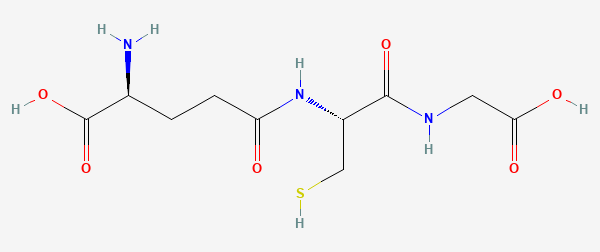
Molecular structure
Mechanism & Physiological Role
Endogenous tripeptide antioxidant. Primary substrate for glutathione peroxidase and glutathione S-transferase in phase II hepatic detoxification and reactive oxygen species neutralization.
Clinical & Research Applications
Discussed in the literature on oxidative stress and glutathione-dependent enzyme biology.
Biosynthesis, Handling & Sourcing
Glutathione is a tripeptide with an unusual bond. The link between glutamate and cysteine forms at the glutamate side chain rather than at its alpha carbon, and that gamma linkage is what makes the molecule resistant to the aminopeptidases that would otherwise clear a tripeptide quickly. Synthesis runs in two ATP-dependent steps, by glutamate-cysteine ligase and then glutathione synthetase, and the first of those is rate limiting, which is why cysteine availability rather than total protein intake is what the biosynthesis literature tends to track.
The functional unit is a ratio rather than a quantity. Reduced glutathione and its oxidized disulfide form a redox couple, and the proportion between them differs sharply between the cytosol, the mitochondria and the endoplasmic reticulum, which maintains a far more oxidizing interior to permit disulfide bond formation in folding proteins. A single number for whole-blood content therefore describes very little on its own, and published work generally reports the ratio and the compartment together.
For a compounding pharmacy the thiol group is the entire handling problem. It oxidizes readily on contact with air and more quickly at alkaline pH, converting to the disulfide, so sterile preparations are compounded under USP General Chapter 797 with headspace and pH controlled, protected from light, and carry a beyond-use date assigned at preparation rather than a manufacturer expiry. Discolouration in a solution that should be clear is a handling signal worth raising with the pharmacy rather than working around.
Injectable and intravenous glutathione has been studied in small clinical cohorts alongside a much larger body of in vitro and animal work, and reviews in the peer-reviewed literature describe its systemic pharmacokinetics as unsettled. Nothing on this page is a statement that any preparation is suitable for a given patient. Compounded medications are not FDA-approved finished drug products.
Peer-Reviewed References
Glutathione: overview of its protective roles, measurement, and biosynthesis
Forman HJ, Zhang H, Rinna A
Molecular Aspects of Medicine · 2009 · PMID: 18796312
Lu SC
Biochimica et Biophysica Acta · 2013 · PMID: 22995213
Glutathione dysregulation and the etiology and progression of human diseases
Ballatori N, Krance SM, Notenboom S, Shi S
Biological Chemistry · 2009 · PMID: 19166318
Figure sources
- [1]PubChem CID 124886, Glutathione. National Center for Biotechnology Information, PubChem. Public domain.
Ready to add Glutathione to your protocol?
Compounded formulations are dispensed by our 503A pharmacy partner, licensed by the Texas State Board of Pharmacy, under a valid patient-specific prescription. Prefer a formal quote? Request formulation-specific pricing instead.