GHK-Cu 3% / SNAP-8 1% / Niacinamide 3% Serum
Licensed practices only
GHK-Cu, acetyl octapeptide-3 and niacinamide topical serum
- Format
- Topical
- Spec
- 30 mL
- Sourcing
- A 503A pharmacy licensed by its state Board of Pharmacy
Available Formulations
Compounded to order by our 503A pharmacy partner; not a dosing recommendation. Beyond-use dates are assigned at compounding and printed on each label, and the shortest applicable limit governs.
| Strength & size | Beyond-use date | Quantity per fill |
|---|---|---|
| (GHK-Cu 3% / SNAP-8 1% / Niacinamide 3%) 30 mL | 180 days | Up to 5 units |
- Compounding standard
- USP <795>, non-sterile
- Pricing
- Available on verified account approval
Mechanism & Physiological Role
Three actives with three unrelated mechanisms in one vehicle: a copper-binding matrikine, an octapeptide patterned on a SNARE protein, and a nicotinamide precursor feeding the NAD salvage pathway.
Clinical & Research Applications
Discussed in the dermatology and drug delivery literature on topical peptides, matrikine signaling and niacinamide, where reviews describe percutaneous penetration as the limiting question for peptide actives.
Biosynthesis, Handling & Sourcing
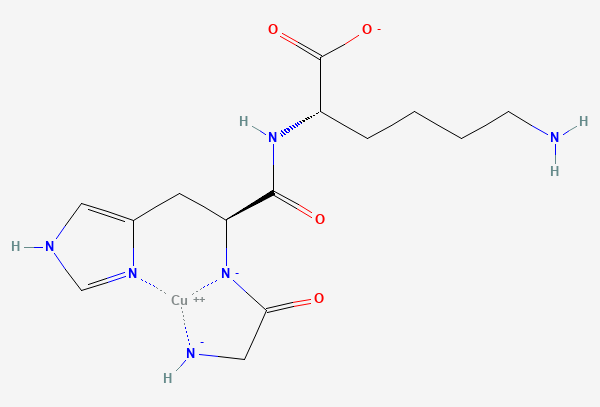
GHK is a matrikine. Matrikines are short peptide fragments liberated when extracellular matrix proteins are cleaved, and they act as signals in their own right rather than as raw material, which is a different idea from a peptide supplied as a nutrient. The GHK sequence corresponds to a stretch within the alpha-2 chain of type I collagen, so the molecule is one the skin already generates when its own matrix turns over. It arrives here as the copper complex, because the tripeptide binds copper(II) tightly through its histidine imidazole and N-terminal amine, and the complex rather than the free peptide is what the literature studies. That coordination chemistry is covered in full on the GHK-Cu hair solution page and is not repeated here.
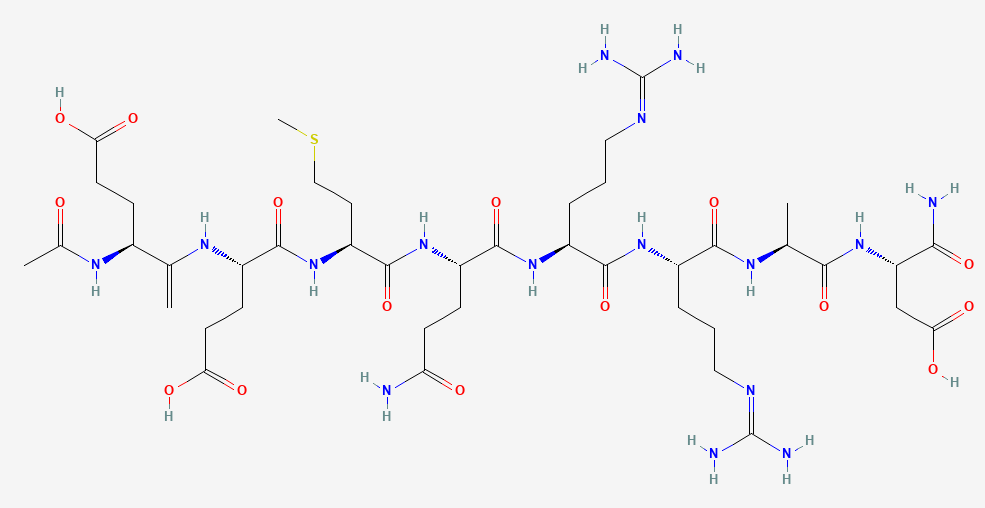
SNAP-8 is acetyl octapeptide-3, and its design premise deserves stating precisely because it is usually stated loosely. Vesicles release their contents by assembling a SNARE complex, a four-helix bundle formed between proteins on the vesicle and on the target membrane, of which SNAP-25 contributes two helices. That release machinery is thoroughly characterized and the work describing it won a Nobel Prize. SNAP-8 is an eight-residue fragment patterned on the N-terminal region of SNAP-25, on the premise that it competes for a place in the bundle and destabilizes assembly.
What follows from that premise is where care is warranted. The biology of the target is established. Whether a topical octapeptide reaches that target is a separate question, and it is the one with almost no peer-reviewed answer: there is essentially no primary literature on acetyl octapeptide-3 itself, and reviews of cosmetic peptides describe percutaneous penetration as the open problem rather than a settled one. An octapeptide runs to roughly a kilodalton, and the stratum corneum is a formidable barrier to hydrophilic molecules much beyond a few hundred daltons. A prescriber specifying this serum is best served holding both of those facts at once. Note also that acetyl hexapeptide-8 is a different molecule with a literature of its own, and evidence about it says nothing about this one.
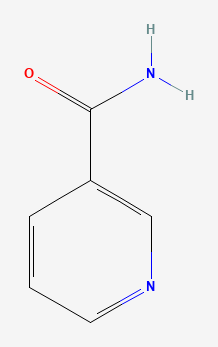
Niacinamide is the third active and the most chemically tractable of the three. It is a pyridine carboxamide and a precursor into the same NAD salvage pathway described on the NAD+ page, entering by way of nicotinamide phosphoribosyltransferase. Being small and water soluble it is far easier to deliver through skin than either peptide, and the dermal delivery literature on it is correspondingly larger. Its presence alongside two peptides is a formulation decision rather than a filler, since a single base has to hold a metal complex, a peptide and a small polar molecule without any of them destabilizing the others.
This is a non-sterile topical serum compounded under USP General Chapter 795, with a beyond-use date assigned at preparation rather than a manufacturer expiry. The governing formulation constraints are the copper ones: chelating agents compete for the metal, reducing agents convert copper(II) to copper(I), and the blue tint of an intact complex is a visible check that survives shipping. This composition is not FDA-approved, compounded medications are not FDA-approved finished drug products, and nothing on this page is a statement that any preparation is suitable for a given patient.
Peer-Reviewed References
Matrikines as mediators of tissue remodelling
Jariwala N, Ozols M, Bell M
Advanced Drug Delivery Reviews · 2022 · PMID: 35378216
Skin aging and topical rejuvenation strategies
Griffiths TW, Watson REB, Langton AK
British Journal of Dermatology · 2023 · PMID: 37903073
The synaptic vesicle release machinery
Rizo J, Xu J
Annual Review of Biophysics · 2015 · PMID: 26098518
Dermal and transdermal delivery of pharmaceutically relevant macromolecules
Münch S, Wohlrab J, Neubert RHH
European Journal of Pharmaceutics and Biopharmaceutics · 2017 · PMID: 28647443
Niacinamide: a review on dermal delivery strategies and clinical evidence
Ong RR, Goh CF
Drug Delivery and Translational Research · 2024 · PMID: 38722460
Figure sources
- [1]PubChem CID 139035031, GHK-Cu. National Center for Biotechnology Information, PubChem. Public domain.
- [2]PubChem CID 71587832, Acetyl octapeptide-3 (SNAP-8). National Center for Biotechnology Information, PubChem. Public domain.
- [3]PubChem CID 936, Niacinamide. National Center for Biotechnology Information, PubChem. Public domain.
Ready to add GHK-Cu 3% / SNAP-8 1% / Niacinamide 3% Serum to your protocol?
Compounded formulations are dispensed by our 503A pharmacy partner, licensed by the Texas State Board of Pharmacy, under a valid patient-specific prescription. Prefer a formal quote? Request formulation-specific pricing instead.