Entonces, ¿qué es exactamente un exosoma?
Un exosoma es una diminuta vesícula envuelta en membrana, en esencia un paquete de tamaño nanométrico que las células liberan como una forma de comunicación. Cada célula de su cuerpo los produce. No son productos de desecho (aunque esa fue una teoría temprana). Se parecen más a mensajes de texto biológicos: paquetes de proteínas, lípidos y material genético (como los microARN) enviados de una célula a otra para coordinar su comportamiento.
Una revisión de 2024 en Signal Transduction and Targeted Therapy, una de las revistas de mayor impacto en el campo, publicada bajo el sello de Nature, describe que los exosomas poseen ventajas clave frente a las terapias con células madre completas, entre ellas la ausencia de inmunogenicidad, la falta de toxicidad por infusión, el fácil acceso y la ausencia de potencial tumorigénico. Los autores señalan que los exosomas pueden heredar los efectos de sus células de origen a través de la entrega de su carga de señalización.[A1]
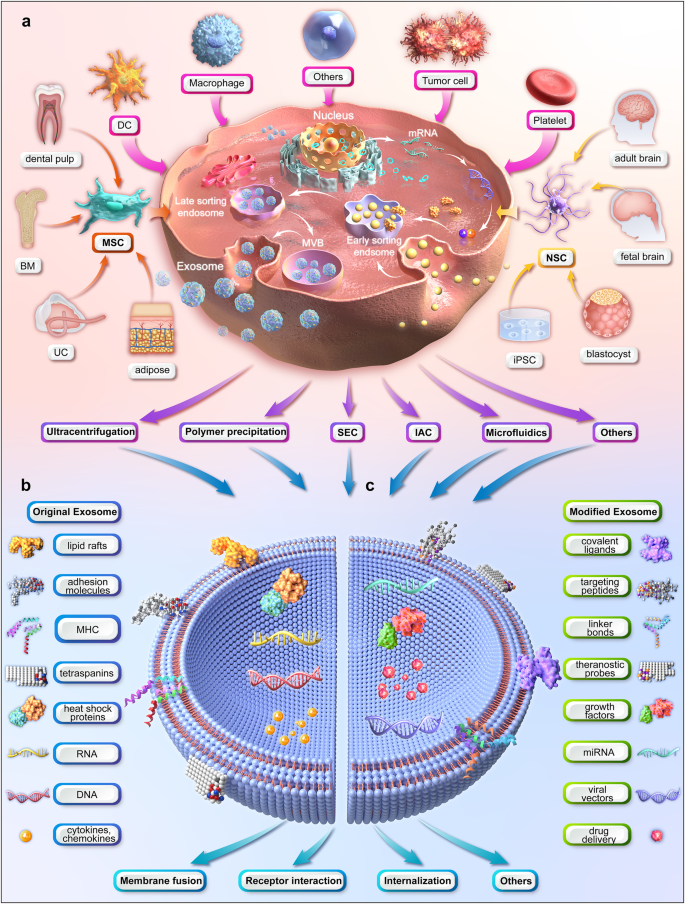
Una revisión de 2025 en Pharmaceutics, la primera de su tipo en comparar sistemáticamente los exosomas según su fuente celular, describe que estos transportan una variedad de moléculas bioactivas que pueden entregarse a las células diana, y destaca la baja inmunogenicidad y la alta bioseguridad como propiedades que impulsan su potencial de aplicación en la ingeniería de tejidos, la cicatrización de heridas y la intervención de enfermedades.[A2]
Piense en los exosomas como el sistema de mensajería de sus células: en lugar de mensajes de texto, envían proteínas e instrucciones genéticas, en paquetes más pequeños que la mayoría de los virus.
¿De dónde provienen? La fuente importa más de lo que cree
No todos los exosomas son iguales, y esto es una de las cosas más importantes que hay que entender al evaluar cualquier aplicación basada en exosomas. Los exosomas adoptan las características de la célula que los produce. Un exosoma de una célula madre mesenquimal (MSC) transporta una carga muy diferente a la de uno proveniente de una célula de la piel, una plaqueta o una célula neural.
La revisión de 2025 en Pharmaceutics introduce explícitamente un marco orientado al tipo celular para seleccionar los productores de exosomas, la denomina la primera comparación integral de exosomas según su fuente celular y señala que factores como el sitio del donante y el método de recolección también influyen en la carga biológica.[A2]
Para las aplicaciones regenerativas, los exosomas derivados de MSC han captado la mayor atención de la investigación. Una revisión de 2024 en Clinical and Experimental Medicine examina específicamente el panorama de la investigación sobre los exosomas derivados de MSC, y describe la investigación activa de sus propiedades de señalización en la inflamación, la comunicación celular y la biología tisular, siendo las MSC de médula ósea, tejido adiposo y tejido del cordón umbilical las fuentes más estudiadas. Los autores señalan que estos hallazgos son preliminares y aún no constituyen indicaciones clínicas aprobadas.[A3]
A partir de enero de 2025, una revisión en Signal Transduction and Targeted Therapy señala que las MSC son la fuente más utilizada a nivel mundial para los ensayos clínicos basados en vesículas extracelulares (EV), y representan aproximadamente el 61 % de los estudios intervencionistas con EV registrados en ClinicalTrials.gov.
La conexión con la medicina estética
La medicina estética, el campo clínico que se ocupa de la salud de la piel, la calidad del tejido, la restauración capilar y el rejuvenecimiento no quirúrgico, se ha convertido en una de las áreas de mayor interés en la investigación sobre exosomas. La razón es bastante intuitiva: la piel y el tejido conectivo son entornos biológicos muy dinámicos donde la comunicación celular desempeña un papel central en la reparación, la renovación y el envejecimiento.
En los contextos estético y dermatológico en particular, el interés de la investigación se centra en el potencial de los exosomas para influir en las vías de síntesis de colágeno, favorecer la cicatrización de heridas, modular las respuestas inflamatorias de la piel e interactuar con los fibroblastos y los queratinocitos, los tipos celulares más relevantes para la estructura y la textura de la piel.
"Los exosomas no actúan sobre la piel como lo hace una crema tópica. Trabajan a nivel de la comunicación celular, influyendo en cómo se comportan las células y qué proteínas producen."
Un análisis integral de 2025 en el Journal of Pharmacology and Pharmacotherapeutics examinó 90 ensayos clínicos en humanos registrados que involucran exosomas. El análisis encontró que las aplicaciones terapéuticas representaron aproximadamente el 21 % de los ensayos, con los exosomas derivados de MSC destacados de forma prominente para aplicaciones que involucran la reparación de tejidos y la señalización celular. Los autores señalan una producción clínica constante de 2020 a 2024, con un interés creciente en distintas especialidades.[A4]
Exosomas derivados de MSC y los cambios celulares relacionados con la edad
Una revisión de 2025 en Cell Proliferation (Wiley) examina específicamente los exosomas derivados de MSC en el contexto de las enfermedades relacionadas con la edad. La revisión analiza el papel de los exosomas derivados de MSC en la modulación de las vías de senescencia celular, los procesos por los cuales las células envejecen y pierden función, y su participación en la homeostasis del tejido. Los autores destacan el microARN y la carga proteica de los exosomas como mecanismos clave a través de los cuales podrían mediarse estos efectos.[A5]
La senescencia celular es relevante para la medicina estética porque subyace a muchos de los signos visibles del envejecimiento de la piel: la pérdida de elasticidad, el adelgazamiento y la alteración de la textura. La investigación sobre si los exosomas pueden influir en las vías de senescencia de las células de la piel es un área de estudio activa y científicamente legítima, aunque su traslación clínica todavía se encuentra en etapas tempranas e intermedias.
Cómo es el panorama de los ensayos clínicos en este momento
A principios de 2025, hay 292 ensayos clínicos relacionados con vesículas extracelulares (EV) registrados en ClinicalTrials.gov, incluidos 170 estudios intervencionistas. De estos, 117 están diseñados específicamente para evaluar efectos terapéuticos en distintas áreas de enfermedad, incluidas afecciones de la piel, inflamatorias y del sistema nervioso. La FDA aprobó su primera solicitud de nuevo fármaco en investigación (IND) para un candidato basado en EV (AB126, de Aruna Bio) en enero de 2024, un hito para el campo. El Ministerio de Seguridad de Alimentos y Medicamentos de Corea aprobó un ensayo de Fase 1b para un producto de EV derivado de MSC de cordón umbilical en mayo de 2025.
Esta actividad nos dice que la ciencia de los exosomas está siendo tomada en serio por los principales organismos reguladores, los centros médicos académicos y los desarrolladores farmacéuticos, y no solo por las empresas de bienestar. También nos dice que estamos en una etapa temprana o intermedia del desarrollo clínico, no en la línea de meta.
Más de 90 ensayos en humanos. 292 estudios con EV registrados a nivel mundial. La primera aprobación IND de la FDA para un candidato basado en exosomas. La ciencia es real y está avanzando.
Lo que la ciencia sí dice y lo que no
Vale la pena ser honestos sobre dónde se encuentra la ciencia actualmente, porque la brecha entre la investigación básica y la prueba de concepto clínica es donde reside mucha de la desinformación.
La mayor parte de la investigación sobre exosomas en contextos estéticos se encuentra en la etapa preclínica (cultivos celulares y modelos animales) o en la etapa temprana de ensayos en humanos de Fase I/II. Los ensayos en humanos rigurosos, a gran escala y controlados con placebo, con preparaciones de exosomas estandarizadas, todavía son limitados. El campo también enfrenta desafíos técnicos importantes: actualmente no existe un método totalmente estandarizado de aislamiento, caracterización o pruebas de potencia de los exosomas, lo que significa que la calidad y la consistencia de las preparaciones de exosomas pueden variar significativamente según la fuente, el método de producción y las instalaciones.
La revisión de 2025 en Pharmaceutics señala explícitamente que la aplicación clínica requiere seleccionar las fuentes celulares en función del propósito específico, a la vez que se optimizan los factores que influyen, lo que sugiere que no existe una preparación de exosomas universal apropiada para todos los usos.[A2]
El estatus regulatorio también varía: en los Estados Unidos, los productos de exosomas usados en humanos generalmente están regulados por la FDA como productos biológicos, y las normas en torno a su uso clínico, sus afirmaciones de marketing y su comercialización están evolucionando activamente.
Preguntas inteligentes para hacerle a su profesional
Si trabaja con un profesional que utiliza o recomienda productos basados en exosomas, estas son preguntas con fundamento científico que vale la pena plantear:
En resumen
Los exosomas son un área legítimamente apasionante de la investigación biomédica. La ciencia detrás de la comunicación celular, la biología de las vesículas extracelulares y la señalización derivada de las MSC es real, está revisada por pares y crece con rapidez. En la medicina estética en particular, el interés está científicamente justificado, pero la base de evidencia clínica todavía está madurando y el panorama regulatorio sigue evolucionando.
La posición intelectualmente más honesta es esta: los exosomas representan una frontera prometedora, con un fundamento científico creíble y un historial creciente de ensayos clínicos. No son magia ni son puro entusiasmo pasajero: son biología, lo que equivale a decir que son más interesantes que cualquiera de las dos cosas.
Aviso educativo: Este artículo está destinado únicamente a fines informativos y no constituye consejo médico, diagnóstico ni recomendaciones de tratamiento. Toda la información proviene de literatura científica revisada por pares. Las terapias basadas en exosomas son un área de investigación activa; el estatus regulatorio y la disponibilidad clínica varían según la jurisdicción. Consulte a un proveedor de salud con licencia antes de tomar cualquier decisión médica.
Tan F, et al. Clinical applications of stem cell-derived exosomes. Signal Transduction and Targeted Therapy. Jan 2024;9:17. DOI: 10.1038/s41392-023-01704-0.
Ver fuente →Chen Y, et al. Exosome Source Matters: A Comprehensive Review from the Perspective of Diverse Cellular Origins. Pharmaceutics. Feb 2025;17(2):147. PMCID: PMC11858990.
Ver fuente →Therapeutic potential of MSC-derived exosomes. Clinical and Experimental Medicine. Mar 2024. PMCID: PMC10907468. DOI: 10.1007/s10238-023-01282-z.
Ver fuente →Mohan S, et al. Clinical Frontiers of Exosome Research: A Comprehensive Analysis of Human Trials in Diagnostics, Therapeutics, and Regenerative Medicine. Journal of Pharmacology and Pharmacotherapeutics. 2025. DOI: 10.1177/0976500X251361201.
Ver fuente →MSC-Derived Exosomes for Age-Related Diseases. Cell Proliferation. May 2025. PMCID: PMC12099225.
Ver fuente →Preguntas frecuentes
¿Qué es un exosoma?+
Una vesícula envuelta en membrana, de unos 30 a 150 nm, que las células liberan como forma de comunicación. Transporta proteínas, lípidos y material genético como microARN de una célula a otra. Todas las células los producen y no son productos de desecho.
¿Por qué importa la fuente celular de un exosoma?+
Los exosomas adoptan características de la célula que los produce, de modo que un exosoma de una célula madre mesenquimal transporta una carga distinta a la de uno procedente de una célula cutánea o de una plaqueta. La revisión de 2025 en Pharmaceutics citada en el artículo introduce un marco orientado al tipo celular para seleccionar productores de exosomas y señala que el sitio del donante y el método de recolección también influyen en la carga.
¿Cómo es el panorama de ensayos clínicos con exosomas?+
A principios de 2025 había 292 ensayos relacionados con vesículas extracelulares registrados en ClinicalTrials.gov, incluidos 170 estudios intervencionales, y las MSC representan alrededor del 61 por ciento de los estudios intervencionales con VE. La FDA aprobó su primera solicitud de nuevo fármaco en investigación para un candidato basado en VE en enero de 2024. La mayor parte de la investigación estética sigue siendo preclínica o de fase temprana, y los ensayos grandes controlados con placebo y preparaciones estandarizadas siguen siendo limitados.
¿Cómo se regulan los productos de exosomas en Estados Unidos?+
Los productos de exosomas usados en humanos están regulados en general por la FDA como biológicos, y las normas sobre uso clínico, afirmaciones de marketing y comercialización evolucionan activamente. No existe un método plenamente estandarizado de aislamiento, caracterización o prueba de potencia de exosomas, por lo que las preparaciones pueden variar según la fuente, el método de producción y la instalación.
¿Qué preguntas debería hacer un profesional sobre un producto de exosomas?+
La fuente celular y el tejido de origen, la concentración de partículas por vial, si la preparación se ha analizado para esterilidad, micoplasma y endotoxinas, si procede de una instalación registrada ante la FDA y qué investigación publicada respalda la aplicación específica.